The second most important categories next to the school ratings are that of the clinic. This
was to judge how the surveyors rated their experience and their supervision.
This was to determine how good of a space you had to treat your patients and get
proper supervision. Additionally, I wanted to see how many schools gave their students
an option aside from the school clinic and if they had made relationships with community hospitals
and clinics.
29.
Rate Your Clinical Experience
1 I Still Can't
Get the Needle In
2
3 I Practice
with Confidence
4
5 I am the
Master!!
2. Clinic Facilites (quality of practice
space)
7% 23
18% 56
27% 84
32% 98
16% 49
Rating Scale: 1 - 5 (Higher = Better Facilities)
1.
Southwest Acupuncture
College
4.18
2.
Oregon College of Oriental Medicine
4.00
2.
Five Branches Institute
4.00
4.
Bastyr University
3.90
5.
NESA, The New England School of Acupuncture
3.70
6.
Pacific
College of Oriental Medicine: San Diego
3.63
6.
American College of Acupuncture and Oriental Med
3.63
8.
Academy of Oriental Medicine
3.50
9.
Emperor's College of Traditional Oriental Med.
3.42
10.
South Baylo University
3.33
11.
Pacific College of Oriental Medicine: Chicago
3.29
12.
International Institute of Chinese Medicine
3.14
13.
Mercy College
3.13
14.
Samra University of Oriental Medicine
3.11
15.
Midwest Center for the Study of Oriental Medicin
3.00
16.
Texas College of Traditional Chinese Medicine
2.93
17.
Tri-State Institute of Traditional Chinese Acup.
2.86
18.
Pacific
College of Oriental Medicine: New York
2.67
19.
Academy of Chinese Healing Arts, Inc
2.45
20.
Maryland Institute of Traditional Chinese Med.
2.13
21.
National College of Oriental Medicine
1.86
26.
Are there outside clinics where you can treat? (hospitals,
community health centers)
How worthwhile are your clinical shifts? Do you see enough patients, are you treating the same
conditions with all your patients, and do you learn how to manage the all important factor of
time? Theory is one thing, but actually "needle time" is what's needed from your clinical shifts
to turn out quality practitioners. Being in a practice requires a good knowledge of many different
disorders and an insanely good ability to juggle a schedule.
29.
Rate Your Clinical Experience
1 I Still Can't
Get the Needle In
2
3 I Practice
with Confidence
4
5 I am the
Master!!
3. Diversity of Patients (variety or just
pain)
6% 20
11% 33
27% 84
32% 100
24% 73
Rating Scale: 1 - 5
(Higher = More Diverse)
1.
Five Branches Institute
4.14
2.
Bastyr University
4.10
3.
Oregon College of Oriental Medicine
4.00
3.
Tri-State Institute of Traditional Chinese Acup.
4.00
3.
American College of Acupuncture and Oriental Med
4.00
6.
NESA, The New England School of Acupuncture
3.85
7.
Pacific
College of Oriental Medicine: San Diego
3.68
8.
Southwest Acupuncture College
3.65
9.
International Institute of Chinese Medicine
3.64
10.
Samra University of Oriental Medicine
3.56
11.
Emperor's College of Traditional Oriental Med.
3.50
12.
South Baylo University
3.44
13.
Academy of Oriental Medicine
3.43
13.
Midwest Center for the Study of Oriental Medicin
3.43
15.
Pacific
College of Oriental Medicine: New York
3.40
16.
Pacific College of Oriental Medicine: Chicago
3.14
17.
Mercy College
3.13
18.
Academy of Chinese Healing Arts, Inc
3.00
18.
Maryland Institute of Traditional Chinese Med.
3.00
20.
Texas College of Traditional Chinese Medicine
2.71
20.
National College of Oriental Medicine
2.71
25.
How many patients do you treat per shift on average?
1
10
3%
2
70
23%
3
100
33%
4
55
18%
5
32
10%
6
14
5%
7
6
2%
8
9
3%
9
1
0%
10
3
1%
11
0
0%
12 or
more
5
2%
305
100%
Gave .25 Points to Schools that
Averaged 4 patients or more per shift.
Tri-State
Institute of Traditional Chinese Acup.
0.25
American College of
Acupuncture and Oriental Med
0.25
NESA, The New England
School of Acupuncture
0.25
International Institute
of Chinese Medicine
0.25
Midwest Center for the
Study of Oriental Medicin
0.25
Mercy College
0.25
28.
Do you learn how to manage you and your patient's time well?
Here are the ones that really count. These are the overall ratings surveyors gave for their
schools and their instructors. I know this is totally subjective but that's the whole
point of this survey anyway.
Even if the education is top notch, the quality of your surroundings can greatly affect
a students ability to actually learn. This, to me, includes a good library, and the ability
for students to do everything they need to at school which requires the use computers.
That is how we do research after all, and can learn how to play with the big boys like your
average med school. Below is also the Overall Ratings give to facilities of each school.
19.
Overall Ratings
1 State
College
2
3 2nd Tier
School
4
5 Ivy
League!
3. Rate
Your Facilities
20% 69
17% 58
27% 94
27% 93
9% 30
Rating Scale: 1 - 5
(Higher = Better Facilities)
1.
Southwest Acupuncture
College
4.11
2.
Oregon College of Oriental Medicine
3.73
3.
Bastyr University
3.60
4.
NESA, The New England School of Acupuncture
3.41
5.
Pacific College of Oriental Medicine: Chicago
3.22
6.
American College of Acupuncture and Oriental Med
3.11
7.
Emperor's College of Traditional Oriental Med.
3.00
8.
Academy of Oriental Medicine
2.93
9.
Pacific
College of Oriental Medicine: San Diego
2.90
10.
Five Branches Institute
2.88
11.
Texas College of Traditional Chinese Medicine
2.79
12.
International Institute of Chinese Medicine
2.64
13.
Tri-State Institute of Traditional Chinese Acup.
2.50
14.
Academy of Chinese Healing Arts, Inc
2.36
15.
South Baylo University
2.30
16.
Mercy College
2.25
17.
Pacific
College of Oriental Medicine: New York
2.22
18.
Midwest Center for the Study of Oriental Medicin
2.21
19.
Samra University of Oriental Medicine
2.20
20.
National College of Oriental Medicine
1.88
21.
Maryland Institute of Traditional Chinese Med.
1.22
14.
Does your school have an adequate library?
Yes
240
69%
No
107
31%
Yes = 1 | No = 0
1.
Bastyr University
0.90
2.
Oregon College of Oriental Medicine
0.87
3.
Academy of Chinese Healing Arts, Inc
0.82
4.
South Baylo University
0.80
5.
Academy of Oriental Medicine
0.79
6.
Pacific
College of Oriental Medicine: New York
0.78
7.
National College of Oriental Medicine
0.75
8.
Southwest Acupuncture College
0.74
9.
Samra University of Oriental Medicine
0.70
10.
NESA, The New England School of Acupuncture
0.68
11.
American College of Acupuncture and Oriental Med
0.67
11.
Pacific
College of Oriental Medicine: San Diego
0.67
13.
International Institute of Chinese Medicine
0.64
13.
Midwest Center for the Study of Oriental Medicin
0.64
15.
Tri-State Institute of Traditional Chinese Acup.
0.63
15.
Mercy College
0.63
17.
Pacific College of Oriental Medicine: Chicago
0.56
18.
Emperor's College of Traditional Oriental Med.
0.50
18.
Five Branches Institute
0.50
20.
Texas College of Traditional Chinese Medicine
0.43
21.
Maryland Institute of Traditional Chinese Med.
0.11
13.
Does your school have computers and/or the internet for
students to use?
Another common problem with Acu schools is their ability to prepare for what comes after
school. For most, that involves setting up a practice. Again my suspicions were confirmed
by the bare majority of those who said they were prepared.
17.
Does your school ready you for the job market/setting up a
practice?
In my mind, I put a decent amount of weight on how well the schools taught herbs. I know
only the CA Exam includes it, but I felt it was very important to the overall understanding of
TCM. As a way out for students in programs that don't offer or didn't take their herbal
program, I left a N/A category below. All ranks below are from people who were actually
in or had taken the herbal program.
16.
How well does your school teach Herbal Medicine? (If not
offered at your school please click N/A for all of the following or
leave blank)
1 Poorly
2 Average
3 Well
N/A
1. Knowledge of Single Herbs
8% 25
24% 79
61% 199
7% 24
2. Knowledge of Formulas
6% 20
21% 70
63% 206
9% 30
3. Clincal Experience
11% 37
29% 93
52% 169
7% 23
4. Patent Knowledge
13% 43
31% 100
46% 149
9% 30
Raw Scores Below Are Averages of 4 Categories
(For overall ranking, each categories' average was added to the
raw score, not the average of all four combined)
A common problem with smaller schools is that they don't have the right infrastructure
to handle graduate students. Many Acu schools have problems with their administrations
so I wanted to see how everyone felt about theirs. The response was almost exactly what I thought
it would be.
12.
Are your administrators easy to talk to and efficient when
dealing with problems?
What better way to judge the caliber of students your school is pumping out than by
how willing you would be to send them your most dear friends and family for treatment.
I am both impressed and amazed that overwhemingly people trusted their fellow students.
I think it says something about the quality of education we are getting.
11.
Would you trust your graduating classmates to treat your
loved ones?
Students' perceived level of experience of
both their instructors and their TA's. I asked this question because a lot of schools
out there have started hiring younger students and fresh grads to be teachers, not just
TA's.
10.
Experience Level of Instructors
1 Fresh
Grads
2 Couple of
Years Worth
3 Very
Experienced
1. Teachers
3% 11
16% 57
81% 282
2. Teacher Assistants (TA's)
43% 119
41% 116
16% 45
Instructors Rating Scale: 1 - 3
(Higher = More Experience)
1.
Oregon College of Oriental
Medicine
3.00
1.
Tri-State Institute of Traditional Chinese Acup.
3.00
1.
Texas College of Traditional Chinese Medicine
3.00
1.
Five Branches Institute
3.00
1.
Academy of Chinese Healing Arts, Inc
3.00
1.
Maryland Institute of Traditional Chinese Med.
3.00
7.
Bastyr University
2.90
8.
American College of Acupuncture and Oriental Med
2.89
8.
Pacific College of Oriental Medicine: Chicago
2.89
10.
New England School of Acupuncture
2.82
10.
Samra University of Oriental Medicine
2.82
12.
Emperor's College of Traditional Oriental Med.
2.75
13.
Southwest Acupuncture College
2.74
14.
Midwest Center for the Study of Oriental Medicin
2.71
14.
Academy of Oriental Medicine
2.71
16.
Pacific
College of Oriental Medicine: San Diego
2.67
17.
International Institute of Chinese Medicine
2.64
18.
South Baylo University
2.50
18.
National College of Oriental Medicine
2.50
20.
Pacific
College of Oriental Medicine: New York
2.28
21.
Mercy College
2.25
TA's Rating Scale: 1 - 3
(Higher = More Experience)
I tried to assess whether students thought they had a good balance between didactic work
and hands on experience. Additionally, was there enough supervision with the hands on part
for it to be worthwhile. 2 questions here so keep scrolling.
8.
Is there a good mix of practical learning with classroom
learning?
Yes
256
73%
No, not enough
practice
93
27%
349
100%
Yes = 1 | No = 0
1.
Five Branches Institute
1.00
1.
Oregon College of Oriental Medicine
1.00
1.
Tri-State Institute of Traditional Chinese Acup.
1.00
4.
Southwest Acupuncture College
0.95
5.
Midwest Center for the Study of Oriental Medicin
0.86
6.
New England School of Acupuncture
0.82
7.
Academy of Oriental Medicine
0.79
8.
Pacific
College of Oriental Medicine: New York
0.72
9.
International Institute of Chinese Medicine
0.71
10.
American College of Acupuncture and Oriental Med
0.67
10.
Emperor's College of Traditional Oriental Med.
0.67
10.
Pacific College of Oriental Medicine: Chicago
0.67
13.
Texas College of Traditional Chinese Medicine
0.64
13.
Academy of Chinese Healing Arts, Inc
0.64
15.
Mercy College
0.63
16.
South Baylo University
0.60
17.
Pacific
College of Oriental Medicine: San Diego
0.53
18.
National College of Oriental Medicine
0.50
19.
Samra University of Oriental Medicine
0.45
20.
Bastyr University
0.40
21.
Maryland Institute of Traditional Chinese Med.
0.22
9.
Do practical classes have enough teachers per student?
Here are some demographics of the students who took the poll including the year they graduated,
their gender, age, and whether they were part or full timers.
The Average Age of the Survey = 35.7 Full Time........88% Part Time........12%
2.
When do/did you graduate?
1980
1
0%
1989
2
1%
1995
2
1%
1996
5
1%
1997
6
2%
1998
9
3%
1999
9
3%
2000
19
5%
2001
43
12%
2002
68
20%
2003
70
20%
2004
58
17%
2005
38
11%
2006
16
5%
346
100%
This shocked me a bit, and maybe it says something to the demographics of the internet and not
acupuncture schools, but I know in my school, I was 1 of 5 guys in a class with over 40 women.
I expected the female majority to be much higher.
Below is a graph of all the schools and the number of responses received per school. If you see your
school on the list here, but not on the final list it's because I didn't receive at least
10 responses to statistically qualify.
These are the overall rankings for the Acupuncture Schools Survey.
The first tab (Overall) are the rankings only including the schools with a stastistically relevant
sampling. The second tab is the raw scores per school.
There were a few ties, and you will see why when you look at the raw scores. Hopefully later I can
list all the schools that were not stat significant.
These are the overall rankings for the Acupuncture Schools Survey.
The first tab (Overall) are the rankings only including the schools with a stastistically relevant
sampling. The second tab is the raw scores per school.
There were a few ties, and you will see why when you look at the raw scores. Hopefully later I can
list all the schools that were not stat significant.
1. Oregon College of Oriental Medicine - Portland, OR
2. Southwest Acupuncture College - Santa Fe, NM
3. New England School of Acupuncture - Watertown, MA
4. American College of Acupuncture and Oriental Medicine - Houston, TX
5. Bastyr University - Kenmore, WA
6. Five Branches Institute - Santa Cruz, CA
6. Tri-State Institute of Traditional Chinese Acupuncture - New York, NY
8. Pacific College of Oriental Medicine: Chicago - Chicago, IL
8. Texas College of Traditional Chinese Medicine - Austin, TX
10. Academy of Chinese Healing Arts, Inc - Sarasota, FL
10. Academy of Oriental Medicine - Austin, TX
12. International Institute of Chinese Medicine - Santa Fe, NM
13. Emperor's College of Traditional Oriental Medicine - Santa Monica, CA
13. Pacific College of Oriental Medicine: San Diego - San Diego, CA
15. Pacific College of Oriental Medicine: New York - New York, NY
15. Midwest Center for the Study of Oriental Medicine - Racine WI
17. Samra University of Oriental Medicine - Los Angeles, CA
18. South Baylo University - Anaheim, CA
19. Mercy College - Dobbs Ferry, NY
20. National College of Oriental Medicine - Orlando, FL
21. Maryland Institute of Traditional Chinese Medicine - Bethesda, MD (closed)
After two years and many setbacks the results of the Acupuncture Schools Survey are finally ready. There is a lot
of information here and thus I have given you a few different ways to take a look at it all. Below are the top
five schools that were determined from all the responses of the survey and a few extra statistics that I received directly
from the schools themselves. To your right is a link that sends you directly to the responses per question
or subject in the survey itself. I will also try and do a school by school listing that tells you where
each school ranked in each of the questions. Below is an explanation of the methods of determining everything.
Without further ado:
The Top 5 Acupuncture Schools
Oregon College of Oriental Medicine - Portland, OR
Southwest Acupuncture College - Santa Fe, NM
New England School of Acupuncture - Watertown, MA
American College of Acupuncture and Oriental Medicine - Houston, TX
Bastyr University - Kenmore, WA
Here's how this was determined. There were 30 questions, 18 of which were relevant questions to the quality
of the school. Each question was assigned a numerical value between .25 and 1, depending on its importance.
These numbers were added up to come up with a raw score.
The ratings in the questionnaire that were already on a numerical scale from 1-3 or 1-5 were averaged and then
added to this raw score. The schools were then ranked according to the raw score. To preserve some measure
of statistical significance, any school that received fewer than 10 ratings from students were excluded.
After this, the top five schools were determined, and then a further analysis was done comparing their programs
in terms of depth, cost, national board passing scores, and the amount of clinical experience given to
students.
The bias in this survey is to the overall ratings of instructors, academics, clinic,
facilities and programs that were supplied by the students. Many of these questions were simple yes/no
so more importance was given to the scale of 3 and 5 ratings systems.
To be fair, I'd like to point out that this survey is far and away NOT statistically valid. The sample sizes were too small to get a large enough representation from each school. Additionally, many have said that my questions were poorly worded and with them I agree. I was going for "informal" and that is what I got. I will soon be following this up with a new study which will erase the errors as best as I can.
If you feel there is a better way to do the statistics for this type of analysis, feel free to click on Contact Me
below and let me know what you think.
If you want to send me a message and don't want to have the whole forum know about it you can use this form. I can
sometimes be quick about replying, and sometimes not. I will try though. Please include your email address or
I will have no way of replying to you. When done, just click on the email me button.
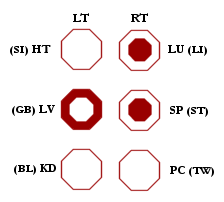
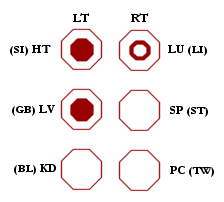
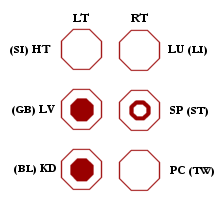
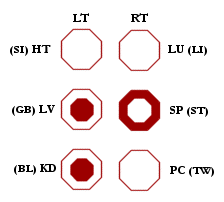
Five phase treatments are aptly named for both their relations to the five phases (elements) which they treat, but
also that the treatment itself consists of five steps. Each step is very precise in its choosing of points to use
and time in which to administer treatment. As with much of Japanese styles of acupuncture, five phase treatments are
very subtle in their workings. How far the needle goes in, the direction of the needle placement, and the
manipulation of the needle are very important. If you are unfamiliar with japanese needles check out the
Needle Comparison Chart.
Step 1 Pulse: Feel the pulse and determine which pulse position, and in turn phase, is the weakest. Then see if the
mother or son is also deficient. This is your pair. Focus on the son here, regardless which of the two is weaker, and
that is the pattern under which you will treat. Let us take the kidneys as our example throughout the page. We felt
the pulse and have determined that both the kidney and the lung are the weakest. We call this a kidney primary pattern.
For all the pulse patterns click here. Needling: In Step 1 we will be treating two points in a specific order. Using the command or five shu chart, we
have the points laid out in the Nan Jing associated with the phases. On each meridian there is a point corresponding
to each of the phases. The first point to treat will be on the primary pattern meridian (kidney here) and it will be the
mother phase point (lung point here) on that meridian. The second point to treat will be on the mother meridian of the
primary pattern (lung meridian here). The point to treat is the horary point on the mother meridian (lung point here).
The horary point on any meridian is the point associated with the same phase as the meridian itself.
Yin
Wood
Fire
Earth
Metal
Water
Jing-Well
Ying-Spring
Shu-Stream
Jing-River
He-Sea
Lung
LU 11
LU 10
LU 9
LU 8
LU 5
Kidney
KD 1
KD 2
KD 3
KD 7
KD 10
If you look at the chart, feast your eyes on the column under the Metal phase (lung). These are your two points;
Kidney 7 and Lung 8. Order is important here. First needle Kidney 7 since it is on the primary pattern meridian, then
needle Lung 8. These are both being tonified so use a small needle, shallow insertion of 1-2mm, following the flow of the meridian.
The side needled can be determined one of two ways. The first is the opposite side of pain or disease. So if someone has
right shoulder pain, treat the side that is healthy, the left. If there is no pain or if the pain is bilateral then
use the second method decided by gender. For men use the left; women use the right. Time: 10 minutes (start counting after the second needle is placed). Exceptions: The Pericardium/San Jiao pulse position is basically ignored in 5 phase since they both belong to
the fire phase as does the Heart. Additionally, the Heart primary pattern is considered taboo in Japan and is not treated.
They save it for extremely serious conditions of physical and mental illness. Note: In our case of the kidney primary, the lung point Lung 5 may also be used as our second point. This was found through empirical work and does
not necessarily come from the theory here. Options:
Primary Pattern
Points
Liver
Lv 8, Kd 10
Lung
Lu 9, Sp 3
Kidney
Kd 7, Lu 8/5
Spleen
Sp 3, Pc 7
Heart
Pc 8, Sp 2 *
* The heart is explained at the end of this section.
Step 2 Pulse: With every primary pattern, there is a secondary pattern that is also treated. The possible meridians that constitute
the secondary pattern are either the one that controls the primary pattern meridian, or is controlled by the primary pattern
meridian (in the controlling cycle). With our example of the kidney, this means the possible secondary patterns are Spleen and Heart. However, as noted above,
the heart is generally avoided under most circumstances for treatment, thus we choose the Spleen. In a case where two meridians are
an option (like in treating a Spleen primary where you have either Kidney or Liver to choose from) you go by
whichever secondary option stands out to you in the pulse, either by being more deficient or excess. So here we feel
the Spleen pulse and we determine if it is excess or deficient (the Spleen is rarely in excess so for example purposes
let's say it is deficient). If none of the above pulses seem deficient or excess you can also just do the same points as
step 1 on the opposite side. Needling: Step 2 involves one point being needled on the opposite side of the primary points.
That point is the source point of the secondary pattern meridian.
How it is needled is determined by the pulse and if it was deficient or excess. In our example, the Spleen is our
secondary pattern, and thus our point is Spleen 3. Here we are dealing with a Spleen secondary deficiency so we are going
to tonify that point by inserting a small size needle shallowly, 1-2mm, following the flow of the meridian. Time: Remainder of 10 minutes from Step 1. Exceptions: The Kidney is never thought of as being in excess, thus if you come up with a Spleen primary you can have
either Liver secondary excess or deficiency, or kidney secondary deficiency. Needle Removal: After the ten minutes has passed, remove the needles in the reverse order in which you put them in.
So in this case, first remove Sp 3, then Lu 8/5, and finally Kd 7. Options:
Primary Pattern
Points
Liver
Lu 9 or Sp 3
Lung
Lv 3
Kidney
Sp 3
Spleen
Kd 3 or Lv 3
Heart
Lu 9 or Kd 3*
* The heart is explained at the end of this section.
Step 3 Pulse: Remove all the needles in steps 1 and 2, remembering to remove in the reverse order. Now check
the pulse again, this time concentrating on the Yang organs. First find the most deficient and tonify that meridian.
Then find the most excess and reduce that meridian. Only feel for the excess yang pulse after you have needled
the deficient one.
Needling: When the deficient yang organ is found, tonify the point on that meridian (below are the list of
points which have been empirically deduced). Use the side of the body which corresponds to the pulse position that
is weak. For example, if the Large Intestine is deficient, since the LI pulse is found on the right side, treat only
right LI 11. After that has been done for the appropriate time, disperse the luo point on the meridian of
the excess organ. Again, only treating the side of the body corresponding the pulse position. Keep in mind that
you will be using a thicker needle and you will be needling against the flow of the meridian when dispersing. Time: Tonify the deficient yang organ for 1-2 minutes. Disperse the excess organ for 30 seconds. Exceptions: If all the yang organs seem deficient, use either TW 4 or St 36 bilaterally. Options:
Yang Deficient
Points
Gall Bladder
GB 37 (l)
Large Intestine
LI 11 (r)
Bladder
Bl 58 (l)
Stomach
St 36 (r)
Small Intestine
SI 7 (l)
Triple Warmer
TW 4 (r)
Yang Excess
Points (Luo)
Gall Bladder
GB 37 (l)
Large Intestine
LI 6 (r)
Bladder
Bl 58 (l)
Stomach
St 40 (r)
Small Intestine
SI 7 (l)
Triple Warmer
TW 5 (r)
Note: The second part of this step, dispersing the excess organ, is not a mandatory step. Often in tonifying
the deficient yang organ, the excess one will disperse on its own. Make sure to look for the excess yang pulse
after needling the deficient organ / meridian.
Step 4 Needling: This step is rather simple with no pulse taking necessary. Turn the patient over and tonify the
the corresponding shu points to the primary diagnosis mother and son. For example, to continue with our Kidney primary pattern, you
would tonify the shu points of the Kidney and the Lung (Bl 23 & Bl 13). Time: 30 seconds from the end of the last needle inserted. Options:
Even with it's definitive roots in the classics of oriental medicine, the Japanese styles hardly resemble modern TCM. The needles are different, the applications are different, even
the points have their own variations at times. Japanese acupuncture definitely takes the more subtle route in many ways. No heavy stimulation, no deep insertions, and everything counts.
Even the gauge of the needle has a special significance in the effect. There are a variety of ways this style is applied, each being rather unique in themselves.
Below the general information is a more in detail look into the three usages of the Japanese style that I know of.
The Liver is referred to as the body's general in the Simple Questions. The liver plans and oversees the direction and efficiency of the flow of qi. It in turn influences the degree of
determination and resolve, and the ability to make decisions in life. It is internally-externally related to the Gallbladder. Its element is Wood.
Functions
Character
Element
Patterns
Stores the Blood
The liver controls the flow of blood out into the muscles and sinews during activity, as well as the return of the blood back into
itself during rest. Proper nourishment of the muscles is necessary to ensure enough energy to be active, and thus how well the liver
does its job greatly effects the level of energy in the body. As a side effect of this, the quantity of blood available to ensure the
nourishment of the muscles and surface help promote the strength of the Wei Qi (Defensive Qi). Menstruation is also greatly effected by
this function of the liver. The volume stored in the liver determines the flow of the menses. Deficient liver blood will lead to a scanty flow
or amenorrhea (lack of period). Excess liver blood will lead to heavy flows, extended periods, or even spotting mid-cycle. Stagnation of liver qi may lead to
stagnant liver blood and thus cause dysmenorrhea (painful periods), clotting in the flow and PMS. Finally, since the liver is where the blood is stored and nourished,
a liver in disharmony (from qi stagnation, dampness, heat, etc.) may affect the blood. It may become reckless or hot and cause skin problems or
emotional problems.
Maintains the Smooth Flow of Qi
Each individual organ usually has a direction in which its qi flows (e.g. the stomach descends while the spleen rises). The liver qi goes in all
directions and ensures that the other organs go the way they are supposed to. This prime aspect of the liver can have great affect on three aspects of the
body: the emotions, digestion, and free flow of blood.
1) Aside from the heart, the liver is closely related to the emotions. A lack of smooth flow of the liver
qi will not allow the mind to be at ease. If it is stagnant it will cause depression, sadness, oppression of the chest or plum pit throat (a lump in the throat).
If it is hyperactive it will cause restlessness, insomnia, dizziness and vertigo.
2) The liver assists in the smooth flow of the stomach and spleen qi,
especially. If the liver qi is not flowing smoothly, bile will not be introduced properly and the liver will attack the stomach and spleen. This can result in
nausea, vomiting, belching, reflux, chest and hypochondriac pain, even diarrhea.
3) The blood cannot go where the qi does not. In the vessels the qi and blood move together. If the free
flow of the qi is stagnated by the liver, the blood will in turn stagnate as well. Though the heart and lung are the promoters of blood
circulation, stagnation of liver qi will still cause stagnation of blood which will lead to the GYN symptoms above, as well as the formation of masses and hypochondric
pain.
Controls the Tendons & Sinews
The tendons are the main tissues linking the joints and muscles, and dominate the movement of the limbs.
The liver nourishes the tendons of the whole body to maintain their normal physiological activities.
Thus, when liver blood is deficient, it may deprive the tendons of nourishment and give rise to weakness of the tendons, numbness of the limbs,
and dysfunction of the joints. When the tendons are invaded by the pathogenic heat of the liver caused by liver yang rising or by
chronic liver qi stagnation, there may be convulsions of the four extremities, opisthotonos and clenching of the teeth.
Opens Into the Eyes
The free movement of the blood from the liver gives the eyes their brightness and shine. When liver blood
is abundant the vision is clear and crisp. When it is deficient, the vision is blurred, dry and conditions such as myopia can develop.
If the liver fire or yang is rising, heat can get into the eyes and cause them to be red, dry, irritated. If the fire is strong
enough to become wind, it may cause the eyes to turn upwards or to move involuntarily.
Manifests in the Nails
When liver blood is ample, the tendons and nails are strong,
and when liver blood is deficient, the nails become soft and brittle.
Houses the Ethereal Soul (Hun)
As the Lungs house the physical or corporeal soul, it is the liver the houses the spiritual or ethereal soul.
The ethereal soul is very similar to a western concept of the soul. It is that in the body which gives it both life and purpose. Without it
we would lose direction and be empty. The ethereal soul is important to classical chinese medicine because it is the ethereal soul that leaves
the body to join the spirits and qi of nature. When the popular thought that disease was caused by the curse of evil spirits and demons
(sometime during the Chou period before ~220 BC), it was the ethereal soul of ancestors that were coming to haunt and plague the ill. The ethereal soul
gives us guidance and a sense of purpose. When the liver blood is deficient it cannot root the ethereal soul and thus we lose
direction in life. A sensation of fear or of floating prior to sleep can indicate this.
The kidneys are the root of all pre-natal qi in the body, just as the Spleen is the root of all post-natal qi.
Anything that might be considered genetic or hereditary in modern terms stems from the kidneys, as all of our ancestral
information is stored there. Thus, the kidneys are also the source of the base yin and yang of the body. Within the kidneys
the interdependence of yin and yang are even more pronounced than in the yin and yang of the other organs.
It is internally-externally related to the Bladder. Its element is Water.
Functions
Character
Element
Patterns
Stores Essence & Governs Reproduction & Development
Essence (jing), comes in 2 forms: pre and post natal. Post-natal Essence is simply the pure substances made by workings of the Spleen (transformation), Lungs and Heart.
Pre-natal Essence is all that is inherited. It, in turn, controls
how the baby develops and matures, and makes up the basic constitution of a person. It is also the basis for sexual function and its strength
is proportionally related to its ability to reproduce. When pre-natal Essence is strong and abundant: fetus develops properly, constitution is strong,
person can reproduce without problem. When pre-natal Essence is weak and deficient: fetus is underdeveloped, can have birth defects, constitution is weak,
infertility, physical and mental retardation. The strength of the Essence pushes a person through their lifelong developments of adolescence, puberty,
reproduction, aging, menopause, etc. Additionally, it is the root of all yin and yang of the Kidney (which is in turn the root of all yin and yang of the body). (Note: The "Su Wen" states that development occurs in periods of 7 years for men, and 8 years for women. These ages are milestones and
are the norm with which a child's development should be compared.)
Controls Water Metabolism
The kidneys control the water in the lower warmer as the lungs do in the upper warmer. This function helps the kidney to regulate the yin (form) and the
yang (function) of the body, by releasing or holding in fluids (processing and urination as in allopathic medicine). The kidneys provide the Qi necessary for the bladder
to hold and release fluid and for the large and small intestines to separate pure and impure fluids. Additionally, remember it warms the fluids to send to the Lungs and upper
warmer in the form of mist.
Receives & Grasps Qi
The kidneys work hand in hand with the lungs by taking the qi sent down to the lower warmer and holding it. If it cannot do this
we have something called counterflow qi where there is qi above, but none below. This can lead to breathing issues, as well as deficiencies of the lower warmer.
Produces Marrow to Fill the Brain & Control the Bones
Get your mind away from the word "marrow" as in where blood cells come from. This marrow is found in both the bones and the brain and spinal cord.
The Essence produces the marrow and the marrow in turn makes the bones strong and fills the spinal cord and brain to garner the intelligence and concentration.
The brain is often called the "Sea of Marrow" for this reason. Everything involved in aging is governed by the kidneys as you can see. When the kidneys finally go weak, the memory and quality of thought is poor (brain), the bodies reactions and speed
are slowed (spine), the teeth crack and fall out (bone), and the bones become brittle.
Opens Into the Ear
The state of hearing is directly related to the strength of the Kidneys.
Manifests in the Hair
The shine, health, and abundance of hair is related to the kidneys as well. Thus when we get old and our essence is weak, our hair stops growing or falls out.
Houses Will Power
No real explanation here. This is all that is said in the Su Wen so assume it means determination and adherence to principles.
The Lung is known as the "canopy" of all the internal organs as it is the superior-most organ in the body. The flow of the lung qi
therefore is always down and out. In addition, the lung is the middle man between the body and its environment. It is internally-externally
related to the Large Intestine. Its element is Metal.
Functions
Character
Element
Patterns
Governs the Qi and Respiration
The lung takes in the qi of the air (kong qi) and in the chest this is what is combined with the food qi
to make true qi. After that it exhales the waste, and then circulates the qi througout the body.
Controls Descending and Dispersing
The lungs circulate the finished product of true qi througout the body. The lungs are responsible for dispersing the qi
to the skin and surface as well as to within the channels and blood (yup there's qi in blood too).
Thus if anything attacks the lungs (external pathogens) the lungs are the first thing effected.
In TCM, the lungs are considered the uppermost organ of the body, so aside from out, the qi has
to descend, and it is the lungs that do this. This function is also key because here it has to communicate with the
kidneys which receives the qi from above (very important with all breathing problems: it is said the kidneys govern inhalation
while the lungs govern exhalation). When functioning properly: strong defensive qi, abundance of qi in channels, lustrous skin.
When not functioning properly:weak defensive qi (easy invasion of pathogens), dull skin, nasal obstructions, poor breathing.
Regulates Water Passages
Descending and dispersing of water are also of the realm of the lungs. The spleen sends pure fluids up to the lungs
who then spreads it to the rest of the body.
Opens into the Nose
No nose, no breathing, you figure it out. Particularly the qi of the lungs effects the opening and closing of the passages
and are thus effected when external pathogens are attacking.
Controls the Skin and Hair
Since the lungs spread both qi and moisture to the outer areas, this determines how nourished the skin and hair are. Additionally,
it gives the lungs another opening to regulate the water passages; the pores.
Houses the Corporeal Soul (Po)
The corporeal and ethereal souls are the yin and yang of a persons sould. The corporeal is the yin or material
aspect of it. It is most affected by grief and sadness. This is the key to the relationship between the breath and the emotions.
Possibly why easy breathing calms the soul, and constriction in the chest can constrict the emotions.
The Spleen is the root of all post-natal Qi. Combined with the Stomach it takes all things consumed and converts them
into energy. If any lack of qi is found in the body, the Spleen is the first place to look for an imbalance.
It is internally-externally related to the Stomach. Its element is earth.
Functions
Character
Element
Patterns
Governs Transformation and Transportation
The spleen is responsible for the intake, processing, and shipping out of food and fluid. From the food and fluid,
the spleen derives key components of making qi and blood and is thus the primary organ looked at when
these two essential substances are not balanced. The spleen extracts the qi of the food (gu qi),
and sends it up to the heart and lungs. In the heart, it combines with the pre-natal qi to form blood. In the lungs,
it combines with the qi of the air (kong qi) and the original qi (yuan qi) to form the True or Upright Qi (zhen qi).
It is this final type of qi that will be sent through the blood and channels of the rest of the body.
When functioning properly: qi is strong, digestion goes smoothly, body is kept moist.
When malfunctioning: qi is weak (lassitude), appetite is poor, digestion is sluggish, stools may be loose, phlegm and damp may accumulate.
Controls the Blood
As just said, the spleen is the key to the manufacturing of blood and is thus in control of its quantity in the body.
Additionally, the spleen qi holds the blood in the vessels. Thus if the spleen qi is weak there may be hemorrhaging or
spilling over of blood.
Controls the Muscles and Four Limbs
This ties into the transformation and transportation function of the spleen to spread nutrients to the muscles
and tissues. If the spleen is weak, the limbs and muscles aren't nourished and they become weak and tired.
Opens into the Mouth
Mastication is necessary to the function of the spleen, thus it is functionally related. Also, if the spleen is weak, the
sense of taste may dull.
Manifests in the Lips
Red and vibrant lips are the domain of the spleen. When the spleen is deficient the lips may turn pale from lack of nourishment.
Controls Upright Qi
The upright qi is that which holds the body, particularly the organs right and in place. It is like the gravity fighting force of the body, that without
the organs would all by lying at the bottom of your abdomen. Thus if the qi is weak, prolapses may occur.
Houses Thought
The spleen is directly related to our capacity for thinking. How well we manage things that require concentration is dependent on the strength of the
spleen. So if you wanna ace that test, make sure your spleen qi is strong. Some translation use different words, some indicate worry as much as thought.
Possibly it is meant that the spleen controls how much we overthink and analyze and when strong the spleen is weak it can't keep the mind from
running through things over and over.
Surrounding the core principles of yin and yang, the theory of the internal organs distinguishes TCM from all other forms of medicine.
Throw away all your thoughts of allopathic medicine's view of the viscera and prepare for a complex, wholistic view that encompasses
the form, function, emotion and spirit of the body.
Zang and Fu are two words which are similarly translated as organ but are different in their composition. Zang can be associated with storage and yin, while Fu can be
associated with governing and yang. The Zang store all the bodily fluids and energies (See Qi, Blood & Body Fluids after this section for further explanation). Fu, on the other
hand, act as governors by taking in, processing and moving out all external substances. The Zang are also called the solid organs since they store, while the Fu are called hollow since things
go through them.
Only Lung, Spleen, Kidney, and Liver so far...
Most of the information in the following pages can be found throughout the classics, mostly the Nan Jing Su Wen. Be sure to check out my bibliography for more
places to read up on this information.
Applying this theory to the body is actually just a matter of plugging in for the variables. Wherever you see
an element, replace it with it's corresponding zangfu organs. The examples below show the zang organs.
This simple substitution is enough to explain how the organs interact within the body. Oriental Medicine, being mostly a system based on imbalances as the cause
of disease, now has a second form of pathology along with the yin-yang theory. The examples below will make more sense as you read on and learn the functions of the organs.
Application Examples of the Cycles
1. One of the most common pathologies, as you will learn, is Liver Qi Stagnation. This pathology is often accompanied by problems with the digestive system. This is an excess of the liver.
According to this theory, the liver controls the spleen. If the liver is in excess as it is here, it will over-act on the spleen and interfere with it's ability to transform and transport food.
2. Using the generating cycle, we see that the kidneys generate or are the mother of the liver. You will learn later on that the kidneys are the
root of the yin of the body. Additionally, the liver stores the blood of the body and is susceptible to deficiency of blood if too much is used during the active hours.
Since the kidney is the mother of the liver, you can nourish the yin of the kidneys, to in turn nourish the blood of the liver (as blood is part of the yin of the body).
3. The heart controls the lungs. When the heart is in excess it will over-act upon the lungs. Symptoms of heart excess are often accompanied by shortness of breath and chest oppression,
affecting the ability of the lungs to control the airways.
Application Examples of the 5 Element Chart
Five Elements
Metal
Seasons
Autumn
Environment
Dry
Zang
Lung
Fu
Large Intestine
Directions
West
Tastes
Pungent
Sense Organs
Nose
Tissues
Skin and Hair
Emotions
Grief
Remember the chart that you saw on the previous page. Lets take the element Metal as an example.
Here you have a chart of correspondences. If a patient comes to you complaining of anything in the chart
you attribute it to an imbalance in that particular organ. If someone comes in and is in grief, has either
skin issues or dry and brittle hair, or maybe a pungent taste in the mouth, you attribute the imbalance to the Lung.
The same goes for the rest of the organs.
In addition, the colors are important, which are noted by the color of the cell in
chart. The Japanese school of five phase, for example, rubs the skin of the forearm and then looks to see a color shading. If it was
green for example, they would attribute imbalances to the liver. If it was red it would be heart, pale white would be lung, yellow would spleen and dark or black
would be kidney. I think you get the idea.
Application Examples from the Nan Jing
In many chapters of the Nan Jing, particularly chapter 69, it discusses how to utilize the mother-son principle for tonifying and reducing the elements
to create balance. The general principle is to tonify the mother in case of deficiency and to reduce the son in case of excess. For example, if the liver is excess, you should
reduce the heart. If the kidney is deficient, you should tonify the lung and so on.
If Deficienct in ...
Tonify
Spleen
Heart
Lung
Spleen
Kidney
Lung
Liver
Kidney
Heart
Liver
If Excess in ...
Reduce
Spleen
Lung
Lung
Kidney
Kidney
Liver
Liver
Heart
Heart
Spleen
Multitude of Possibilities
Okay, now to tie it all together here. So imagine, if you see a deficiency in an organ there are a lot of possibilities as to
what is causing it. There is a good picture in Maciocia's Foundations of Chinese Medicine book on page 32 that describes almost
all of the possible pathologies that any organ can have according to five phase. Take a look to get a cool pictoral view.
For our purposes, let's take the spleen (earth) as an example here. The spleen is susceptible to becoming deficient or attacked at least 4 different
ways.
The liver controls the spleen. If the liver is excess it can over-act on the spleen.
The spleen controls the kidneys. If the kidneys are excess they can insult the spleen.
The heart is the mother of the spleen. If the heart is deficient, it will not have enough to nourish the spleen.
The lung is the son of the spleen. If the lungs are deficient, they may drain too much from the mother spleen.
Now you can see how complex diagnosing can become. If you take into account the fact that there are 2 organs per element (four for fire since the pericardium and triple warmer are both associated with fire), at least 4 different ways for imbalance to
occur per organ, you get a nice and easy 48 possible diagnoses to look at. Let's not think that this is just one aspect of organ and body disharmony. Don't worry, it gets
worse :)
I have put the explanation of the zang/fu next. Usually a discussion of the fluids and influences of the body come next in most texts but I think this way will make it easier to understand the concepts of
qi and blood.
The theory of the five elements has an interesting history and is utilized in the different forms of acupuncture very differently.
It seems that some forms, Japanese in particular (including Shiatsu), take it more seriously and it is absolutely instrumental to diagnosis. TCM seems
to take it with a grain of salt. Mostly they use it to help explain the etiology of disease and to associate symptoms or signs to particular organ pathologies found in the five element
chart.
History
The theory of five elements or wu xing, was most likely conceived in or around the Warring States Period (476 - 221 BC) by someone named Zou Yen. Interestingly,
many translators think that using the term "elements" is almost wrong. Unschuld translates it as "phase" and this seems to me as the best translation yet, although it seems
elements has stuck in people's heads and thus it isn't going anywhere. By calling them phases it allures more to the processes that are occurring in both nature and the microcosm that is the
body. Particularly it better explains the motion of the generating and controlling cycle (see below). In early texts these same five things are also referred to as basic materials of the universe with an addition of grain
as a sixth, so I guess they can be thought of in both ways. Keep the term "phase" in mind though as you learn more.
Five Element Correspondences
Without further adieu here they are, pretty much unchanged from the way it is in the Nan Jing (Yellow Emperor's Classic of Internal Medicine).
Five Elements
Wood
Fire
Earth
Metal
Water
Seasons
Spring
Summer
Late Summer
Autumn
Winter
Environment
Wind
Heat
Damp
Dry
Cold
Zang
Liver
Heart
Spleen
Lung
Kidney
Fu
Gallbladder
Small Intestine
Stomach
Large Intestine
Bladder
Directions
East
South
Middle
West
North
Tastes
Sour
Bitter
Sweet
Pungent
Salty
Sense Organs
Eye
Tongue
Mouth
Nose
Ear
Tissues
Tendon
Vessel
Muscle
Skin and Hair
Bone
Emotions
Anger
Joy
Worry *
Grief
Fear
Quick note: pay attention to the seasons being the first on the list. The Earth element or phase has an interesting position here. In this table it
is denoted as Late Summer. In parts of the Nei Jing it is said that it also corresponds to the time in between the seasons.
Movement of the Five Phases
The five phases have a flow in which they move called the Generating Cycle. Again looking at the seasons, put the phases in order by season and
you get the image to your right. (I myself wonder if this cycle was originally formed from the concept of Earth being Late Summer or if that was extrapolated later to
give some reasoning for this cycle.) Starting with water (a good way to remember it), water generates wood, wood generates fire, fire generates earth, earth generates metal, and metal generates water.
The Nan Jing or Classic of Difficulties, makes the analogy of mother to son when it comes to the generating cycle (e.g., fire is the mother and earth is the son, water is the mother wood and wood is the son of water, etc.). This becomes more relevant
when we look at the application of this theory to medical applications.
The way I remember it is: Water is the necessary ingredient
for plants to grow, thus you get wood. Wood can be rubbed together to form and transform into fire. Fire burns the wood to ash and what is left is earth. Earth in the form of continents crashes together to create mountains of rock from which metal can be drawn.
Then the rain falls on the mountains of rock and from the metal, water flows down the ground to nourish the trees. It's a little bit of a stretch but it works. Think up your own and you'll remember.
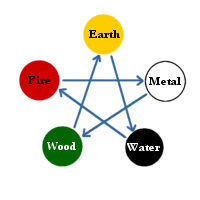
Now, in true democratic form and of course to preserve balance, the five phases also have a system of checks & balances. This cycle,
as seen below, is called the Controlling Cycle. Here the phases insure that no phase is too long or too strong. Again starting from water,
water controls fire, fire controls metal, metal controls wood, wood controls earth, earth controls water. Another cycle which is just a further example of the
image to the right, is the Over-Acting Cycle. Basically the over-acting cycle is when any given phase is overly strong and not controlled enough. It then
takes the element it controls and does damage to it (e.g., water controls fire, but if too much water is used the fire will go out completely, etc.)
The way I remember it is: Water can be thrown to dose out fire. Fire melts metal. Metal in the form of an axe or knife cuts wood. Wood in the form of a tree
breaks through the earth to grow. Earth clouds and turns water to mud.
A third way to look at this same image is to reverse the direction of the arrows. If you do this you get the Insulting Cycle. If any phase is extremely strong, it
can actually turn around and put down the phase which normally controls it.
Every sign, symptom and aspect of the body can be contemplated with yin and yang in mind. Before looking at medical applications and imbalances, first the structure
of the body is placed into the two categories by their nature. This includes both the external surface of the body as well as the internal organs and meridians or channels
(Surprisingly no introductory texts actually explain the origin of meridians and where they fit, thus I am throwing them in as well).
YinYang Application to Body Structure
There is a story that says the application of yin and yang to the body came from watching the way the noon time sun would hit an animal.
Just as every hill had a sunny side and a shady side, so too does the animal. Every part of the animal that touched the sunlight was associated with yang
and every part that was in shade was associated with yin. To yang went the entirety of the head, the posterior-lateral arms and legs, the posterior of the torso, etc.
To yin went the anterior of the torso, the anterior-medial arms and legs, etc. Internally, those organs which are in direct contact with the outside world, mostly from
mouth to anus, went to yang (a.k.a. the hollow organs). Those organs which open to the outside only indirectly went to yin (solid organs). Here are the basics:
Body Structure Aspects
Yang
Yin
Superior
Posterior
Lateral
Exterior
Organ Function
Qi
Hollow Organs(Fu)
Inferior
Anterior
Medial
Interior
Organ Structure
Blood/Body Fluids
Solid Organs(Zang)
As for the meridians, the split is correlated to both the meridians organ association and it's location. Interestingly,
all of the hollow organs have meridians which run along the posterior-lateral aspects of the arms and legs. Similarly all
the solid organs have meridians that run along the anterior-medial aspects of the arms and legs. (What's curious is even
though some meridians have a greater percentage of points on one aspect of the body, they fall into the other.)
YinYang Application to Pathology and Treatment
It is the imbalance between yin and yang in the body that is one of the major pathologies in TCM. In addition, the nature and
characteristics of an illness and how it runs its course, can also give inclinations to whether the pathogen or pattern is yin or yang.
Pathology Aspects
Yang
Yin
Acute Disease
Rapid Onset
External Pathogen
Changes in Pathology
Qi Disease
Hot Illnesses
Dry Illnesses
Hardness*
Hyperactivity
Chronic Disorder
Gradual Onset
Internal Disorder
Lingering Pathology
Blood Disease
Cold Illnesses
Damp Illnesses
Softness*
Hypoactivity
*Hardness and softness refer to lumps, masses and swellings.
Recall the graph from the four properties page (YinYang Graph).
It is this property of mutual consuming and supporting that gives us four major pathologies
(Yin deficiency, Yin Excess, Yang deficiency, Yang Excess). Each have a set of symptoms and signs discussed in
the Eight Principles section. Balance must be achieved, so the strategy is to tonify that
which is deficient, and reduce that which is excess. Yin and yang patterns are rather serious patterns and are not as simple
as those that are in the table above. Just because you have a qi deficiency does not mean that you have yang deficiency. In these cases,
any effect you wish to have on yin and yang should be indirect or subtle.
There are four basic properties that help to understand the relationship of yin and yang and make it easier to apply these prinicples
to the microcosm that is the human body.
1) The Opposition of Yin & Yang
Yin and Yang are oppossite, however only relative to each other. Nothing is wholly yin or wholly yang. Each contains even the smallest
of seeds of the other inside it. At any given time the two are in a constantly changing balance, with each vying for that one step ahead.
Yang natured things (e.g., heat) counter and dispel yin natured things (e.g., cold) and vice-versa. If one predominates, it can overact on
the other, cause imbalance and lead to disease.
2) The Interdependence of Yin & Yang
Yin and yang, though relatively opposite to one another, can not exist independently. They define each other, much as night and day do. One cannot know
light without dark, or dark without light. They only exist in relation to the other. In addition, they feed off of each other. Yang is energy, and it needs nutrients
to exert itself. Yin is nutrient and needs energy to form.
3) The Mutual Consuming & Supporting Nature of Yin & Yang
Being in a constant balance, yin and yang are constantly attempting to adjust to levels of the other. Outside influences may cause levels of one to either
become significantly greater or lesser than the other. Four possibilities can occur: Yang Deficiency or Heat Xu, Yang Excess of Heat Shi, Yin Deficiency
or Cold Xu, Yin Excess or Cold Shi.
There are two things to take note of here. The first is to pay attention to the heat and the cold attributes. Interchanging the words yang and yin with heat and cold respectively,
plus combining with deficiency (xu) and excess (shi), you can get a rather good sense how to apply this to the body imbalances. For example, yin deficiency can also be thought
of as cold deficiency. With a lack of cold in the body, false heat signs can be seen. The second thing to note is the level of the non-deficient part of a xu/deficient condition.
Since yin & yang draw off each other to exist, any deficient condition will cause a general deficiency of both yin and yang. For example, yin deficiency will also have a minor
deficiency of yang that puts it just below its balanced level.
4) The Intertransformation of Yin & Yang
The dynamic balance of yin & yang is such that the two can transform into each other. Summer will eventually turn to winter, day will become night, even the most wild sugar rush will eventually lead
to a resounding depression. The change is not spontaneous but needs certain factors or precursors to exist. Internal factors are primary, yet external factors also have an effect.
In addition, the timing of these things must be right. Consider the transformation of matter to energy. The internal conditions of the composition of matter must be right and external
factors must be applied at the right time for Mass to multiply by C2 and cross over that equal sign to Energy (wonder where Einstein really got the notion of E=MC2 ?).
Yin and yang are one of the most fundamental concepts in TCM because it makes up such a large chunk of the foundation of diagnosis and treatment. First appearing in the Book of Changes (Yi Jing), the theory has probably been around since prior to the Warring States Period (pre 221 B.C.).
The common meaning of the traditional characters for yin and yang stand for the dark and light sides of a hill, respectively (simplified characters in parentheses).
This leads us to the basic metaphor of yin and yang being the cycle of the day, with yin being night and yang being day. The two are opposite, true. However, one will eventually lead into another in an endless cycle. Furthermore, the two define themselves by being the opposite of the other.
The ancients then looked in nature for other representations of this dichotomy. They began with fire and water and went on from there. To the yang side went all that is bright, exciting, moving and warm. To the yin side went all that is dark, dull, still and cold. When they were done they
had a list which placed every natural occurrence and state into one of the two camps. Here is a small example:
Yang
Yin
Fire
Sun
Male
Excess
Active
Energy
Function
Water
Moon
Female
Deficient
Inactive
Matter
Form
The yin-yang symbol (tai ji tu), again draws off of the day and night association of yin and yang. The story goes that the ancients plotted a graph made up of 6 concentrically larger rings.
In the center they placed an 8 foot high stick and measured the shadow cast by the sun throughout the seasons. They then colored in where the shade landed and where there was none. When they looked at
the graph from above, they ended up with a picture that extremely resembles the yin-yang without the two dots on either side. (For the whole story go to www.chinesefortunecalendar.com/yinyang.htm).
The addition of the smaller black and white circles are inserted into the opposite sides to further show the inseparable relationship
between the two. A fun explanation of yin and yang is to think of a coin with yang being heads and yin being tails.
They are two sides of the same thing. Now take that coin and spin it on a table and watch it make what looks like a globe. That is how close their relationship is.
Traditional Chinese Medicine(TCM), as it is in modern China, is a glorious trinity made up of acupuncture and moxibustion, tui-na massage, and herbal medicine.
At it's foundation is a deep theory of the nature of the world and its relationship to the human body. It is this theory that is the basis for TCM's diagnostic
and treatment strategies. The best place to start is on the most influential theory
to chinese medicine, that of the tai ji or yin-yang.
The patient is a 23 year old female whose main complaint is acne rosacea, localized more on the cheeks than the nose. She has had it for almost 2 years. Currently, she is using metronidizaloe cream/gel .75% applied twice a day as treatment. In the past, courses of erythromycin and tetracycline have been tried. The antibiotics worked to some extent, but only as long as she was taking them. Her secondary complaint was tendinitis of the wrist joint, mostly on the anterior side near the carpal tunnel but no other signs of carpal tunnel syndrome were present.
Other symptoms included mild dizzy spells for the past year, generalized headaches with no specific location a few times a week, stiffness in the trapezius, trouble falling asleep, and general stress. She is slightly irritable, especially before her periods which were towards the darker side with some clots lasting for 5 days. The patient runs on the cold side, often has an insatiable thirst, yet the stools and urine were normal. Her tongue was slightly red with a normal coat, and the pulse was wiry on the left and slippery on the right.
My initial diagnosis was liver qi stagnation, which may be turning into yang rising. It is possible that this is causing the wind and heat which may be perpetually flushing her face. Initially I considered blood deficiency, but the length of her menstrual cycles with clots plus the tongue and pulse led me differently. My point selections were chosen from both the diagnosis and the research I will present below, with consideration to the fact that this is America and many of the treatments in the research wouldnít fly so well here.
The treatment involved needling the following points: Yin Tang, LI 20 to Bi Tong, LI 11, LI 4, LV 3, ST 36, ST 44, GB 20. In addition, cupping with bloodletting was applied to GV 14. As of yet the patient has only had one treatment and results are yet to be determined. Follow up treatments may include the addition of points locally for the tendinitis but immediate concentration is currently on the rosacea. Also, she is not the greatest with needles so the fewer used, the better.
Research
An interesting thing to note is that the major pathology that acne rosacea usually falls into is one of Lung heat with Large Intestine dry. However, some discussion about the causes have stated that stagnation of Liver qi or heat in the Stomach and Spleen can also be the cause. Many of the published cases involve patients where the rosacea is concentrated in the male population, and are many times accompanied by severe constipation.
It seems almost like there are two different types of this disease. On the one hand are males, usually older than 30, which show much of the Lung heat and Large Intestine dry symptoms. Also the disease can progress further in a male to nasal rhinophoma and sometimes extended systemically. On the other you have females, ranging from 18-50, with more Liver qi stagnation symptoms where the disease goes no further than the face.
A thorough search of the major publications of oriental medicine came up with three articles which influenced the treatment protocol used here. There were another seven articles which revolved area general acne and acne vulgaris, but after reading them little was found that was relevant to acne rosacea. This was mostly because the symptoms and pathology were different enough for them to have not been relevant here.
The first study involved 32 cases that were treated with regular acupuncture along with fire-needle techniques. Most of the patients were male and the author attributed the disorder to accumulation of heat within the Lung and Stomach which manifested by attacking the nose and cheeks. The treatment protocol involved two things. The first was a treatment protocol of the points: LI 20, LI 11, TW 5, LI 4, ST 36, ST 40 and LV 3. The points were treated once a day for ten days as one course of treatment, with three days in between each course.
The interesting addition to their treatments was the use of the fire-needle which was applied to the nose mostly. Fire-needle was done by putting a needle to flame until the shaft gets red hot. It is then quickly inserted and withdrawn with one fluid motion. It was unclear as to how many times the fire needle was done per treatment.
The results of the study were extremely promising. 84.4% of the cases showed marked improvement with 75% showing a complete cure and were symptom free after a 2 year follow up. Unfortunately, fire-needle is not something that this particular patient would allow. Her fear around needles in general is high enough without the addition of a glowing red needle. Itís also unclear why fire needle was used, since the conditionís pathology is based on heat.
The next study was a report of 26 cases, this time mostly female. All of the patients were concurrently utilizing some form of external medicine all to no avail. This study also attributed the cause of the disease to heat stasis in the Lungs. It again cited that the lung opens into the nose and thus that is where the heat is stagnated. Most of the patients in this study as well had a central location of the disorder on the nose.
Four points were used here; DU 14, BL 13 and 15 (both bilateral), and LI 11 (bilateral). The points were all punctured with a three-edged needle (lancet) and then cupped. The cup stayed on for 15 minutes. The treatments were given once every other day with 6 treatments being considered a course. 2-3 courses were usually enough to show results. In addition, the patients were all given an herbal decoction. The decoction was not given until after the third treatment, was taken twice a day, and continued throughout the rest of the courses.
This study had similar results as the first. 92.3% of the patients had marked improvement with 80% completely cured even after a 1 year follow-up. The average patient showed results by the third treatment, and was usually at itís best after 2 courses. Itís curious why they added the herbal decoction after the third treatment since by then they were seeing results with blood-letting and cupping alone. A follow up to the study could be a separation of the two, with one group getting the herbs, and another getting just the cupping and seeing how they were in relation to the combination.
The last study did not focus solely on rosacea but on acne in general. Of the 120 cases, 61 were pustular acne (which rosacea falls under), 29 were pustular, 19 were nodular, and 11 were mixed. The distribution was more even between male and female, though slightly more on the female, and the age range was slightly younger since it involved some cases that were under 18. Their explained pathology didnít say either Lung or Liver, but instead simply said that stagnation of blood-heat was the cause, and this stagnation rose to the face.
Their treatment involved one thing only. The point GV 14 was pricked with a three-edged needle (lancet) and then a fire-cup was placed on top of it. The cups were in place for no more than five minutes. The treatments were given once a week, and a course of treatment was considered 3 treatments. It didnít say if there was a spacing between courses of treatment. The study also prohibited the use of any type of drug during the study.
Again the results were outstanding. 95.8% showed marked improvement with 70% showing complete cure with no recurrence of symptoms after 2 years. Most results were seen after one course, and 2-3 courses were usually enough to reach maximum. Some, however, did require an extra 1 or 2 treatments (not courses). The study said that GV 14 was the perfect point since the 3 Yang meridians met there and that the etiology of the stagnant heat was in the Yangming. It was amazing that with such minimal treatment amazing results could be had.
The point prescription for the original patient was chosen for three reasons. Since the treatments are being done in the student clinic, herbal medicine cannot be given without a separate consult. Secondly, the patient could only come once a week as that is the nature of the clinic. Finally, the patients condition is slightly different than the Lung heat which is apparent in the first two studies, especially since the concentration of her problem is not on the nose.
In many ways the prescription would be only slightly different if used for treating Lung heat. The points GB 20 and ST 44 could be removed and replaced with ST 40 to match almost exactly to the first study. At the same time, with just GV 14 the third study was able to show amazing results once a week. With that kind of success it wasnít necessary to add BL 13 & 15 into the bloodletting and cupping, and LI 11 was already being needled.
Since only one treatment thus far has been given, more time is necessary to test the results. If by the third treatment little progress is seen, possibly an herbal consult would be worthwhile or possibly changing LI 11 to cupping with bloodletting. It would be interesting to see if these studies included the signs and symptoms their patients presented with to see if truly they all fell into this Lung heat category or if some other diagnosis could have been given.
Sources
1.Chen, Wei Ling. Treatment of acne by injection plus cosmetic acupuncture. Shanghai Journal of Acupuncture and Moxibustion, Vol. 1, #3, 1999, pages 85-86.
2.Xiuyan, Yan. Treatment of acne rosacea with filiform needle and burned-needle: a report of 32 cases. Shanghai Journal of Acupuncture and Moxibustion, Vol. 1, # 1, 1999, pages 43-44.
3.Tian, Xu. Blood-letting and cupping for acne rosacea: report of 26 cases. International Journal of Clinical Acupuncture, Vol. 11, # 1, 2000, pages 75-76.
4.Hua, A. & Shu-Zhang, Y. Treatment of facial acne with bloodletting followed by cupping at dazhui. International Journal of Clinical Acupuncture, Vol. 7, # 2, 1996, pages 245-246.
A Discussion of the Eight Strategies (Ba Fa) from the Aspect of Herbal Formulary
by Attilio D'Alberto
Introduction
The eight strategies (Ba Fa) were originally recorded in the Nei Jing Su Wen. It wasn't until the Qing dynasty that Dr Cheng Zhong-Ling organized and categorized the eight basic strategies known as the 'Eight Methods in Therapy' (Yi Men Ba Fa) (Williams 1992, p28) and recorded them in the 'Medical Revelations' (Yi Xue Xin Wu).
The eight strategies are categorised according to their therapeutic action and are shown below.
Sweating (Han Fa)
Vomiting (Tu Fa)
Draining Downward (Xia Fa)
Harmonizing (He Fa)
Warming (Wen Fa)
Clearing (Qing Fa)
Reducing (Xiao Fa)
Tonifying (Bu Fa)
In TCM, diagnosis and treatment are based on an overall analysis of signs and symptoms, aetiology, the nature and location of the illness, the patient's Qi level (weak or strong) and their constitution (Bian Zheng Lun Zhi). The practitioner will then make a syndrome differentiation and use the eight methods to conduct their treatment strategy.
The aim of this essay is to discuss the eight strategies (Ba Fa) in relation to TCM and herbal formulary and present a case study with an analysis of the strategies used.
Discussion
Sweating - Han Fa
The sweating strategy induces perspiration to aid in the regulation of lung Qi. This facilitates interaction between the nutritive (Ying) and protective (Wei) Qi allowing for the release of pathogens from the exterior of the body. It is used in patients with wind-heat or cold syndromes (i.e. patients with the common cold). Pungent warm formulas are used to release the exterior (Ma Huang Tang), and pungent cool formulas are used to release the exterior (Yin Qiao San).
If sweating is induced in a patient suffering from an exterior syndrome then it should be only for a short period of time after which the patient should feel better. If sweating, whether diseased or medicinal, lasts too long or is excessive it will then injure Yin.
Applications:
Externally-contracted exterior excess conditions
Rashes
Acute oedema which is more severe in the upper part of the body
Early-stage pain and swelling from wind-damp
Skin disorders caused by wind
Diseases that are working their way out from the interior
Vomiting - Tu Fa
This strategy uses herbs that over-stimulate the stomach to induce vomiting. It is rarely used today except in acute interior full (excess, shi) conditions and is used in emergency or life-threatening conditions (Yi 2000, p19). This is because it injures Yin and the stomach due to its violent action and should therefore only be used in strong patients. When it is used it induces vomiting to quickly remove stagnation of food, phlegm or poisonous materials from either the stomach, throat or oesophagus. An example of a vomiting inducing formula is Gua Di San.
Applications:
Phlegm stuck in the throat
Phlegm accumulation in the chest
Food stagnation in the stomach
Ingestion of poisons
Draining Downwards - Xia Fa
This strategy induces defecation to purge the bowels by irritating or stimulating the intestines to treat interior full (excess, shi) conditions. For example to drain heat and move stools (Da Cheng Qi Tang), warm the Yang and guide out accumulation (San Wu Bei Ji Wan), moisten the intestines and unblock the bowels (Ma Zi Ren Wan), and drive out excess water (Shi Zao Tang).
Draining downward formulas (purgatives) are used to treat constipation, certain febrile diseases and certain gynaecological disorders. It should however be used with caution during pregnancy, parturition and menstruation.
Applications:
Constipation
Dried faeces in the intestines
Heat accumulation
Cold accumulation
Excess water
Blood build up
Harmonizing - He Fa
This strategy is used to harmonize the different levels of the body and the Zangfu organs. Harmonizing can both expel pathogenic factors aswell as tonify the upright Qi (Zheng Qi). It is used to harmonise the Shaoyang (Xiao Chai Hu Tang) when the pathogen lies half-way between the interior and exterior of the body, harmonise the Zangfu organs that are affected simultaneously, for example the liver and spleen (Si Ni San), and the intestines and stomach (Ban Xia Xie Xin Tang). It is also used for complex conditions such as heat with cold or emptiness with fullness.
Applications:
Half interior-half exterior (Shaoyang) disorders
Malarial
Depression
Dysmenorrhoea
Epigastric focal distention
Warming - Wen Fa
This strategy is used to warm the Yang. It is used to eliminate pathogenic cold conditions of both fullness (excess, shi) and emptiness (deficiency, xu) in either the interior or exterior. For example, to warm the channels and disperse cold (Dang Gui Si Ni Tang), warm the middle jiao and dispel cold (Li Zhong Wan), restore and revive the devastated Yang (Si Ni Tang), and warm the menses and dispel cold (Wen Jing Tang). It can also be used to treat mal-absorption syndromes and certain gynaecological disorders.
Applications:
Cold in the channels
Cold attacking the middle jiao
Cold with devastated Yang
Clearing Heat - Qing Fa
This strategy is used to clear heat or cool the heat in the body. It eliminates pathogenic heat or drains the fire from the body's interior in full (shi) or empty (xu) conditions. For example, to clear heat from the Qi level (Bai Hu Tang), clear the Ying level and cool the blood (Qing Ying Tang), drain the fire and relieve toxicity (Huang Lian Jie Du Tang), and clear heat from the Zangfu organs (Qing Wei San).
Applications:
Interior heat
Heat in the Zangfu organs
Tonifying - Bu Fa
This strategy is used to either tonify, restore, supplement or replenish emptiness, deficiency or weakness of the body's Qi, Blood, Yin, Yang, fluids, essence or any of the Zangfu organs. For example, to tonify Qi and replenish the spleen (Si Jun Zi Tang), tonify the blood (Si Wu Tang), tonify the Yin (Liu Wei Di Huang Wan) or tonify the Yang (Jin Gui Shen Qi Wan).
Applications:
Deficiency of Qi, Blood, Yin or Yang
Deficiency of the Zangfu organs
Reducing - Xiao Fa
This strategy is used to reduce, dissolve or eliminate accumulation. For example, chronic conditions resulting from the accumulation of hard and swollen substances such as blood (Xue Fu Zhu Yu Tang), phlegm (Er Chen Tang) or food stagnation (Bao He Wan); Qi stagnation (Yue Ju Wan); abscesses (Wu Ling San) and parasites (Wu Mei Wan).
Applications:
Qi stagnation
Blood stasis
Food stagnation
Phlegm
Abscesses
Parasites
Case Study
In many conditions the disease is too complex to be treated with just one method alone, therefore two or more methods are used together. For example a patient presents the following symptoms: night fever and morning coolness with an absence of sweating as the fever recedes, emaciation with no loss of appetite. Upon further inspection the tongue had a red colour with a little coating and the pulse was fine and rapid.
The patient's syndrome is deficient heat due to the advanced stage of febrile disease of an insufficient type (heat smouldering in the Yin regions). Therefore the most appropriate formula for this condition is Qing Hao Bie Jia Tang. It acts by simultaneously nourishing (tonifying-Bu Fa) the Yin and venting (heat clearing-Qing Fa) the heat. Two of the eight strategies are used in this formula, one to tonify the Yin and the other to clear the heat. The eight strategies are further reiterated within the 'feudal system' (king, minister, assistant and envoy) adopted to illustrate the different roles of each herb in any particular formula.
In Qing Hao Bie Jia Tang the king herb Bie Jia (6g) directly enters the Yin regions to enrich the Yin (tonifying-Bu Fa) and reduce the fever caused from deficiency. Qing Hao (15g), another king herb, vents the heat and expels it from the body (heat clearing-Qing Fa). The minister herbs Sheng Di Huang (12g) and Zhi Mu (6g), assists Bie Jia in nourishing the Yin (tonifying-Bu Fa) and clearing heat from deficiency. The assistant herb Mu Dan Pi (8g) drains heat from the Yin regions and assists Qing Hao (8g) in venting and dispersing the heat (heat clearing-Qing Fa).
Conclusion
The eight strategies are the first recorded number of therapeutic actions that are accomplished by formulas and are related to a practitioner's syndrome differentiation. Furthermore the practitioner's treatment strategy is related to the fundamental aspects of the eight strategies.
Due to the nature of the pathogen and the way in which it can move or develop through the body's various levels, a formula often contains two or more strategies in order to treat the condition.
Today the eight strategies have increased tenfold to further subcategorise formulas according to their therapeutic actions. Nevertheless, the eight strategies are the basis and the broad framework from which all strategies originated. As Dr Cheng once said:
"The eight methods exist in any single method. Likewise, a myriad of methods exist within the eight methods." (Bensky and Barolet 1990, p9).
References
Bensky, D. & Barolet, R. (1990). Formulas & Strategies. Seattle: Eastland Press, Inc.
Williams, J.E. (1992). 'Herbal Prescriptions Corresponding to the Eight Methods', Journal of Chinese Medicine, May, p28-31.
Yi, Q. (2000). The Traditional Chinese Medicine Formula Study Guide. Boulder: Snow Lotus Press.
A Comparison of the Influence of the Chinese and Western Philosophies on the
Development of TCM and Western Medicine.
by Attilio D'Alberto
Introduction
Various cultures throughout history have sought to construct life to understand the relationships between birth, death, sickness and health. When civilised cultures developed their skills and became specialised, healthcare physicians became a separated form within the community. Since then, they have sort to influence man's daily life. Chinese medicine has been notably more concerned with the nature of the cosmos in relationship to the human being, whilst the West preoccupied itself with the individual, their identity and the body's own cosmos. In Europe from the Greco-Roman times and in Asia, medicine changed its explanations of disease and healing from a transcendental basis to one in which the natural elements were governed within the law of the cosmos.
The aim of this essay is to explore the development of Western orthodox medicine and Chinese medicine with their accompanying philosophy. The comparisons of the two idealologies will also be discussed along with how these two philosophies might merge at a later date.
Discussion
Western medicine is greatly related to Greek thinking. Porter (1997, p7) states that Greek medicine emphasized the microcosm/macrocosm relationship between man and nature. Great attention was given to hygiene, which was seen as the root to all ills. This was carried forward later during the Renaissance period, where in actual fact no cures were ever found for man's great ills; i.e. the black plague, typhoid, tuberculosis, etc, rather it developed a preventative measure of medicine. Actually, the Renaissance period did more for knowledge than health for it was the basis of our modern understanding of Western medicine.
It was in the work of Galen that recorded dissections were first carried out but only on dogs and rarely. This was later carried on solely by European medicine in late medieval Italy. However, later during the Renaissance period, a flourish of anatomical and physiological studies began to emerge. These investigations were based upon the philosophy that all our answers could be found by delving deeper into the structure and flesh of humanity. It was Rene Descartes, the philosopher and physician who made a major contribution to Western medicine. He needed bodies to dissect, these bodies were controlled by the Christian church so he had to comprise with the Pope of Rome. The
Pope agreed that he could have the bodies to dissect if he wouldn't have anything to do with the soul, mind or emotions, which were left to the church for exclusive control (Pert 1997, p18). This caused a major split between the body, emotions and the soul. Suddenly Western medicine had moved completely into the Greek notion of microcosm/macrocosm, but not within nature but just within the body itself.
It was not until the publication of Paduan's De humani corporis fabrica in 1543 that this theology was truly indoctrinated. It challenged Galen's teachings of anatomy with its own maps of the body drawn and studied during dissections. Later Harvey's De motu cordis, published in 1628 showed for the first time the workings of the heart in relation to blood. Medicine then began to sub-divide itself in scientific entities that we see today, notably physiological experimentation, pathology, microscopy, biochemistry and surgery. The advent of technology also helped to prove and encourage the growth of the microcosm/macrocosm relation held solely within the body. This was seen with the invention of the microscope during the nineteenth century. Medicine went truly inward as cell biology was born along with pathological anatomy. This lead to a greater understanding of the respiration system, digestive system and nutrition. It was largely Louis Pasteur and Robert Koch who established micro organic biology. Now medicine could look at infectious diseases like air pathogens, soil and water hygiene and person-to-person contact. Then within the twentieth century came the age of genetics and molecular biology.
During the West's industrial revolution, thinking began to be broken down into its sub units with Isaac Newton's philosophy of singular components. Suddenly everything was specialised and categorised according to its component properties. This advocated Western medical thinking. He believed that the body was a complex biological system in which abnormally functioning components could be removed and replaced with man made mechanical ones, i.e. the heart. After some time Albert Einsteinian's famous equation E=mc≤ came in being. It opened the way as Gerber (1988, p68) puts it for 'the conformation of the human being as a multidimensional organism made up of physical/cellular systems in dynamic interplay with complex regulatory energetic fields'. It thus confirmed acupuncture, Qi as the vital force of all things and the etheric body, although it has never been fully indoctrinated in Western orthodox medicine.
The modern mechanisms of thought was collaborated upon Renaissance thinking and Isaac Newton's theories by Charles Darwin. It reiterated the clinical view of man's evolution in their quest for survival and re-propagation of man's genes. This is contrary to one of harmony with man's environment as seen in ancient Greek and Chinese thinking to one of struggle, pain and death.
Since Western medicine moved away from its origins and developed its own philosophy on illness and disease it has created a personalisation of the physician. Chinese medicine however, is a collective weight of its tradition as a whole. Although individual Chinese doctors can translate and interpret traditional texts better than others based upon practical experience. This is why so much importance is given to practical application rather than theory.
Chinese theory was greatly politically orientated as we see with the shifting of views from Daoism to Confucianism to Buddhism to Communism. The Chinese empire became politically united in 221 BC. The Han dynasty established political, philosophical and religious teachings. It was built upon the four major classical texts, the Yellow Emperor's Classic of Medicine, the Divine Husbandman's Materia Medica, the Canon of Problems and the Treatise on Cold-Damage Disorders (Porter 1997, p149). One of the most important shifts in theory came from the transcendental texts of the I Ching. It was from there that the theories of Qi movement within nature derived from: the theory of Yin and Yang. This theory represents the duality of our universe: light and dark, high and low good and bad, etc, where Yin and Yang are in a constant state of dynamic balance. It is a philosophical concept in constant flux, therefore it is never fixed but in a state of continuous mutual consumption and support.
Daoism was based upon the teachings and writings of Laozi and Zhuangzi (c.339 - 295 BC). It stressed non-action (wu wei) by the need to withdraw from the world and following 'the way' or dao. Daoism is one of the oldest forms of Chinese philosophy. It has had popular support from society and the imperial state in which it co-existed alongside Confucianism throughout Chinese history. Confucianism was founded by Confucius (c.551 - 479 BC). It focused upon a series of key relationships and behaviour within social hierarchy. Confucius looked back to the 'Golden Days' of far-gone Emperors, where man lived in harmony with nature and others. His idea was to solve your own problems first then your family's and then your community's. Confucianism later brought in Daoist thinking to combat the sophisticated Buddhist teachings in an effect to maintain popularity. It became a corner stone of Chinese thinking and subsequent structures within Chinese state and society. Buddhism was introduced to China from the Indian subcontinent as early as the Han dynasty (200 BC - AD 220). It brought the ancient Sanskrit texts into China, which greatly influenced medicine and philosophy.
Chinese phonetics played a great part in all aspects of learning and life throughout history. Because Chinese characters remained the same throughout time, it helped to keep the important philosophical and medical knowledge that would otherwise have been lost. With that, the idea that spirits walked with the living also helped to maintain Chinese medical traditions, because of the need to uphold the ancestor's traditional ways.
There are many comparisons between Chinese philosophy and that of the ancient West. As Reid (1989, p80) reminds us, Hippocrates once said to his students 'Thy food shall be thy medicine'. This is identical to Chinese thinking: Sun Ssu-mo the physician wrote in Precious Recipes 'a truly good physician first finds out the cause of the illness, and having found that, he first tries to cure it by food. Only when food fails does he prescribe medication'.
Another example is Greek and Roman thinking: The influential Roman physician Claudius Galen devised a theory on breathing based on earlier Greek writers. He thought that a natural 'world spirit', seeped from the air down the windpipe into the lungs, along hollow pulmonary veins and into the heart, where it added special life to the vital flame. This vital spirit was then distributed throughout the arterial system (Parker 1993, p24). In Traditional Chinese Medicine (TCM), air (Qing Qi) is mixed in the chest with the essence from food and fluids (Gu Qi) and then given the spark of life by the primary Qi (Yuan Qi) stored in the Kidneys to produce Zong Qi. This Zong Qi is dispersed around the body and to the Heart where it is transformed to produce the vital substance of all mammals, blood.
From Hippocrates to Galen humoral medicine was based upon the Greek's four elements; fire, water, air and earth, which in turn related to the four bodily fluids; blood, phlegm, yellow bile and black bile. In Chinese medicine, there are five elements or phases which are related to certain organs of the body.
Conclusion
There is a highly significant paradox to Western medicine: it is an unresolved dis-equilibrium between the powerful science-based medical establishment and the larger issue of unfulfilled health requirements of the people. Humanity today, lives in a wishful dream ideal of genetic molecular biology, when everywhere around us there is still disease, ignorance and unanswered questions, hundreds of years old, rotting in the corner where no one wants to look. Western medicine needs to change and update their philosophy from a Newton perspective to the more expanded Einsteinian view, even if this is difficult, if they ever want to restore their faith in the people who use it. This can only be lead by an evolutionary step in Western philosophy. We can only watch as Einsteinian's theory is full integrated into Western and Chinese medicine. From there, we shall see a more unified, whole and integrated philosophy and a new world healthcare system that is more effective at treating disease.
References
Gerber, R. (1988). Vibrational Medicine. Santa Fe: Bear & Company.
Parker, S. (1993). Human Body. London: Dorling Kindersley.
Pert, C. (1997). Molecules of Emotion. London: Simon & Schuster.
Porter, R. (1997). The Greatest Benefit to Mankind-A Medical History of Humanity From Antiquity to the Present. London: Harper Collins.
Reid, D. (1989). The Tao of Health, Sex and Longevity. London: Simon & Schuster.
The Use of Gui
Pi Tang in TCM Internal Medicine
Attilio DíAlberto
Introduction
The Zangfu organ relationship
is often a ëblindí detective game in which externally manifested symptoms give
clues to the pathological underlying mechanisms that occur within the body.
These symptoms and signs are then broken down in a symptom differentiation (Bianzheng). This allows the physician to
metaphorically look inside the body and understand which organ(s) is diseased,
the pattern or movement of the disharmony from one organ to another and its
origin. This is because Traditional Chinese Medicine (TCM) chiefly focuses on
the difference of the pathogenesis, that being the syndrome rather than the
disease itself. From there a treatment strategy is employed, (Lunzhi) to either treat the branch (Biao) (often the presenting symptoms) or
the root (Ben) cause. Therefore, the aim of this essay
is to discuss the Bianzheng Lunzhi of
Gui Pi Tang in terms of the theory of
treating different diseases with the same method.
Gui Pi Tang (Restore the Spleen Decoction) was first recorded in the
classic Ji Sheng Fang (Formulas to
Aid the Living) in 1253AD by Yan Yonghe and is derived
from the modification of Si Jun Zi Tang. However, it wasnít
until three to four centuries later that the Ming and Qing physicians completed
its actions, indications and symptom complexes. It is categorised as a formula
that tonifies Qi and Blood. Gui Pi Tang is used to treat different diseases with the same method. This
method implies that the same principle and method may be applied for different
diseases on condition that they share some pathological syndrome conditions (Bo
2000). When prescribing any formula, the physician should always consider the
action of supporting the Zheng Qi (genuine)
and dispelling the Shi Qi (evil). The
pattern of Zheng Qi and Shi Qi can one of three:
Excess: Right and Evil are strong.
Deficiency: Right and Evil are weak.
Complex: Deficiency complicated by excess and visa versa.
When treating the complex patterns, the physician must employ one of
the following strategies listed below. Gui
Pi Tang acts to tonify the Spleen and nourish the Heart Blood, therefore
strengthening the Zheng Qi.
Strong Zheng Qi: .Drain/Tonify:
Not so
strong Zheng Qi: First, drain,
second tonify.
Weak Zheng Qi: First tonify, second
drain (Wahnish 2000).
The abnormality of Qi and
Blood are closely and directly connected with the functions of the Zangfu. The Lung dominates Qi, the Heart controls the circulation
of Blood, the Spleen is the source of Qi and
Blood and keeps it flowing, the Liver stores Blood and regulates the flow of Qi and the Kidney governs the reception
of air and stores essence which shares a common source with Blood (Bo 2000).
In TCM, the Spleen
and Stomach are regarded as the ëSea of Qi
and Bloodí. This symbolism refers to the Spleen being the source, origin or
reservoir of Qi and Blood. The Stomach stores the food stuffs and then the Spleen transforms
and transports the Gu Qi to the Lung.
From there it is mixed with air to form Zong
Qi. It is then transported to the Heart where it is transformed into Blood
(Maciocia 1989). There are several schools of thought in TCM. One of these is
the Li Kao school, which states that
a large number of rooted Zangfu disharmonies
are cured by treating the Spleen and Stomach. A deficient Spleen will lead to a
reduction in Qi and Blood production and will have a
major influence on the rest of the Zangfu
organs moreover than any other organ because a lack of generated Qi and Blood will lead to a lack of Qi to correctly maintain the Zangfu organs and dysfunction will occur.
Therefore, the importance of Gui Pi Tang is
greatly exuberated by the condition it treats, that being; Spleen Qi and Heart Blood deficiency. The
composition of Gui Pi Tang is given
below with the original dosage. The modern dosage is shown in brackets. All the
herbs should be cooked together as a decoction using water.
Ingredients: Dosage:
Ren Shen (Radix Ginseng)15g
(3-6g)
Huang Qi (Radix Astragali Membranacei)30g (9-12g)
Bai Zhu (Rhizoma Atractylodis Macrocephalae)30g (9-12g)
Fu Ling (Sclerotium Poriae Cocos)30g
(9-12g)
Suan Zao Ren (Semen Zizyphi Spinosae)30g (9-12g)
Long Yao Rou (Arillus Euphoriae
Longanae)30g
(6-9g)
Mu Xiang (Radix Aucklandiae
Lappae)15g
(3-6g)
Zhi Gan Cao (Honey-fried Radix
Glycyrrhizae Uralensis)7.5g
(3-6g)
Ren Shen, Huang Qi, Bai Zhu and Gan Cao tonify the Qi and
strengthen the Spleen. Dang Gui and Long Yan Rou nourish the Blood, whilst Da Zao stops sweating and strengthens
the Heart and calms the Shen. Yuan Zhi and Fu Ling also strengthen the Heart and calm the Shen. Sheng Jiang and Da Zao strengthen the Spleen and stomach
to promote the production of Qi and
Blood. Whilst Mu Xiang promotes the
circulation of Qi and strengthens the
Spleenís transportation function thereby avoiding excessive tonification
(Junying 1991).
Actions:
Tonifies the Qi and nourishes the Blood. Strengthens
the Spleen and nourishes the Heart.
Indications:
Amnesia
Anxiety
Bleeding
Dream disturbed sleep
Fatigue
General debility
Insomnia
Irregular menstruation
Low grade fever
Night sweats
Pale, swollen tongue with a
thin white coating
Palpitations
Phobias
Poor appetite
Poor memory
Swallow complexion
Weak and thin pulse
Weariness
Withdrawal (Qiao and Stone
2000).
Discussion
Every disease has its own pathogenesis and can be categorised into three
essential patterns: excess or deficiency of the vital Qi, the imbalance of Yin and
Yang and the abnormality of Qi and Blood (Bo 2000). Any Zangfu disorder will fall into one of
these three patterns. In this Bianzheng, we
are concerned with the inadequacy of Spleen Qi
and Heart Blood; both being a deficiency type.
To understand how Gui Pi Tang acts
to treat several disorders with the same method, we have to first look at the
relation between the Spleen and the Heart. In the Five element theory as laid
down by the Huang Dei Nei Jing, the
Heart is Fire and the Spleen is Earth. Fire produces ashes, which will turn
into Earth, hence the Heart is the mother and the Spleen is the son (see figure
1). Therefore the Heart may have a greater effect upon the Spleen than any
other Zangfu organ within the Five
Element theory.
Along with the Five Element theory is its controlling sequence
(figure 2). Here, each organ as defined by its element controls the next organ.
Thus the Spleen controls the Kidney, as Earth controls Water. Therefore when
there is a deficient Spleen it will adversely affect the Kidney. The majority
of syndromes that Gui Pi Tang treats will
not only show symptoms of a deficient Spleen but also symptoms of a deficient Kidney.
Figure 1. The generating sequence of the Five Elements.
We have seen how the Spleen dominates the bodyís Qi and Blood with the Li Kao school of theory, yet the Heart
also has this function, but within a Zangfu
hierarchy framework. This is because the Heart houses the Shen (mind) and is the organ that
controls all the Zangfu, as the Su
Wen chapter 8 states:
ìAs the heart is the monarch in the organs, it dominates the
functions of the various viscera.î (Wu and Wu 1997).
As the Heart houses the Shen
and the Spleen is associated with pensiveness, any excessive thinking will also
affect the Shen.This will affect the Spleen again and lead to a deficiency of the Spleenís
ability to produce Qi and Blood
resulting in a further weakened Heart, as the son (although indirectly) insults
the mother. This creates a cycle in which both organs will mutually adversely
affect each other.
In the case of amnesia (Jian
Wang) the dysfunction of the brain is brought about by a deficiency of Qi, Blood and essence. The Heart and
Spleen are impaired by anxiety and worry which will cause a deficiency of Blood
as the weakened Spleen Qi is unable
to produce sufficient quantities of Qi and
Blood leading to a deficiency of Heart Blood and a restless Shen. Essence is depleted as the Kidney
is weakened by sexual hyperactivity and in its role of supplementing
post-heaven Qi due to a deficiency of
Spleen Qi. In this relationship
between the Heart, Spleen and Kidney, the Spleen dominates the syndrome as it is
the origin of Qi and Blood.
Figure 2. The controlling sequence of the Five Elements.
An important action of Gui Pi
Tang that lies outside its standardised actions is
its ability to nourish the Heart to warm the Spleen and Stomach. As the Spleen is
warmed it allows the food to be further cooked and transformed and transported.
Gui Pi
Tang also acts directly upon the Spleen to nourish it. This principle of tonifying
both the Heart and the Spleen is known as the combined method of treatment
(Williams 1992).
Generally, a deficiency of Spleen Qi will manifest itself as fatigue, tiredness, weariness and a weak
pulse, all of which are Yang deficiency
type symptoms. Secondly, it acts upon the Heart Blood which is the Yin aspect. A deficiency of Heart Blood
can cause the patient to manifest a pale complexion due to a lack of
circulating Blood, whilst dizziness is due to a lack of circulating nutritive
Blood supplying the brain. Listlessness is also due to a lack of Blood as Blood
transports nutrients to the tissues. A thin pulse is a Blood aspect as a
reduction in the quantity of circulating Blood with lead to a thin movement of
Blood through the vessels.
The pathological mechanisms involved with insomnia (Bu Mei) of a deficient type is when
Blood fails to nourish the Heart and therefore cannot house the Shen due to a deficiency of Heart Blood.
This leads to a restless Shen causing
the sufferer to experience difficulty in falling sleeping as the Shen spirit has trouble ëfallingí into
its residence, the Heart. The sufferer may also experience excessive dreams and
be easily woken from their sleep for the same reason of a disturbed Shen.
A deficiency of Heart
Blood can lead to palpitations (Xin Ji)
as the lack of Heart Blood fails to fill the vessels and therefore will lead to
a lack of nourishment to the tissues, brain and Shen. The night sweating (Dan
Han) accompanying this syndrome is the result of the consumption of Heart
Blood in the form of sweat, as sweat is the Yin
aspect of the Heart. Therefore, the patient will have Blood deficiency
symptoms, i.e. a pale complexion, pale tongue, tiredness, etc.
An important syndrome
treated by Gui Pi Tang is bleeding (Xue Zheng). The mechanisms involved in
bleeding syndromes are more complex than the previous aspects looked at so far.
Here, the physician may need to take into account other Zangfu organs, i.e. the Stomach. Gui Pi Tang can only treat bleeding syndromes caused by a
deficiency in cases of epistaxis, haematemesis, haematuria and purpura. They are
all categorised by the failure of Spleen Qi
to command Blood (Pi Tong Xue). The
mechanism of bleeding is when the Spleen fails to assists the Blood to
circulate inside the vessels, and no extravasation occurs, therefore ëthe
Spleen controls Bloodí (Shousheng 1996). Another explanation of the Spleenís
controlling functions of Blood can be related to its element, Earth, as stated in
the Classic of Difficulties (Nanjing):
ìThe spleen contains the blood. This function of the spleen
is evocative of the characteristics of earth, just as rivers and streams are
contained by an earthen bed, the bodyís blood is contained in the channelsî (cited in Dharmananda
2002).
A personís constitution
will also have a major influence upon the location of any bleeding. For
example, in relation to the Stomach, bleeding can occur in the gums, nose and
in the Stomach itself. The root cause usually lies with insufficient amounts of
Kidney Yin. If there is a deficiency
of Kidney Yin then there is not
enough water to balance Yang, leading
to Stomach Fire. Again this can often be traced back to a deficient Spleen,
which is unable to supply the correct quantity of Qi and Blood causing the exhaustion of Kidney essence/Yin. The different locations of bleeding
can be contributed to the Stomach meridian itself. It starts at the eyes and
ends on the foot making it one of the longest and extensive meridians (see
figures 3 and 4). Another pathological mechanism involved in bleeding is when
the Stomach meridian has several weaknesses along its pathway where exogenous
or endogenous evils may attack. The success of an evil attack depends upon the ZhengQi. The struggle between Zheng
Qi and the evil Qi can also lead to
bleeding as the two struggle for dominance and generate Heat causing the Blood
to boil out of the vessels. The strength of the Zheng Qi is largely based upon pre and post heaven Qi, that being again the Spleen and the
Kidney. In cases such as these, Gui Pi
Tang acts to tonify Qi and Blood
and therefore strengthening the Zheng Qi in
its ability to ward-off evil Qi.
Figure 3. The pathway of the Stomach
meridian on the face (Qiu 1993).
Figure 4. The pathway of the Stomach
meridian on the body (Qiu 1993).
Epistaxis is usually
associated with bleeding gums and haematohidrosis. The typical Spleen Qi symptoms of listlessness, pale
complexion and dizziness are also prevalent along with tinnitus and a thready
pulse. Tinnitus is attributed to a deficiency of Kidney Qi. The lack of Qi and
Blood will cause the extra depletion of Jing
essence stored in the Kidneys leading to a deficient Kidney and therefore poor
hearing as the bodily functions must be maintained from any available energy
source. Again it is seen how the Spleen controls the Kidney. In these instances
a modification of Gui Pi Tang is used
to treat the syndrome, with the addition of Xian
He Cao to restrain the leakage of Blood, E Jiao to nourish the Blood and stop bleeding and Qian Cao Gen, which also stops bleeding.
The mechanism in cases of spermatorrhoea is the same as above, as overwork
injuries the Spleen and leads to the use of Kidney essence as a source of
energy.
With haematemesis the
palpitations indicate a deficiency of Heart Blood but this is not as serious or
prevalent than with insomnia. Again Gui
Pi Tang is modified to include herbs whose sole action is to stop bleeding;
Xian He Cao, as we saw with
epistaxis, along with other herbs such as Bai
Ji, Jiang Tan and Hai Piao Xiao. The
breathlessness seen with haematemesis syndromes indicates a deficiency of Kidney
Qi due to a depletion of Jing caused by a deficiency of Blood.
The Kidney Yang then fails to grasp
the Lung Qi resulting in shallow
breathing and breathlessness.
Haematuria symptoms
are very similar to that of the previous two bleeding syndromes, except that in
this instance we may also see bleeding gums and breathlessness with a low
voice. The mechanisms of these additional symptoms are the same with the
previous bleeding disorders; a deficiency of Spleen Qi, which failures to command Blood, a weakness of the Stomach
meridian along various parts of its course and a deficiency of Kidney Qi.
Purpura, macules,
papules and haematohidrosis are often seen with typical Spleen deficient
symptoms of listlessness, dizziness and a pale complexion. However, the purpura
is often accompanied with signs of Blood stasis with a dull purple colour to
the skin, all of which are aggravated by overwork. This is due to the depletion
of more notably Qi than its
counterpart Blood. Overwork will exhaust an already depleted quantity of Qi to the point at which Qi cannot hold the Blood within the
vessels. In this case the modification of Gui
Pi Tang is used with the addition of Xian
He Cao, Zhong Lu Tan, Di Yu, Pu Huang, Qian Cao Gen and Zi Cao.
As we have seen in
the latter syndromes, Gui Pi Tang is
modified to include herbs whose sole action is to directly stop bleeding in
addition to the reinforcing of Spleen Qi and
the nourishing of Heart Blood. By
doing so, the formula is not only able to strengthen the Spleenís function of
controlling the Blood and keeping it housed within the vessels in a general
broad sense but also has the ability to stop bleeding locally.
In most instances
looked at so far, the syndrome manifests the typical symptoms of either a deficient
Spleen Qi or Heart Blood. However, in
the case of Xu Re (deficient fever), we
see that the deficiency of Qi and
Blood, are unable to hold the Yang, causing
itto float upwards and outwards and
manifest as fever. By tonifying the Spleen Qi
and Heart Blood it is possible to restrain the upward floating Yang Qi thereby balancing Yin and Yang.
An example of how Gui Pi Tang can
employ the principle of treating different diseases with the same method can be
expressed in the following case where the chief complaint is ulcers of the
mouth. The clinical features include, recurrent mouth ulceration of the tongue,
and to a lesser extent the gums and buccal cavity, dizziness, light headedness,
blurred vision, pale complexion, fatigue, pale nails, lethargy, weakness,
spontaneous sweating, a low weak voice and a shortness of breath. The pulse is
thready and weak whilst the tongue is pale with a thin white coating. All these
indicate a deficiency of Qi, Blood
and Spleen Qi. The Spleen and Heart
both influence the tongue and weakness of these two organs can lead to a
general failure of Qi and Blood
nourishment in the tissues of the mouth (Maclean and Lyttleton 2002). The fact
that no nourishment is reaching these areas of the mouth indicates a deficiency
of Qi and its ability to move
nourishment to these areas of the body whilst the deficiency of Blood and its Yin aspect means there is no nourishment
to move to the mouth. Gui Pi Tang is
used to tonify the Qi and Blood and also
calm the Shen, which may be restless
as ulcers are commonly associated with anxiety and stress.
Conclusion
Gui Pi Tang acts to treat many disorders with the same principle; tonify the Spleen Qi and nourish the Heart Blood. It acts
upon these two important organs that either generate Qi and Blood or control the Zangfu
as a whole, whilst indirectly it allows the other Zangfu to function correctly without any adverse effects. In the
case of the Kidney, it safeguards any potential unnecessary lose of essence
resulted by the Spleen attacking the Kidney. It therefore, truly encompasses
the theory of treating different diseases with the same method and TCMís
philosophy of treating the whole person; the body and the mind in one treatment
as one entity.
References
Bensky, D. & Barolet, R. (1990). Chinese Herbal Medicine
Formulas & Strategies. Seattle: Eastland Press.
Bo, P. (2000). Traditional Chinese
Internal Medicine.Beijing: Peopleís Medical
Publishing House.
Dharmananda, S. (subhuti@itmonline.org).
24th October 2002. Re: Gui Pi Tang.Email to Attilio DíAlberto
(attilio74@hotmail.com).
Junying, G. &
Zhihong, S. (1990). Basic Theories and Principles. Beijing: New World
Press.
Junying, G. (1991). Herbal Formulas. Beijing: New World
Press.
Long, Z. (1998). Formulas
of Traditional Chinese Medicine. Beijing: Academy Press.
Maciocia, G. (1989). The Foundations of
Chinese Medicine. Edinburgh: Churchill Livingstone.
Maclean, W. & Lyttleton, J. (2002). Clinical
Handbook of Internal Medicine vol 2. Penrith South DC: University of
Western Sydney.
Shousheng, W. (1996). Advanced Textbook on Traditional Chinese
Medicine and Pharmacology. Beijing: New World Press.
Qiao, Y & Stone, A. (2000). The
Traditional Chinese Medicine Formula Study Guide. Boulder: Snow Lotus
Press.
Qiu, M. (1993). Chinese Acupuncture and Moxibustion. Edinburgh:
Churchill Livingstone.
Wahnish, J.R. (2000). Pattern Differentiation/Diagnosis/Treatment.
New York: Energetics Press.
Williams, J.E. (1992). ëHerbal Prescriptions Corresponding to the Eight
Methodsí, Journal of Chinese Medicine, 39, (May), p28-31.
Wu, N. L. & Wu, A. Q. (1997). Yellow Emperorís Canon Internal
Medicine. Beijing: China Science & Technology Press.
Why Does Excessive Sex Lead
to Disease? By Zheng Younil
We are born with Qi widespread in the Nature and Universe.
Qi is a vital power in the body and mind.
Microscopically, we are a small universe. Our body's main energy sources are made up of four elements in
the light of holistic medicine. These elements are Semen , Blood , Qi , and
Spirit. Generally speaking, the order of formation is as such: Semen >
Blood > Qi >
Spirit. Of course, these four elements
can be interchangeable and inseparable among themselves.
Semen has two sources. One is what
we inherited from our parents. The other is what we obtain from foods we eat
everyday. Semen can not only be
stockpiled in our kidney but also be secreted when our other respective
internal organs need it or when we have intercourse with our spouse. Physiologically, semen can be transformed to
Blood, Qi , or Spirit through metabolism in our body. Semen and blood are visible.
On the contrary, Qi and Spirit are invisible and can only be felt by our sixth
sense. Speaking figuratively, Semen and
Blood are to red wine what Qi and Spirit are to white wine. White wine is more
expensive and higher in calories than red wine. Likewise, Qi and Spirit are
more precious and difficult to be made than Semen and Blood.
Why is Qi so important?
Qi is very important for our body metabolism for these
reasons;
It
heats up our internal organs and makes them function well. For example, it circulates our Blood
through our heart and stores Blood in the liver.
It
regulates our body fluid's balance and excretes dampness formed by useless
fluid in the course of metabolism in the form of feces and urine. So lack of Qi caused by exhaustion of
semen by excessive sex accumulates dampness in our body which can lead to
obesity.
It
also passes through our internal meridians, which control our body's whole
network system. It is different from nerves in the western medicine by no
means.
In conclusion, excessive sex exhausts our semen and thereby
interfering with the formation of Qi.
Then the lack of Qi accumulates dampness in our body which can lead to
disease. Of course, moderate sex is
inevitable for the instinct of preservation of the human species for us. But
excessive sex just for pleasure is dangerous to our life. I presume that what I've written above is
different from the common concepts of western medicine. So, whether you believe
it or not is up to you. But what I am sure of is that this concept of holistic
medicine has our korean ancestors' long experience.
Yin Yang Tang For Preventing Disease & A Healthy Life
** How to make
Yin-Yang Tang **
First pour hot water in the cup about 2/3 deep. Next, pour
cold water the rest 1/3 and drink whenever you want to drink something. It's that simple, just two different temperatures
of water.
Why? Our upper body or head should be cool and reversely, our lower
body should be warm so that the upper body's cool Qi is able to descend and the
lower body's warm Qi can go up thereby circulating the Qi and blood through the
entire body. Thus the stomach and
spleen in the middle of our body can balance the two Qi's interaction by lukewarm water (Yin-Yang Tang). If this dynamic movement stops, dampness
accumulates in our stomach and spleen and interferes with the metabolism of the
stomach and spleen and affects our urination and defecation thereby forming
fats and dampness in our body. I bet,
if we keep this habit of drinking lukewarm water (Yin-Yang Tang), we could lead
a healthy life without putting on weight and without getting ill.
This theory was emphasized by our
master Gum - ho, a mogul in Korean
holistic medicine. He has been teaching Sa-Am acupuncture for 24 years to
Korean holistic medical student in our South Korea for free in person and serve the community by doing
non-profit Sa-Am Acupuncture Service for the public with us.
Liver Wind, also referred as Liver Wind stirring internally, is internal Wind arising from extreme Yin/Yang and Qi/Blood imbalance when excessive depletion of Liver and kidney Yin humor deprives the Liver's Yang Qi of its nourishment and counterbalancing. The result of this is an erratic movement of Liver-Qi manifesting sings characterized by movement or by the absence of it, like for example tremor and convulsions or paralysis.
The main signs are dizziness, headache with a pulling sensation, tensions and stiffness in the neck, tremor, tic, convulsions, paralysis, tingling or numbness in the limbs, seizures, and sudden loss of consciousness.
There are three main causes of Liver- Wind: Extreme Heat with upflaming of Liver-Fire generating Wind, Deficiency of Liver-Yin with raising of Liver-Yang and Deficiency of Liver-Blood.
Extreme heat generating Wind is an excess pattern related to acute febrile diseases in which the exterior Heat penetrates deeply into the Blood level. Liver is the viscera of Wind and trees, it governs the sinews and stores blood, when Blood Heat scorches the Liver channel, the sinews and vessels lose nourishment and Wind is stirred.
Evil heat is internally exuberant. It causes a vigorous fever. Extreme fever engenders Wind, which rises and harasses the clear openings resulting in dizziness and distending pain in the heart. Transverse penetration of the channel vessels results in vexation of the hands and feet and in convulsions. Rigidity of the limbs, tightly closed jaw, upward gazing eyes and arched back and rigidity are also manifestations of stirred Wind. When heat attacks the spirit brightness, mania results.
Internal Wind signs are characterized by movements hence the tremor of limbs and convulsions. It also prevents the Liver from moistening the sinews, causing rigidity. The main signs are high fever with thirst, red face and eyes, ringing in the ears, convulsions, hypertonicity, upward staring eyes, rigidity of neck and back and clenched jaw. Other signs are short inhibited voidings of urine, constipation. In severe cases, when entering the pericardium, the extreme Heat and Wind can cloud the Mind causing clouded spirit, delirious speech and coma.
The tongue will be deep-red, stiff and with a thick, yellow coating. The Pulse will be wiry, rapid and full.
The method will be clearing. The treatment will be clear Heat, disperse the Liver and subdue Wind.
Useful herbs for this type of pattern are: Ling Yang Jiao (Cornus Antelopis), Niu Xi (Acyranthes) and Gou Teng (Uncaria).
Formulas: Ling Jiao Gou Teng Tang (Antelope Horn and Uncaria Decoction) or An Gong Niu Huang Wan (Peaceful Palace Bovine Bezoar pill).
Extreme heat generating Wind it is more common in children, Fright Wind, as a complication of febrile diseases like measles, encephalitis and meningitis. In such cases, patients need urgent Western medical treatment.
Liver-Yang rising causing Wind arises when Liver-Kidney Yin depletion makes Yin unable to constrain Yang, and Liver Yang becomes hyperactive causing Wind to stir and Fire Qi to float upwards.
This pattern is a combination of deficiency and excess, usually caused by emotional factors, especially due to a continuous state of anger, resentment, frustration, etcÖ It may include symptoms of Liver Wind by extreme Heat (Headache, dizziness, anger, red eyes,Ö) and signs of Liver and Kidney Yin deficiency. The Yin and Blood of the Liver depend on the nourishment of Kidney-Yin and Essence because the Kidneys correspond to the water element, which should nourish wood, the Liver element. Thus, if Kidney fails to nourish, Liver-Yang upbears and stirs unchecked.
The signs are dizziness that upsets balance, shaking head, trembling of the limbs, sluggish speech or stiff tongue preventing speech, sudden collapse and unconsciousness, convulsions, deviation of eyes and mouth, headache, rigidity of the neck, numbness of the extremities and unsteady gait.
The tongue is red-peeled, deviated. The pulse is floating-empty or wiry-fine and rapid.
The method is combined (supplement Yin-subdue Wind). The treatment principles are: Extinguish Liver-Wind, subdue Liver-Yang, nourish Yin, regulate Liver.
The herbs to use: Tian Ma (Gastrodia), Gou Teng (Uncaria).
The formulas: Tian Ma Gou Teng Yin (Gastrodia and Uncaria Decoction) or Zhen Gan Xi Feng Tang (Liver Settling Wind Extinguishing Decoction)
Deficiency of Liver-Blood is a pattern where a vacuity of Liver-Blood creates an emptiness in the blood vessels that is filled by internal Wind. This is a deficient type of internal Wind.
Two main causes for Liver Blood vacuity are commonly observed: damage to Yin-Blood during the course of an enduring illness which deprives the Liver of blood for storage and adequate nourishment; and an excessive loss of blood due to an acute or chronic hemorrhage or other type of bleeding. That insufficiency of Liver Blood deprives the sinews of nourishment and gives rise to spasm.
Among the main signs, itchy rashes that change location, shaking of the head, tic and tremor are due to internal Wind. The numbness of limbs is due to deficient Blood not nourishing muscles and sinews. There are also tremors, but in this case they are much softer than in the other two types, where real convulsions will be found.
Besides the main signs due to Liver-Wind the pattern will present the general Blood vacuity signs with symptoms getting worst as day goes on: functional weakness, dryness, difficulty sleeping, malar flush, night sweats, 5 hearts fever. Since Blood is insufficient it cannot ascend to nourish the head and face, manifesting in dizziness, tinnitus, lusterless complexion and pale tongue, unclear vision, dry eyes, night blindness, and scant menstrual flow or menstrual block.
The tongue is pale and deviated. The pulse is fine, choppy (because blood is scanty and vessels are empty).
The method of treatment is combined. The principles are nourishing Blood and subdue Liver-Wind.
Case Study & Research of Meniere's Disease Patient
Meniere's disease, defined by western medicine, is a distention of compartments in the inner ear due to an unknown cause. The often thought causes include head trauma and viral infection. As far as manifestations, there is usually vertigo (dizziness where the room seems to spin around you), tinnitus, and possibly hearing loss. Underneath Meniere's disease is a variety of types, but the basic difference is whether their onset was acute or chronic, and which of the three symptoms is worse.
A female patient around 28 years old came into the clinic with a Western diagnosis of Meniere's disease, of a particular variety known as labyrinthitis (acute onset of vertigo with little to no hearing loss). Amazingly, within 4 treatments almost all symptoms of the disorder were gone. Even though she suffered with the symptoms for the past 7 months straight, they returned after the initial four treatments but one time and then never again.
What was most interesting was that I did not think at the time that I was giving a Meniere's specific treatment. Instead I found a TCM diagnosis (in this case liver qi stagnation with yang rising) and followed through with it. In other words I did not use any "magical" empirical point known to the ancients for vertigo or dizziness. In effect it became a proof that the theory of Chinese medicine wasn't just a complete farce, but instead a meaningful pursuit in treating problems that didn't have "magic" points.
My patient's main complaints were dizzy spells. They had been going on since last November (7 months). For her, the room tilts, occurring three to four times a week, felt particularly at the vertex of the head, was better with rest, and was definitely stress related. Her complexion is rather pale yet she tended towards warmth. She also had migraines once every 2-3 months which manifested right in the point yin tang. In addition she had stress related headache's about three times a week, tinnitus once a week which was high pitched, and alternating stools between hard and soft. Her tongue was scalloped with a purple body and her pulse was tight and slippery. I diagnosed her with classic Liver Qi stagnation with some yang rising up to the head. My treatment was simple, Chinese style acupuncture: LI4, Liv3, GB 20, SI19, Tai Yang, Yin Tang, GV 20, TW 5, and GB 41.
Research produced four different articles relating directly to Meniere's disease and the symptoms that she had. What was most interesting in studying the four was that only slight differences could be found between them and in turn between them and my own case study. One of the articles I am omitting here because its focus was solely on electro-acupuncture and the results presented were not compelling enough to warrant writing about.
All of the articles (including the electro article) agreed upon but two possible etiologies and pathologies that cause the disorder to manifest. They are "liver yang rising from qi stagnation" and "phlegm & damp in the middle burner." One also mentioned a quick stab at a possible diagnosis of kidney and liver yin deficiency but that it was very rare and it wasn't included in the study. An interesting thing to note is that all the studies, being TCM theory based, stated an uneven population of men and women, with a much higher frequency of occurrence in men, and in turn all their studies had a greater male population. Yet in the western medical book it mentioned no such predisposition of the disorder to men, and in fact stated there were hints of the opposite.
The first study was very simply laid out, placing the 30 plus patient population into one of the two diagnoses of liver stagnation or phlegm-damp. It's point selection for liver stagnation were GB20, LV3, GV20, YT, KD3 with moxa on the kidney and liver shu points. For phlegm-damp the selection was ST8, TW17, ST36, PC6, GB43, and ST40. The study followed the patient's symptoms while giving treatments multiple times a week as one course, and treating for three courses. Eighty percent of the patient responded and were considered cured after the finish of the third course. The other twenty all had a great reduction in symptoms. Thirty percent of the whole population had a relapse of symptoms within one year, most of which came from the non-cured patients.
The second study was almost a perfect mimic of the first and had very similar conclusions. The point selection for liver stagnation were LV3, SP6, KD3, LV8, TW17, and SI19. They used ST36, SP3, ST40, SP9, PC6, GB20, TW17, SI19 for the cases with phlegm-damp. The study included a greater number of patients than the first (72), again mostly male. This population enjoyed a seventy percent cure rate, a seventeen percent lessening of symptoms, and a mere twenty percent of relapse within a year. In this case it is kind of interesting to note that they used GB20 in the phlegm cases and not with the liver qi stagnation that could cause wind or yang to rise up. Yet, the results seemed no less successful.
The final study had less of a conclusion since it was only most of the way finished and it seemed a publisher's deadline must have been looming and they only published partial results. However, they were very promising. Their point selections for liver pattern was LV2, LV3, GV20, TW17, and SI19. Phlegm patterns received SP6, ST36, ST40, SI19, and TW17. A population was not given since the final number wasn't calculated. In the article it gave an average example of a typical patient and the results were a complete cure of all symptoms after but three treatments. It was stated that that was the "average patient." Promising results indeed.
After going over my patients signs and symptoms I definitely think I made the correct decision to utilize the Liver yang rising from Qi stagnation approach as opposed to phlegm-damp since her damp sings were few and far between. It was almost difficult to write a paper that felt comprehensive given how congruent all the clinical studies and case studies have been in treating this disease. It was truly difficult to find a significant difference in the studies that were done in either point selection or treatment principle. The reason I discluded the electro-study is because it's results were poor and it definitely doesn't seem like the way to go in treating when these two simple methods appear so effective. The only things that differed, amusingly, were how they introduced the disease itself from a western standpoint. It didn't seem like they all read the same text to garner a definition of the disorder.
All of the studies had excellent short and long term outcomes. My patient for example, I still keep in touch with and has yet to have any relapse for over 8 months now and is feeling wonderful. The minor recurrence of symptoms in a few of the studies were reported in cases of long standing disease and the recurrence was again treated successfully with acupuncture. To me this seems like one that should go on the walls in doctors offices of when to just let it go and refer to acupuncture.
Sources
1. Tierney, Lawrence. M. Current: Medical Diagnosis & Treatment. Connecticut: Norwalk. 1995, p179.
2. Tian, Zhen-ming. "Treatment by Electro-Acupuncture of Meniere's Disease." Journal of Chinese Medicine #61, p27-29, 1999.
3. Chell, Keith. "Treatment by Acupuncture of Meniere's Disease." Journal of Chinese Medicine #55, p5-9, 1997.
4. Zhong-hou, LU. "Meniere's Syndrome Treated with Acupuncture: a Report of 30 Cases". International Journal of Clinical Acupuncture. Vol 8, p295-296, 1997.
5. Zhou, Hong Zi. "Treatment by Acupuncture of Meniere's Disease." International Journal of Clinical Acupuncture. Vol 9, p195, 1999.
Acuxo - Acuxo is a great website that contains a ton of quality info on points along
with images to go with them. Additionally the site has a great and interesting html based TCM differentiation tool. The guys at
acuxo have decided to basically port their site to the palm and from what I have seen they did a great job doing exactly that.
So if you like their site and want access to everything it contains away from the net, pick it up. A demo is available at their
site. The file is about 250kb, runs on OS 3.0 or higher and costs 33$.
AcuClinic 1.0
AcuClinic 1.0 - This is made by tcmpc and is a clinical diagnosing tool.
It quickly allows you to diagnose and find points for commonly treated ailments via western medicine or TCM.
It also includes a small point database of common points, and is editable to allow for your own point
combos or additions. Seems like a great idea if the points and diagnoses are right. A demo is available
and registration for unlocking is 39.95.
Acupuncture Points Database Pro 1.4
Acpuncture Points Database Pro 1.4 - Ah yes, finally some freeware. I quote the author
JoEllen Donahue Hermes L.Ac.: "This database of acupuncture points was compiled during my studies in Traditional Chinese Medicine
to assist myself and fellow students in learning the points and functions. The database file POINTSPRO.PDB requires JfilePro to run."
AcuPoints 1.0
AcuPoints 1.0 - This is a handbase searchable database of points and indications.
It additionally includes five phase, shu and mu points and more specifications.
From PalmGear: "Searchable acupuncture point database. Lists point, name, relative strength (per Helms),
five phase element, meridians (principal, extroardinary, distinct ) shu-mu points, command and phase functions.
Detailed indications and location hints. You can modify and add notes of your own. Works with HanDBase (an essential
application). This is very useful for study or for every day patient managment." Cost is 15$. There is a demo available.
BodyEnergyPoint 2.0a
BodyEnergyPoint 2.0a - It's a little hard to tell exactly what this does but it appears to calculate the
ten day cycle of Japanese style of acupuncture based on the palms clock. It also includes some basic point info.
From PalmGear: "BodyEnergyPoint displays and updates
the biorhythmic acupuncture points (or acupoints) based on the clock and calendar of a Palm device, allows one to step through all
the biorhythmic acupoints in any 10-day cycle, and includes a handy popup list to provide a quick lookup of specific acupoints
that are associated with selected physiological disorders." Cost is 19$. There is a demo available.
Qpalm
Qpalm - The Qpuncture equivalent for the Palm and Pocket PC. Full color with lots of illustrations and helpfull tools. One for Herbs is also available. Qpalm focuses mostly on acupoints but does also include some other info. Very visually pretty like all the other qpuncture software.
Jeffers Acupoints 3.5 - Jeffers Software seems to be a whole suite of database software for the Pocket PC where Acupoints is the anchor. The databases include one for Points, Formulas, Diagnosing, and more. Admittedly the prices are a little higher than most handheld software but try them out and see if they work. They all integrate together which is also helpful.
Qpalm
Qpalm - The Qpuncture equivalent for the Palm and Pocket PC. Full color with lots of illustrations and helpfull tools. One for Herbs is also available. Qpalm focuses mostly on acupoints but does also include some other info. Very visually pretty like all the other qpuncture software.
AcuBase 2.001 - Acubase comes from the people at Trigram Software. They have created a combination reference guide and practice management software to be used by practitioners.
The reference section holds information in database form of points, herbs (single herbs, patents & regular formulas), TCM theory material. In addition, it has a practice management section that contains patient information databases, billing
forms, a system for keeping inventory and vendor information for patent herbs. It's very simple and allows you to modify the information in the reference section to your own knowledge. It comes for both Macs and PCs, and runs 199$ new, or 99$ if you already
own their software and need to upgrade.
Qpuncture II
Qpuncture II - The people from Qpuncture are back and they claim to be better than ever.
Qpuncture II builds off of the beautiful 3d animation of the original and adds just a bit more. First it includes herbal information
including formulas and pictures of the herbs. It also includes pics of tongue diagnosis and pulse. Finally, they added
patient management software which seems good but it is just the basics (ptnt management is not included with the mac version
for some odd reason). For windows and mac both, and costs 299$.
TCM Windows /Pro/Pro+
TCM Windows - It is hard to tell the quality of this software as their site is not so informative.
The software seems to combine reference material, study tools, and practice management. The level of practice management goes up as you go to Pro and Pro+ but so does
the price. They software claims to be a fully searchable database of all herbs, formulas, point combinations, diseases, syndromes,
and point tables. The images seem 2d but again hard to tell. The pro version does billing and record keeping. The Pro+ version is for
machines solely with that software on it, in other words it runs the software, patient management, scheduling, inventory and word processing.
All are available for PC and Macs. TCM Windows is 199$, Pro is 299$, and Pro+ is 799$.
Book Description
Completely and thoroughly revised, The Web That Has No Weaver is the classic, comprehensive guide on the theory
and practice of Chinese medicine. This accessible and invaluable resource has earned its place as
the foremost authority in the synthesizing of Western and Eastern healing practices.
Reviews
8 / 10 by M.L. on 6/13/03
As someone who read this book knowing very little about Oriental Medicine, I found it very
informative. I highly recommend it to anyone who is trying to build a foundation on which to learn more about
TCM. For someone new to acupuncture it does go a little bit in depth in later chapters concerning various
disharmonies...and I found myself confused because I lacked the basic knowledge of the organs to follow
along.
Overall, this book is probably a good intro, if a little difficult to follow at times.
M.L.: I will be a first year student of Oriental Medicine in the Fall of 2003 at the New York College of
Health Professions in Syosset, NY.
7 / 10 by S.A.K. on 2/10/03
This is a great book. That being said, I think it isnt for the
"faint of heart." It was the first TCM book I got and it took we
several times of throwing it back on the shelf before finally slogging
throught the whole thing.
Perhaps because his training and knowledge is vastly more advanced that
most Western practitioners, Dr. K. assumes alot of previous knowledge.
Regardless of the fact that alot of schools and various programs
recommend this as one of the first texts to be read, it is NOT an
introductory text. I also dont think that most practitioners would find it
particularly useful as a day to day reference book in their offices. Thats
not its purpose. This is TCM Kaptchuk style, complete with literally
hundreds of vastly obscure references and chapters which can seem to be
more explanatory and bibliographic notes than they are original
scholarship.
S.A.K.: I will be starting my Master's in Oriental Medicine at the
International Institute of Chinese Medicine in Santa Fe in January. I have
been studying TCM on my own for about a year now and cant wait to get
started formally.
Please submit both a rating and a review of the book you clicked. By clicking submit below you agree to allow me
to post your rating and review on the site. If you want something other than your name posted, please note that in the
about you area. Thanks!
Books which are just plain interesting, even though they may never end up on a syllabus.
Neuro-Acupuncture by Zang Hee Cho Ph.D. - A pictorially beautiful way of teaching the beginner or novice of basic neuro-science (by the guy who invented the PET scan) and current theories on how acupuncture may really work. A must for impressing those pesky MD's.
Q-dex - I just think this is cool. Instead of a Far Side calender stand on your desk, use this and if you look at one a day you may actually remember every point! (note: this is not a calendar)
Chinese Medicine by Paul U. Unschuld - This is a wonderful book of the more specific evolution of chinese medicine in the mainland and how the dynastys and republics alike inflicted their influence.
Grasping the Wind by Nigel Wiseman - Great book for those who care where the names of the points came from. Great tool for expanding your knowledge and making you really think about why an action is associated with a point.
China: A New History by John King Fairbank - An Excellent book on the history of China. Not TCM specific but nonetheless it gives you the background for where the art was created and how it has changed through dynasty and republic.
These are translations of the ancient texts where chinese medicine began.
Yellow Emperors Classic of Internal Medicine by Maoshing Ni - The newest translation of the book where it all comes from. This is less of a scholarly translation and more of a well written extrapolation.
The Yellow Emperor's Classic of Internal Medicine by Ilza Veith - This version is more of a direct translation of the classic text, and though not as easy a read as Maoshing's, probably more true to the text.
Shang Han Lun by Craig Mitchell, et al - Zhang Zhong Jing's Classic which explains the progression of a disease from exterior to interior. This edition features the Chinese text, Pinyin transliteration, and an English translation of the entire Song Dynasty text.
Warm Disease Theory: Wen Bing Xue by Jian Min Wen - This book introduces warm disease and provides history, identification, and more general treatment. It also discusses treating individual warm diseases of the four seasons.
The Treatise on the Spleen and Stomach by Li Dong-Yuan - This is the book which elevated the spleen and stomach to pivotal importance in the theory and practice of tcm. However, it also introduced the concept of yin fire, one of the more important concepts in understanding complicated internal diseases.
Nan-Ching: The Classic of Difficult Issues by Paul U. Unschuld - Written in the late Han Dynasty, this is the book that systematized pulse diagnosis at the radial arteries on the wrists and that also systematized the use of the 60 transport points in five phase acupuncture.
A typical students book list for studying the Japanese style of acupuncture and it's various forms.
Chasing The Dragon's Tail by Yoshio Manaka - Manaka's masterpiece where he explains the X-signal system, and gives us his ion pumping cord treatments as well as some great local treatments.
Japanese Acupuncture: A Clinical Guide by Stephen Birch - Great beginning to starting Japanese Acupuncture. Gets you out of the TCM mind frame. Great addition to your local treatment strategies as well.
Hara Diagnosis: Reflections on the Sea by Kiiko Matsumoto - Kiiko's interesting and insightful views on where hara diagnosis comes from and some of her own ways of clearing the abdomen.
Extraordinary Vessels by Kiiko Matsumoto - Theoretical explanations and treatment systems based on the use of the eight extraordinary vessels. Descriptions of the eight trajectories include starting points, pathways, variant pathways, and branches.
A typical students book list for studying Herbs and Formulas.
Chinese Herbal Medicine: Materia Medica by Dan Bensky - One of the more common intro to herbs books. It presents an in-depth study of 473 medicinal substances. Meticulously illustrated, each herb is identified by its pharmaceutical, botanical and family names, together with its Chinese, Japanese, Korean and English common names.
Chinese Herbal Medicine: Formulas and Strategies by Dan Bensky - Bensky's matching book, set up exactly like the Materia Medica, with almost 600 formulas, their components, usages and dosages. Both this and the Materia Medica are on the Primary Resource list for the NCCAOM herbal exam.
Clinical Handbook of Internal Medicine by Will MacLean - Herbal and acupuncture internal medicine guidebook. It pics a few disorders per organ and then goes in depth into every possible pathology and then tells how to treat every pathology present with both herbs and acupuncture.
Practical Therapeutics of Traditional Chinese Medicine by Yan Wu - Internal medicine with a focus on herbs. Similar to the Clinical Handbook with a broader range of topics but less detail.
Handbook of Chinese Herbs by Him Che. Yeung - Aside from Bensky, this is the other book on the Primary List for the NCCAOM Herbal. Although Bensky's volumes are in most ways more comprehensive, these are better laid out and accessible.
A typical students book list for school, focusing on the Chinese style of acupuncture.
Foundations of Chinese Medicine by Giovanni Macciocia - One of the more common school intro to theory texts. Great book for learning zangfu theory, and the basics of TCM.
Fundamentals of Chinese Acupuncture by Nigel Wiseman, et al. - Another intro to theory text which is just as good as Gio's but with more of a focus on the points than the zangfu.
Fundamentals of Chinese Medicine by Nigel Wisemann (Translator) - A translation of the Zhong Yi Xue Ji Chu. This book is a relatively inexpensive compendium which tries to include everything, including an intro to herbs.
The Practice of Chinese Medicine by Giovanni Maciocia - Continuing from his intro book, this goes into case studies of various disorders including point and herbal treatments.
Tongue Diagnosis in Chinese Medicine by Giovanni Maciocia - All the gross and interesting tongues you have ever wanted to see, and what the heck they mean. Lots of pictures.
Pulse Diagnosis by Li Shi Zhen - The Bin Hu Ma Xue, from which this translation was taken, was first written in 1518. This translation develops each of the basic pulses and their combinations, explaining the essentials of pulse diagnosis: depth, position, relation to areas of the body, seasonal variation, and organ relationships.
The Secret of Chinese Pulse Diagnosis by Bob Flaws - Bob has indentified a single key secret technique which will unlock Chinese pulse diagnosis for all who apply it. Using this technique, anyone can feel the 27 or 28 classical pulses in their clinical practice.
Acupuncture in the Treatment of Children by Julian Scott - From basic childhood patterns, puberty and the stages of development, immunizations, and learning difficulties to hayfever, hyperactivity and attention deficit disorder, autism, Down's syndrome, cerebral palsy and infantile paralysis. There is a new outline of patterns commonly seen in children, and an extensive survey of pediatric symptoms and disorders that are treatable with acupuncture.
Cupping Therapy: Traditional Chinese Medicine by Ilkay Zihni Chirali - Ten cupping methods, theoretical principles, tonifying and sedating techniques, differences in practice with adults and children, key aspects of safety, and history of cupping therapy.
Gua Sha by Arya Nielsen - Textbook of Gua Sha, a traditional Asian medicine technique where the skin is pressured in strokes by a round-edged instrument. Covers theory, purpose, and applications.
Acu-Market 4630 University Drive Suite 351 Coral Springs, Florida 33067 1-866-440-7703
Patents
Acumarket sells a limited supply of Mayway patents only.
They carry both the Min Shan style and the Mayway Teapills. Though selection is limited the price is definitely right
if you can find it here. Credit cards and secure check out. Free shipping if over 150$.
Blue Poppy Herbs 5441 Western Ave, #2 Boulder, CO 80301 (800) 487-9296 Fax (303)245-8362
Patents Special
BluePoppy does require registration for their formulas, but not for their
externally applied products. Most of the formulas at BluePoppy were created by Bob Flaws. You won't find the typical
Xiao Yao Wan type stuff here. Instead Bob seems to have created some special formulas for specific problems and TCM patterns.
Their selection is not wide, but the formulas are definitely interesting, well thought out and worth taking a look at
if the old standards seem to be inadequate. Secure check out and all that jazz.
CraneHerb requires you to be a student or practitioner to have an account with them.
Once you have an account, the web site changes and the prices and ordering info appear. They sell just about every single herbal formula
you can think of; Blue poppy, K'an, Golden Flower, Nuherbs, Giovanni, etc. As a
bonus they carry the Helio Medical Supply catalog for acupuncture supplies, including AcuGlide and AcuMaster needles. Check out is secure but you give them
your credit card info when you sign up and that is what gets billed.
Again an account is necessary. Their line includes classical formulas for practitioners, their own formulas, and even formulas specifically labeled well for patients.
All are GMP qualtiy and made at the Lanzhou factory and they definitely have some great prices.
Spanda Pittsfield, MA 01201
800-772-6320 413-448-2122 Fax
Patents Extracts
One of the few stores where an account is not necessary. Spanda has a variety of companies, notably K'an, Golden Flower, Blue Poppy, and more. They
also have a decent supply section of moxa, plasters and also acupuncture books. Secure check out but the site is lacking any images of products so you have
to know what you want.
All Heart
431 Calle San Pablo Camarillo, CA 93012 Fax:(805) 445-8816
Great site with a huge amount of supplies for a medical/acupuncture office. A wealth of scrubs, labcoats, medical bags, blood pressure devices,
scopes and just about everything you would ever need acupuncturist or doc. Secure check out with all major credit cards. Great images for all products.
Meyer Distribution
1810 Summit Commerce Park Twinsburg, OH 44087 Phone: 1.800.472.4221 Fax: 1.800.577.4632
Has a variety of alternative oriented supplies. It claims to have Acupuncture supplies but they're minimal. Unsure if they've finally allowed online purchases yet or not but their catalog is really extensive and worth having.
I hope this challenges you and makes you think. There can be more than one answer for every question, including multiple choice. To see the answer to any question, go to the red area next to the question. Take your mouse and, while holding the left button, drag it across the area of the red area. This will highlight the answer. You can also press Ctrl-A (PC) or Command-A (Mac) to highlight everything on the screen and this will show you the answers as well.
If you see any errors or can think of good questions to add please email me. Good luck and enjoy.
51. Discoloration on the sides of the tongue usually indicate an imbalance in what organ?
a. stomach
b. kidney
c. gall bladder
d. spleen
c. gall bladder
52. Which organ houses the po (material soul)?
a. lung
b. brain
c. liver
d. heart
a. lung
53. Spontaneous sweating during the day is associated with what disorder?
a. qi deficiency
b. yin deficiency
c. yang deficiency
d. blood deficiency
c. yang deficiency
54. Cock's crow (early AM) diarrhea is indicative of what disorder?
a. kidney yang deficiency
b. spleen qi deficieny
c. stomach fire
d. large intestine dry
I hope this challenges you and makes you think. There can be more than one answer for every question, including multiple choice. To see the answer to any question, go to the red area next to the question. Take your mouse and, while holding the left button, drag it across the area of the red area. This will highlight the answer. You can also press Ctrl-A (PC) or Command-A (Mac) to highlight everything on the screen and this will show you the answers as well.
If you see any errors or can think of good questions to add please email me. Good luck and enjoy.
41. Which of the following disorders can be associated with a thin pulse?
a. blood deficiency
b. qi deficiency
c. yin deficiency
d. yang deficiency
all of them!
42. A thick, greasy, white coating on the tongue indicates what?
a. dampness
b. cold
c. heat
d. deficiency
a. dampness + b. cold
43. Teeth marks on a tongue's edges from being swollen indicates what disorder?
a. lung yin deficiency
b. spleen qi deficiency
c. spleen yang deficiency
d. liver blood deficiency
b. spleen qi deficiency + c. spleen yang deficiency
44. How does internal wind or heat manifest on the tongue?
a. purple tongue body
b. gray tongue coat
c. deviated tongue
d. peeled tongue
c. deviated tongue
45. Name the three major yin organs that control water metabolism?
1. spleen 2. lung 3. kidney
46. According to the chinese clock what channel controls the time of 1-3AM?
a. spleen
b. liver
c. gall bladder
d. heart
b. liver
47. List three possible reasons for bleeding to occur?
1. heat in the blood 2. blood stagnation from trauma 3. spleen not controlling the vessels
48. A slow, irregularly irregular pulse beat means what?
a. qi deficiency
b. cold obstructing qi and blood
c. heat causing recklessness of blood
d. blood and yin deficiency
b. cold obstructing qi and blood
49. Redness at the tip of the tongue indicates what?
a. lung qi deficiency
b. liver blood deficiency
c. stomach heat
d. heart heat
d. heart heat
50. A disease of the yin type will appear as what?
a. chronic, slow onset, deficient, cold
b. acute, quick onset, deficient, heat
c. chronic, slow onset, excess, heat
d. acute, quick onset, excess, cold
I hope this challenges you and makes you think. There can be more than one answer for every question, including multiple choice. To see the answer to any question, go to the red area next to the question. Take your mouse and, while holding the left button, drag it across the area of the red area. This will highlight the answer. You can also press Ctrl-A (PC) or Command-A (Mac) to highlight everything on the screen and this will show you the answers as well.
If you see any errors or can think of good questions to add please email me. Good luck and enjoy.
31. The liver organ ...?
a. promotes the smooth flow of qi
b. produces blood
c. stores blood
d. manifests in the lips
a. promotes the smooth flow of qi + c. stores blood
32. What are the four major aspects of the yin-yang relationship?
1. interdependence 2. opposition 3. mutual consumption 4. inter-transformation
33. Which of the following organs can be found in the lower burner?
I hope this challenges you and makes you think. There can be more than one answer for every question, including multiple choice. To see the answer to any question, go to the red area next to the question.
Take your mouse and, while holding the left button, drag it across the area of the red area. This will highlight the answer. You can also press Ctrl-A (PC) or Command-A (Mac) to highlight everything on the screen and this will show you the answers as well.
If you see any errors or can think of good questions to add please email me. Good luck and enjoy.
21. The root of the post-heaven qi is the?
a. kidney
b. lung
c. spleen
d. jing (essence)
c. spleen
22. Which of the following organs can be found in the upper warmer?
a. pericardium
b. lung
c. liver
d. spleen
a. pericardium + b. lung
23. What 3 organs can be found in the middle warmer?
1. spleen 2. stomach 3. gall bladder
24. What yang organ is also an extraordinary yang organ?
a. large intestine
b. stomach
c. gall bladder
d. bladder
c. gall bladder
25. What are the two types of phlegm?
1. substantial 2. non-substantial
26. Diarrhea, low appetite and fatigue are common symptoms of what organ?
a. heart
b. kidney
c. gall bladder
d. spleen
d. spleen
27. A red tongue body could indicate which of the following conditions?
a. excess heat
b. yang deficiency
c. blood deficiency
d. yin deficiency
a. excess heat + d. yin deficiency
28. A wiry pulse usually indicates what condition?
a. qi deficiency
b. blood deficiency
c. dampness
d. qi stagnation
d. qi stagnation
29. What pulse quality indicates blood stagnation?
a. wiry
b. choppy
c. slippery
d. full
b. choppy
30. Yang deficiency will manifest with what tongue body color?
I hope this challenges you and makes you think. There can be more than one answer for every question, including multiple choice. To see the answer to any question, go to the red area next to the question.
Take your mouse and, while holding the left button, drag it across the area of the red area. This will highlight the answer. You can also press Ctrl-A (PC) or Command-A (Mac) to highlight everything on the screen and this will show you the answers as well.
If you see any errors or can think of good questions to add please email me. Good luck and enjoy.
11. Which of the following attributes can be attributed to Yin?
a. function
b. male
c. excess
d. darkness
d. darkness
12. What channels are related to yin?
a. channels on the medial leg
b. channels on the lateral arm
c. channels on the abdomen
d. channels on the face
a. channels on the medial leg
13. The two extraordinary vessels that play a part in menstruation are?
a. ren mai and du mai
b. dai mai and chong mai
c. du mai and dai mai
d. ren mai and chong mai
d. ren mai and chong mai
14. What organ controls the descending & dispersing of qi?
a. heart
b. lung
c. liver
d. stomach
b. lung
15. Qi can have four major disorders, what are they?
I hope this challenges you and makes you think. There can be more than one answer for every question, including multiple choice. To see the answer to any question, go to the red area next to the question.
Take your mouse and, while holding the left button, drag it across the area of the red area. This will highlight the answer. You can also press Ctrl-A (PC) or Command-A (Mac) to highlight everything on the screen and this will show you the answers as well.
If you see any errors or can think of good questions to add please email me. Good luck and enjoy.
1. Which of the following attributes can be attributed to Yang?
b. function
2. What channels are related to yang?
a. channels on the medial arm
b. channels on the medial leg
c. channels on the head
d. channels on the chest
c. channels on the head
3. The stomach is the origin or what?
a. blood
b. phlegm
c. qi
d. marrow
c. qi
4. What does the liver store?
a. bile
b. blood
c. qi
d. marrow
b. blood
5. Which organ manifests in the lips?
a. heart
b. lung
c. liver
d. spleen
d. spleen
6. What 3 organs control the creation of blood?
a. heart, liver, kidney
b. spleen, lung, heart
c. spleen, lung, kidney
d. spleen, heart, kidney
d. spleen, heart, kidney
7. Any type of yin or yang deficiency will eventually lead to a deficiency of what organ?
a. heart
b. kidney
c. gall bladder
d. bladder
b. kidney
8. What are the two types of congenital qi?
1. yuan qi (original qi) 2. jing (essence)
9. According to five element theory, what two organs can harm the heart if deficient?
a. liver, spleen
b. spleen, heart
c. liver, kidney
d. lung, liver
a. liver, spleen
10. Pre-heaven and post-heaven qi combine to form what?
a. yuan (source) qi
b. ying (nutritive) qi
c. wei (protective) qi
d. jing (essence)
Pulse is uneven and rough. Classically defined as a knife scraping bamboo.
Blood deficiency or blood stagnation
Deep
Pulse has most strength at lowest level and requires deep pressure to feel well.
Internal organ deficiency
Fast
Pulse is greater than 80 beats per mintue.
Heat, either excess or deficient
Full
Pulse can be felt strongly on all three levels (superficial, middle and deep).
Heat, excess or both.
Hurried
Irregularly irregular and fast. Pulse seems to miss a beat with no apparent pattern.
Internal heat causing recklessness of blood, condition is deep and serious.
Intermittent
Regularly irregular. Pulse seems to miss a beat with a definite pattern.
Heart organ disharmony or exhaustion of the organs
Knotted
Irregularly irregular and slow. Pulse seems to miss a beat with no apparent pattern.
Cold obstructing the flow of qi and blood.
Short
Pulse doesn't seem to fill all three positions (front, middle, rear).
Qi deficiency or congenital problem.
Slippery
Pulse feels like pearls coursing through the pulse, with a definitive rolling quality. The pulse quickly hits each individual finger and just as quickly rolls away.
Dampness of any variety, phlegm, pregnancy.
Slow
Pulse is less than 60 beats per minute.
Cold in the interior, or severe qi deficiency
Superficial
Pulse has most strength at upper-most level, and can be felt with only a slight touch.
External pathogen (OPI) or Yin deficiency
Thin
Exactly what it says. Pulse simply feels thinner than it should.
Blood or qi deficiency.
Tight
Pulse feels taught like a rope, thicker than wiry, feels as if the pulse evenly hits the fingers in different places with every beat.
Cold, usually causing stagnation.
Weak
Strength of the pulse is minimal, and with more pressure cannot be felt at all.
Qi deficiency
Wiry
Pulse feels like a thin rope that bounds up against the fingers evenly but with force.
Qi stagnation, especially in Liver, can also be phlegm
This clock was donated by Fred Bungert and I took the drawing into photoshop. He used an interesting pneumonic to remember the time order of organs and elements which I've modified slightly. If you've got ones, leave 'em here in the comments.
Gabby Lives Luxuriously. Large Stables Span Her Small Beautiful Kingdom, Playful Tigers Within.
Gallbladder, Liver, Lungs, Large Intestine, Stomach, Spleen, Heart, Small Intestine, Bladder, Kidney, Pericardium, Triple Warmer.
The Window of Sky (aka Window of Heaven) points were mentioned in the Ling Shu, chap 21 pertaining to Jue Bi. I haven't found a good interpretation that I'm able to reprint here, but here are some of the main ideas.
A few things are clear. Many of these points are located where the neck and body meet. It is thought that when used together they are meant to balance the body when the Qi & Blood (or Yin & Yang) of the head and body miscommunicate. Sympotmatology includes things such as mental/emotional issues (most things related to the sky or heaven deal with the mind), goiter or glandular swelling of neck, sudden loss of voice, sudden epilepsy or seizures, quick onset Lung issues, etc.
There is definitely a connection between these points with the Divergent / Luo channels. Additionally, they are named so because of their proximity to SJ-16 (Tian You - Celestial Window). 7 out of 10 pts have the term 'tian' as part of their pinyin name (which is interprited as Heaven or Sky).
This chart was compiled from multiple sources, including classical TCM ear charts, German auricular charts, some of Nogier's points, and
ones I have learned personally. Charts can vary pending on their source, and many may look different than this one just so you know.
1My source noted that for females one should use the point Yu Men located in the anterior fold of the vagina, also only use moxa.
2Hai Quan is located under the tongue at the center of the lingual frenulum.
Additional Ghost Points
Ghost Point
Pinyin Name
English Name
PC 5
Gui Lu
Ghost Road
GV 22
Gui Men
Ghost Gate
LI 5
Zhong Kui
Possessed by Ghosts
LI 10
Gui Xie
Ghost Evil
LU 5
Gui Shou
Ghost Suffering
LU 9
Gui Xin
Ghost Heart
ST 36
Gui Xie
Ghost Evil
The above points were found in various sources but it seems that the ones with most application are LI 10 and ST 36.
Most of the information was taken from: Dale, Ralph. "Sun Si-Miao's Ode to 13 Ghost Acupoints for the Treatment of Mental Disorders".
American Journal of Acupuncture. Vol 20, No 3, 1992, p267-268.
The system of using the cun is a genius way for acupuncture to measure and locate acupoints on anyone's body. Since everyone's body is
of a different size and shape, using a person's inborn measurement system makes finding the points a snap. The process starts with
the measurement of one cun. This is done two ways: (a)using the width of the distal inter-phalangeal joint of the thumb (first finger) or (b)using the distance between
the distal and proximal inter-phalangeal joints of the 3rd (middle) finger. All other specific measurements are outlined in the diagrams below. When in doubt
in measuring, the thumb (1 cun) or the four finger method (3 cun) can always be used in a pinch.
one of the baxie points; Amy believes that the TW channel is underutilized
TW 3***
facilitates circulation of qi in channels; benefits the ear; main distal point for ear problems;
tinnitus; deafness
shu stream; with TW 17 for ear problems
TW 4**
local
pain and diseases of the soft tissues of wrist in TCM
source point; is used in JA for chronic KD deficiency because the TW carries the pre-natal qi around
TW 5****
relieves exterior; facilitates circulation of stagnant qi in channels; very strong distal point on the channel (not including ear problems)
common colds (disperse); high fever (shao yang - half in and half out); tinnitus; temporal migraines; lateral stiff neck; hemiplegia (because master point of yang wei); pain in joints; controlling point for the hand and opens up qi circulation to the hand
master point of the yang wei meridian; paired confluent point of dai mai
with GB 34 (with dampness) for intercostal neuralgia; GB 41 when a pathway problem; with KD 6 for dry constipation (float the boat) and SP6 to help moisten; with GB 34 for shingles as well as the mu points LV 14 and GB 24
TW 7*
local
local
local
TW 8**
clears the yang channels of the arm - LI, SI, TW
pain in the arm involving all three arm meridians; pain in forearm inhibiting movement
meeting point of three upper yang meridians
TW 9*
local
local
local
TW 10**
lymphatic swelling in the neck with colds or not;
diseases of the soft tissue of the elbow
local
AcuPoint
Functions
Indications
Special Notes
TW 11*
local
local
local
TW 12*
local
local
local
TW 13*
local
local
local
TW 14***
main point for shoulder joint pain
local
with LI 15 for shoulder pain;
TW 15**
local
local
usually what you grab at the back when you find GB 21
TW 16**
swelling around neck
tinnitus; deafness; lymphatic swellings around neck
window of sky; with TB 10 for lymph swelling; Kiiko uses it for immune problems and calls it east wind and wind can invade here
TW 17***
benefits hearing and vision
tinnitus; parotitis; locked jaw; facial paralysis; most important local point for ear; dizziness involving ear problems
GB crosses here; with TW 3
TW 18*
local
local
local
TW 19*
local
local
local
TW 20**
local
parotitis; toothache; tinnitus
SI and GB cross here' rarely used
TW 21***
opens ear; disperses heat as relates to ear; ear problems with heat
tinnitus; otitis media; pus in ear; temporomandibular joint problems
On the lateral side of the ring finger, about .1 cun posterior to the corner of the nail.
used as a jing well
TW 2*
When the fist is clenched, the point is located in the depression proximal to the margin of the web between the ring and small fingers.
local point
TW 3***
When the fist is clenched, the point is on the dorsum of the hand between the 4th and 5th metacarpal bones, in the depression proximal to the metacarpophalangeal joint.
most important distal ear point
TW 4**
On the transverse crease of the dorsum of the wrist, in the depression lateral to the tendon of muscle extensor digitorum communis.
local point
TW 5****
2 cun above TW 4, between the radius and the ulna.
tonifies wei qi and opens hand; with GB 41 for shao yang problems; yang wei
TW 6***
3 cun above TW 4, between the radius and the ulna, on the radial side of muscle extensor digitorum.
dry constipation; intercostal neuralgia and herpes zoster
TW 7*
At the level of TW 6, about 1 finger breadth lateral to TW 6, on the radial side of the ulna.
local point
TW 8**
4 cun above TW 4, between the radius and the ulna.
meeting of 3 yang; problems with all three meridians
TW 9*
On the lateral side of the forearm, 5 sun below the olecranon, between the radius and the ulna.
local point
TW 10**
When the elbow is flexed, the point is in the depression about 1 cun superior to the olecranon.
AcuPoint
Point Location
Point Summary
TW 11*
1 cun above TW 10 when the elbow is flexed.
TW 12*
On the line joining the olecranon and TW 14, midway between TW 11 and TW 13.
TW 13*
On the line joining TW 14 and the olecranon, on the posterior border of muscle deltoidus.
TW 14***
Posterior and inferior to the acromion, in the depression about 1 cun posterior to LI 15 when the arm is abducted.
shoulder, shoulder
TW 15**
Midway between GB 21 and SI 13, on the superior angle of the scapula.
local point
TW 16**
Posterior and inferior to the mastoid process, on the posterior border of muscle SCM, almost level with SI 17 and BL 10%.
local for neck and lymph swelling of neck
TW 17***
Posterior to the lobule of the ear, in the depression between the mandible and the mastoid process.
ear, ear
TW 18*
In the center of the mastoid process, at the junction of the middle and lower 1/3 of the curve formed by TW 17 and TW 20 posterior to the helix.
local
TW 19*
Posterior to the ear, at the junction of the upper and middle 1/3 of the curve formed by TW 17 and TW 20 posterior to the helix.
local
TW 20**
Directly above the ear apex, within the hair line.
TW 21***
In the depression anterior to the supratragic notch and slightly superior to the condyloid process of the mandible. The point is located with the mouth open.
ear problems with heat
TW 22*
Anterior and superior to TW 21, level with the root of the auricle, on the posterior border of the hairline of the temple where the superficial temporal artery passes.
TW 23**
In the depression at the lateral end of the eyebrow.
disperses wind; opens channels; benefits teeth and jaw
lower toothache; mumps; TMJ; grinding of teeth; facial paralysis;
with LI 4, ST 36 for dental pain; with TW 17 and LI 4 for mumps
ST 7**
dispels wind and clears collaterals
upper toothache; TMJ; TM arthritis; otitis media; tinnitus; earache; pus in ear;
GB meridian crosses here
ST 8***
dispels head wind; sedates fire in upper part of face and front of head;
frontal and damp HA; psychosis if phlegm misting; facial paralysis; major HA point for frontal and vertex HA; other for dizziness especially with damp involvement; Meniere's disease (qi defic with damp)
GB and yang wei cross here; with PC 5 for psychosis with phlegm missing problems; with GV 20 for dizziness
ST 9**
regulates blood and qi going to head; benefits the throat; regulates high or low blood pressure; good for hypothyroid
blood pressure
local
ST 10*
local
local
local
ST 11*
local
local
local
ST 12*
local
local
local
ST 13*
local
local
local
ST 14*
local
local
local
AcuPoint
Functions
Indications
Special Notes
ST 15*
local
local
local
ST 16**
local
mastitis; insufficient lactation
local
ST 17
local
local
local
ST 18**
sometimes regulates LV qi as it affects the breast; more of a regulatory action on lactation than ST 16 (close to LV meridian and influences flow)
stomach ache; stomach ulcers; gastritis; nervous stomach; nausea; vomiting; secondary back up support point used with CV 12
used with CV 12 for stomach problems
ST 22**
local
abdominal distension; lack of appetite
local
ST 23*
local
local
local
ST 24*
local
local
local
ST 25****
regulates the function of the intestines; regulates qi and eliminates stagnation in the abdomen; regulates menses with stagnation; very regulating and moving point
all intestinal problems; constipation; gastritis; abdominal distension and stagnation; diarrhea; constipation; low back pain as related to constipation; vomiting; colitis; blood in stools;
dispels damp; clears and regulates fluid pathways; cool damp heat; benefit bladder; any genital inflammation; pelvic inflammatory disease; damp heat in lower warmer
UTIs; menstrual and fertility problems related to dampness
with BL 27 for damp heat; with BL 52 for male sexual dysfunction
ST 29***
removes blood stasis in uterus; warms the womb; blood and cold stagnation in the uterus
irregular menstruation; orchitis from blood or cold stagnation; endometriosis; inguinal hernia
with BL 27 and BL 52 as above
ST 30**
harmonizes the ying and blood; nourishes jing;
diseases of the reproductive organs; external genitalia pain female or male; retained placenta
chong mai passes through here; sea of nourishment point
AcuPoint
Functions
Indications
Special Notes
ST 31***
invigorates qi and blood in legs
paralysis of the lower limb; atrophy and blockage of the muscles of the thigh and buttock if at least the thigh is involved;
from knee down this point does not do as much
ST 32*
local
local
local
ST 33*
local
local
local
ST 34***
pacifies the ST; clears the ST channel
gastritis (stomach); mastitis (meridian); diseases of the knee (meridian); excess and hot ST problems; stuck food (needle against the flow of the qi)
xi cleft of the ST meridian; with CV 12 for ST pain;
ST 35***
disease of the knee and surrounding soft tissue
local
moxa on head of the needle is good; can go deep
ST 36****
main point benefits the ST and SP; main point tonifies Qi and blood; regulates ying and wei; regulates the intestines; regulates the repro system; one of few points that builds qi and blood; major point for building wei qi; major point for digestion; main
with BL 43 for serious fatigue used with SP 6 and CV 6 for building of qi and blood and strengthening the digestion; for digestion can also add CV 12 as well as BL 20; can use ST 31 to help with hemiplegia; frequent moxa here increases longevity; from hea
ST 37***
regulates intestines and stomach; clears and cools damp heat from the intestines
colitis; and problem in the large intestine; abdominal pain or distension; diarrhea; appendicitis; dysentery like disorder (a damp heat disorder; hemiplegia
lower he sea of the LI
ST 38**
local
perifocal inflammation of the shoulder; frozen shoulder; limited ROM; good local point
local
ST 39**
dispels damp and heat; regulates stomach and in intestines
acute or chronic enteritis; paralysis of lower limb; mastitis in some books
lower he sea of SI; sea of blood points used when "the person feels bigger than they are"
ST 40****
transform phlegm and dampness; calms the spirit; clears phlegm in the lungs
all phlegm situations; coughing; asthma (excess or deficient, but with phlegm); abundant mucous; phlegm nodules; damp HA with tight band around head; vertigo; swelling of the limbs; any significant swelling;
luo point; with ST 8 for damp HA; with PC 5 for mental confusion; with LU 5 for phlegm in the chest
ST 41**
opens up foot and top of ankle;
disease of foot and soft tissues; good distal point on the ST meridian;
local
ST 42**
local
local
source point; exit point
ST 43**
clears heat form the face (ST 44 better)
facial edema; conjunctivitis with heat
shu stream; with LI 6 for facial edema
ST 44***
very cooling; cools and drains heat from the stomach; treats head and face heat; clears heat from the yang ming (stomach, large intestine, face (where yang ming meridians end up)); distal point for heat in the face
upper toothache; trigeminal neuralgia; gastric pain; stomach heat from overeating; acid reflux with heat involved; hot diarrhea and constipation; sore throat and tonsillitis combined especially when combined with digestive symptoms; gum disorders; pain in
ying spring; water point; with LI 4 for bleeding gums
ST 45**
clears heat; calms the spirit
tonsillitis; febrile disease with heat; toothache (bleed); facial inflammation; distal point for any yang ming face problems
can bleed the point; ST 44 is a better cooling point
With the eyes looking straight forward, the point is directly below the pupil, between the eyeball and the infraorbital ridge.
ST 2***
Below ST 1, in the depression at the infraorbital foramen.
local around infraorbital foramen; good for maxillary and ethmoid sinusitis
ST 3**
Directly below ST 2, at the level of the lower border of the ala nasi, on the lateral side of the nasolabial groove.
ST 4**
Lateral to the corner of the mouth, directly below ST 3.
not able to close eyes; facial paralysis; trigeminal neuralgia; herpes; mouth ulcers; gum problems
ST 5*
Anterior to the angle of the mandible, on the anterior border of the attached portion of the masseter muscle, in the groove like depression appearing when the cheek is bulged.
ST 6***
One finger breadth anterior and superior to the lower angle of the mandible where the masseter attaches, at the prominence of the muscle when the teeth are clenched.
lower jaw toothache; parotitis (mumps); TMJ
ST 7**
At the lower border of the zygomatic arch, in the depression anterior to the condyloid process of the mandible - located with mouth closed.
major TMJ point; upper jaw toothache
ST 8***
.5 cun within the anterior hairline at the corner of the forehead, 4.5 cun lateral to GV 24.
head and face with damp; damp HA in frontal area
ST 9**
Level with the tip of the Adam's apple, just on the course of the carotid artery, on the anterior border of the SCM.
local neck and throat; BP
ST 10*
At the midpoint of the line joining ST 9 and ST 11, on the anterior border of the SCM.
local
ST 11*
At the superior border of the sternal extremity of the clavicle, between the sternal head and the clavicular head of the SCM.
local
ST 12*
In the midpoint of the supraclavicular fossa, 4 cun lateral to the ren meridian.
local
ST 13*
At the lower border of the middle of the clavicle, 4 cun lateral to the ren meridian.
local
ST 14*
In the 1st intercostal space, 4 cun lateral to the ren meridian.
local
ST 15*
In the 2nd intercostal space, 4 cun lateral to ren meridian.
local
AcuPoint
Point Location
Point Summary
ST 16**
In the 3rd intercostal space, 4 cun lateral to the ren meridian.
local for breast problems; mastitis
ST 17
In the 4th intercostal space, 4 cun lateral to the ren meridian.
anatomical landmark - do not needle
ST 18**
In the 5th intercostal space, directly below the nipple.
insufficient lactation
ST 19**
6 cun above the umbilicus, 2 cun lateral to the CV 14.
ST 20**
5 cun above the umbilicus, 2 cun lateral to CV 13.
local point for stomach pain
ST 21***
4 cun above the umbilicus, 2 cun lateral to CV 12.
secondary point for ST disharmony of excess type; more moving than tonifying
ST 22**
3 cun above the umbilicus, 2 cun lateral to CV 11.
local
ST 23*
2 cun above the umbilicus, 2 cun lateral to CV 10%.
local
ST 24*
1 cun above the umbilicus, 2 cun lateral to CV 9.
local
ST 25****
2 cun lateral to the center of the umbilicus.
all intestinal problems; front mu of LI; always with BL 25
ST 26*
1 cun below the umbilicus, 2 cun lateral to CV 7.
local
ST 27***
2 cun below the umbilicus, 2 cun lateral to CV 5.
male sexual problems; KD qi and KD yang type usually; with BL 52 and BL 23
ST 28***
3 cun below the umbilicus, 2 cun lateral to CV 4
damp heat in lower warmer; genital herpes; damp heat leucorrhoea
ST 29***
4 cun below the umbilicus, 2 cun lateral to CV 3
cold, blood stagnation in lower warmer; cold and blood stagnation GYN problems
ST 30**
5 cun below the umbilicus, 2 cun lateral to CV 2.
AcuPoint
Point Location
Point Summary
ST 31***
At the crossing point of the line drawn down from the ASIS and the line level with the lower border of the pubic symphisis, in the depression on the lateral side of sartorius, when the thigh is flexed.
qi defic in thigh and whole leg; opens leg and thigh
ST 32*
On the line connecting the anterior superior iliac spine and lateral border of the patella, 6 cun above the laterosuperior border of the patella, in muscle rectus femoris.
local
ST 33*
When the knee is flexed, the point is 3 cun above the latero superior border of the patella, on the line joining the laterosuperior border of the patella and ASIS.
local
ST 34***
When the knee is flexed, point is 2 cun above the laterosuperior border of the patella.
xi cleft; acute breast and ST (organ); knee locally
ST 35***
When the knee is flexed, the point is at the lower border of the patella, in the depression lateral to the patellar ligament.
knee joint problems
ST 36****
3 cun below ST 35, one finger breadth from the anterior crest of the tibia, in tibialis anterior.
builds qi and blood; builds wei qi; digestive problems; regulates the intestines; with BL 20 to build SP qi; BL 23 to build KD qi
ST 37***
3 cun below ST 36, one finger breadth from the anterior crest of the tibia, in the muscle tibialis anterior.
LI damp heat; lower he sea of LI; with LI 11 for damp heat and round out with LI mu and shu
ST 38**
2 cun below ST 37, midway between ST 35 and ST 41.
frozen shoulder empirical point; with ST 38, TW 14, ST 15
ST 39**
3 cun below the ST 37, one finger breadth from the anterior crest of the tibia, in muscle tibialis anterior.
ST 40****
8 cun superior to the external malleolus about one finger breadth lateral to ST 38.
phlegm anywhere for any reason
ST 41**
On the dorsum of the foot, at the midpoint of the transverse crease of the ankle, in the depression between the tendons of muscle extensor digitorum longus and hallucis longus, approximately at the level of the tip of the external malleolus.
opens foot and top of ankle
ST 42**
Distal to ST 41, at the highest point of the dorsum of the foot, in the depression between the 2nd and 3rd metatarsal bones and cuneiform bone.
local in TCM; source point in JA
ST 43**
In the depression distal to the junction of the 2nd and 3rd metatarsal bones.
ST 44***
Proximal to the web margin between the 2nd and 3rd those, in the depression distal and lateral to the 2nd metatarsodigital joint.
very cooling; rids heat in yang ming (ST, LI, face); local
ST 45**
On the lateral side of the 2nd toe, .1 cun posterior to the corner of the nail.
benefits the SP and regulates the blood; stops bleeding when the weak SP is not holding the blood; contains the blood; sedates the mind for excessive chatter in the head (over thinking insomnia)
any kind of bleeding, especially uterine (mostly from deficiency); watery, thin, scanty menorrhaghea; bleeding of GI tract (most common places for SP related bleeding); mental diseases (SP over thinking); continuous nose bleeds; blood in stool; dream dist
Kapchuk says it is good for people who have no boundaries; LV 1 is for people who have very rigid boundaries; often moxaed; sometimes bled
SP 2**
local
used for fever because the ying spring point; used locally for gout, foot pain, and cold feet;
fire point; tonification point, not used clinically as such
SP 3***
benefits the SP; eliminates damp; not a primary point for edema, but used adjunctively
HA from damp; stomach or gastric pain; abdominal distension, usually due to damp; sluggishness damp feeling; mental obsessions (can't let it go), cloying kind of thing, like emotional dampness; deficient type constipation or diarrhea
source point; shu stream point; more tonifying than SP 2
SP 4****
regulates the SP and ST; regulates penetrating vessel (chong); supports (moves) the ST and SP; reduces qi stagnation; invigorates blood; stops bleeding from accumulation of blood (masses and lumps); very moving point; regulate menstruation; pacify the ST;
fullness in chest and abdomen; great point for stomachache; acute and chronic enteritis; vomiting; endometriosis; ammenorrhea (stuck type); intestines like a drum; abdominal pain and distension; LV invading the SP; borborygmous; couple of yin wei; severe
luo point; master point of the chong mai; yellow emperor discovered this point; used with SP 4 for stomach pain and also PC 6, CV 12, ST 21, ST 34; with PC 6 for ST, HT, and gyn problems like tenderness, emotion - this is a chong mai pattern;
SP 5*
local
edema; diseases of ankle and surrounding soft tissue;
metal point; dispersion point
SP 6****
big yin point; big GYN point; strengthen SP; spreads the LV qi; benefits the KD; helps movement and transformation of SP qi; transforms qi stagnation in lower jiao; regulates blood; moves blood and eliminates stasis; nourishes blood yin and qi; stops pain
diseases of reproductive system; distension or pain in abdomen; diarrhea; hemiplegia; neurasthenia; eczema; urticaria; deficient and weak conditions of SP and ST; borborygmous; poor digestion; irregular menstruation; almost any reproductive system problem
3 yin crossing; contraindicated in pregnancy; with ST 36, BL 17, BL 20 to tonify blood; with a yin qiao use KD 6; with HT 7 for over thinking insomnia; ST 27, BL 52, BL 23 for male repro issues
SP 7*
local
local
local
SP 8**
harmonizes blood and regulates uterus; transforms blood stagnation; moves blood, therefore stops pain and removes obstruction in channel; moving point because a xi cleft; moving to lower abdomen, especially for stuck blood stagnation, not stuck qi stagnat
irregular menstruation; dysmennorhea; irregular menstruation; edema of the legs or abdomen; nocturnal emissions; stuck food; emotional stuckness
with LI 4 for dysmennorhea from stagnation also SP 4, ST 29, CV 6, BL 32, LV 3 - CV 4 if deficiency; with CV 12, ST 34 for stuck food; Peter believes that SP 8 is better for qi stagnation than SP 10, which really moves blood stagnation
SP 9****
transforms damp; benefits the lower burner; regulates the SP; regulates waterways; tonifies SP yang as it regulates the waterways;
distension and pain of the abdomen; ascites; retention of urine; incontinence of urine; irregular menstruation due to damp; knee pain; edema; diarrhea with undigested food; pain in the genitals; main diuretic point with CV 9; main point for leucorrhoea; d
water point; with GB 26 for leucorrhoea; with SP 6 for damp heat; SP 3 is not a diuretic point, but SP 9 is
SP 10****
cools heat in the blood; invigorates the blood (moves blood stasis); clears blood heat; blood cooling and clearing point;
all skin diseases (especially redness and itchiness); irregular menstruation; dermatitis; menstrual and uterine bleeding disorders (from heat in blood);
with LI 11 for clearing heat in the blood; with ST 36 and LI 11 for anemia - better for moistening the blood rather than building qi to build blood
AcuPoint
Functions
Indications
Special Notes
SP 11*
local
local
local
SP 12*
local
local
local
SP 13*
local
local
local
SP 14*
regulates SP qi; secondary point for chronic deficient diarrhea
similar to ST 25
yin weir crosses here; with CV 8 and St 25 for diarrhea
On the medial side of the great toe, .1 cun posterior to the corner of the nail.
any defic. SP bleeding; obsessing insomnia; dream disturbed sleep
SP 2**
On the medial side of the great toe, distal and inferior to the first metatarso-digital joint, at the junction of the red and white skin.
SP 3***
Proximal and inferior to the to the head of the first metatarsal bone, at the junction of the red and white skin.
SP dampness from defic; source point
SP 4****
In the depression distal and inferior to the base of the first metatarsal bone, at the junction of the red and nd white skin.
moving; moves fullness; irregular menstruation; gastric pain; vomiting; excess abdominal pain; bleeding with blood stasis; masses with blood stasis
SP 5*
In the depression distal and inferior to the medial malleolus, midway between the tuberosity of the navicular bone and the tip of the medial malleolus.
SP 6****
3 cun directly above the tip of the medial malleolus, on the posterior border of the medial aspect of the tibia.
yin point; gyn point; strengthen SP, KD, yin, blood; moving in lower abdomen; calms the mind; all reproductive issues
SP 7*
3 cun above SP 6, on the line joining the tip of the medial malleoulus and SP 9.
local
SP 8**
3 cun below Sp 9, on the line joining the tip of the medial malleolus and SP 9.
xi cleft; moving in lower abdomen; stuck blood; channel obstruction; with SP 4 and ST 29 and SP 6
SP 9****
On the lower border of the condyle of the tibia, in the depression on the medial border of the tibia.
damp; diuretic point; tonifying damp and yang; all damp things; with CV 9 as diuretic
SP 10****
When the knee is flexed, the point is 2 cun above the mediosuperior border of the patella, on the bulge of the medial portion of the muscle quadriceps femoris.
skin; blood wind, heat; dry blood; with LI 11, BL 17, BL 40
SP 11*
6 cun above SP 10%, on the line drawn from SP 10% to SP 12.
local
SP 12*
Superior to the lateral end of the groove, on the lateral side of the femoral artery, at the level of the upper border of the symphisis pubis, 3.5 cun lateral to CV 2.
local
SP 13*
.7 cun laterosuperior to SP 12, 4 cun lateral to the Ren meridian.
local
SP 14*
1.3 cun below SP 15, 4 cun lateral to the Ren meridian, on the lateral side of the muscle rectus abdominis.
local
SP 15**
4 cun lateral to the center of the umbilicus, lateral to the muscle rectus abdominus.
secondary chronic deficient diarrhea point;
SP 16*
3 cun above SP 15, 4 cun lateral to CV 11.
local
SP 17*
In the 5th intercostal space, 6 cun lateral to the Ren meridian.
local
SP 18*
In the 4th intercostal space, 6 cun lateral to the Ren meridian.
local
SP 19*
IN the 3rd intercostal space, 6 cun lateral to the Ren meridian.
local
SP 20*
In the 2nd intercostal space, 6 cun lateral to the Ren meridian.
local
SP 21**
On the mid-axillary line, 6 cun below the axilla, midway between the axilla and the free end of the 11th rib.
disperses wind and heat; facilitates the flow of milk; opens orifices; clears heart heat
mastitis; insufficient lactations; sometimes for PMS breast tenderness; swollen breasts including benign breast lumps and fibrocystic lumps; as jing well point can be used for loss of consciousness
local
SI 2*
local
local
local
SI 3****
opens the GV (eliminating interior wind); clears the spirit and mind; relieves exterior; stimulate sweat; dispels wind heat; related to wei qi;
seizures; psychosis; mania; all kinds of sweating; stiff neck; low back pain (acute and chronic); tinnitus; deafness (meridian related); the strongest distal point on the SI meridian
master point of the GV; with BL 62 for low back pain; with GV 8, GV 26 for pain along the spine with difficult flexion and extension
SI 4**
local
local
source point
SI 5**
used a little as a distal cooling point for neck swelling
local
horary point
SI 6***
relaxes the sinews and muscles and clears the channels for the SI channel
pain in shoulder and back; arthritis; main point for acute low back sprains; used a lot for whiplash
xi cleft point; controversy about whether this should be used for low back pain - many people say SI 3 is better; everything you use this for musculo-skeletally you could use SI 3 instead
SI 7**
not used in TCM for anything but a luo point; wakes the spirit; calms heart and mind; strong point for mental emotional
local
luo point
SI 8**
local
local
earth point
SI 9**
local
local
often needled higher than the classic CAM location; can be found by palpating around lateral edge of scapula
SI 10**
local
local
yang weir and yang qiao cross here
AcuPoint
Functions
Indications
Special Notes
SI 11***
facilitates lactation; important local point to clear channels and decrease swelling and pain;
pain in the shoulder; insufficient lactations
with SI 1 for insufficient lactation
SI 12**
local
local
GB, TW, BL, and LI all cross here
SI 13**
local
local
local
SI 14*
local
local
Amy believes it is a very good point for local stagnation
SI 15*
local
local
Amy believes it is a very good point for local stagnation
SI 16**
local
tinnitus; stiff neck; loss of voice
window of sky point
SI 17**
local
difficulty hearing; difficulty swallowing; sometimes goiter; tonsillitis
window of sky point
SI 18*
local
trigeminal neuralgia; facial paralysis; toothache in upper jaw
LI 4 can also be a good point for toothaches
SI 19***
benefits hearing
tinnitus; difficulty hearing; jaw problems like TMJ; otitis media
On the ulnar side of the little finger, about .1 cun posterior to the corner of the nail.
mastitis; insufficient lactation; loss of consciousness; heat (jing well)
SI 2*
When a loose fist is made, the point is on the ulnar side, distal to the 5th MP joint, at the junction of the red and white skin.
local point
SI 3****
When a loose fist is made, the point is on the ulnar side, proximal to the 5th MP joint, at the end of the transverse crease at the junction of the red and white and skin.
stiff neck; GV master point; external wind; low back; mind; spirit; all kind of stroke problems
SI 4**
On the ulnar side of the palm, in the depression between the base of the fifth metacarpal bone and the triquetral bone.
local point
SI 5**
At the ulnar end of the transverse crease on the dorsal aspect of the wrist, in the depression between the styloid process of the ulna and the triquetral bone.
local point
SI 6***
Dorsal to the head of the ulna. When the palm faces the chest, the point is in the bony cleft on the radial side of the styloid process of the ulna.
xi cleft; pain in the meridian; stiff neck' secondarily low back
SI 7**
On the line joining SI 5 and SI 8, 5 cun above SI 5.
local and used as a luo point
SI 8**
When the elbow is flexed, the point is located in the depression between the olecranon of the ulna and the medial epicondyle of the humerus.
local point
SI 9**
Posterior and inferior to the shoulder joint. When the arm is adducted, the point is 1 cun above the posterior end of the axillary fold.
local point for shoulder pain and ROM problems
SI 10**
When the arm is adducted, the point is directly above SI 9, in the depression inferior to the scapular spine.
local point for shoulder pain and ROM problems
AcuPoint
Point Location
Point Summary
SI 11***
In the infrascapular fossa, at the junction of the upper and middle third of the distance between the lower border of the scapular spine and the inferior angle of the scapula.
important local point to clear channels and decrease swelling and pain; secondary breast point
SI 12**
In the center of the suprascapular fossa, directly above the SI 11. When the arm is lifted, the point is at the site of the depression.
local point
SI 13**
On the medial extremity of the suprascapular fossa, about midway between SI 10% and the spinous process of the 2nd thoracic vertebra.
local point
SI 14*
3 cun lateral to the lower border of the spinous process of the 1st thoracic vertebra where GV 13 is located.
local point
SI 15*
2 cun lateral to the lower border of the spinous process of the 7th thoracic vertebra.
local point
SI 16**
In the lateral aspect of the neck, in the posterior border of the SCM, posterior and superior to LI 18.
local point
SI 17**
Posterior to the angle of the mandible, in the depression on the anterior border of the SCM.
local point
SI 18*
Directly below the outer canthus, in the depression on the lower border of the zygoma.
local point
SI 19***
Anterior to the tragus and posterior to the condyloid process of the mandible, in the depression formed when the mouth is open.
intercostal neuralgia; pain and swelling under the axilla; mastitis; insufficient lactation
local
PC 2*
local
pain along the upper aspect of the arm; local for chest
local
PC 3**
opens up heart qi; drains heat from the blood; regulates the stomach; clears heat from the blood as a secondary indication
acute gastritis and gastroenteritis; easily frightened and startled; pain along the arm; mostly for gastric problems;
he sea point; the internal meridian has much effect on the upper and middle warmers
PC 4**
regulates the qi to stop pain; regulates heart qi and blood; moves obstruction in either the meridian or the chest
myocarditis; angina pectoris; palpitations from obstruction, not deficiency (most are from deficiency); irritability and acute pain in the chest of emotional origins; most significant pain from angina; important for chest pain; clears the channel and thus
xi cleft point
PC 5***
seizures with drooling; hysteria; psychosis; clears insubstantial phlegm;
calms the spirit; harmonizes stomach when phlegm is involved; chest pain, stomach ache, vomiting if phlegm is involved;
meeting point of three upper yin meridians; ST 8 and ST 40 (all purpose can also be used for phlegm
PC 6****
opens the chest; harmonizes the ST; calms the spirit; regulates the liver and middle jiao; good point to treat LV invading the ST
angina pectoris; chest pain; stuffiness in chest; pain in hypochondrium; asthma; nausea or vomiting; opens the chest; stomachache; any kind of upper abdominal pain; spasms of the diaphragm; cough; seizures; hysteria; irritability, insomnia, nervousness, a
luo point; inner gate; master point; has a calming effect on the ST, diaphragm, chest - is the perfect point to treat these things; calming effect; with CV 12 for nausea; nausea from LV invading ST LV 3 or LV 14; with CV 17 for asthma; paired with SP 4 to
PC 7***
clears and calms the heart; clears HT heat; sedates fire and cools; soothe, calm and quiet by cooling when heat is involved; main point for CTS
palpitations; gastritis with heat and anxiety; intercostal neuralgia; mental illness;
ghost point; shu stream; strong point but not used much in TCM; earth point and thus the dispersion point
PC 8**
cools heart; drains heat
heat exhaustion; cardiac pain; yin exhaustion; stomatitis; foul breath; ulcerated oral cavity; hysteria and mental illness due to heat; excessive sweating of palms
fire point
PC 9**
clears HT heat; revives yang from collapse; revives consciousness
shock; apoplectic coma; main jing well point for returning consciousness
In the 4th intercostal space, 1 cun lateral to the nipple.
local point
PC 2*
2 cun below the level of the anterior axillary fold, between the two heads of the muscle biceps brachii.
local point
PC 3**
On the transverse cubital crease, at the ulnar side of the tendon of muscle biceps brachii.
PC 4**
5 cun above the transverse crease of the wrist, on the line connecting PC 3 and PC 7, between the tendons of palmaris longus and flexor carpi radialis
xi cleft point; pain in the meridian; chest pain
PC 5***
3 cun above the transverse crease of the wrist between the tendons of palmaris longus and flexor carpi radialis
calms the spirit; eliminates phlegm
PC 6****
2 cun above the transverse crease of the wrist between the tendons of palmaris longus and flexor carpi radialis
opens chest; harmonizes ST; calms spirit
PC 7***
In the middle of the transverse crease of the wrist, between the tendons of muscle palmaris longus and flexor carpi radialis.
PC 8**
On the transverse crease of the palm, between the 2nd and 3rd metacarpal bones. When the fist is clenched, the point is just below the tip of the middle finger.
stops bleeding when moxaed; treats genitourinary aspects of the LV; swollen inguinal lymph nodes; irregular menstruation; any genital inflammation;
abnormal uterine bleeding from hot blood
use a pecking technique with a moxa pole that disperse the heat
LV 2***
drains fire from the LV; cools the blood (especially menstrual blood); dispels LV wind; useful in excess situations involving heat; main point for hypertensive HA; sedation point
vertex HA; vertigo; dizziness from upsurge of wind (not anything else); intercostal neuralgia from heat; abnormal menstrual bleeding due to heat; cloudy urine or urethra discharge; eyes red and swollen; seizures and convulsions of any type; distension of
fire point; more cooling than moving; more for excess, sedating and heat
LV 3****
benefits all aspects of the LV; regulates and/or tonifies yin, yang of LV; drains heat (but LV 2); regulates menses (controls the movement of cycle); sedates rebellious qi and LV yang; extinguishes LV wind (more heat use LV 2); helps with problems involvi
improves vision; rising LV yang; LV wind; vertex and ocular HA; dizziness of LV yang rising and LV wind type; hypertension (excess or deficient); insomnia; hepatitis; mastitis; major point for irregular menstruation due to stagnation (could be cold or blo
source point; with LV 2 for excess situations that involve heat and wind; with PC 6 for calming the mind; with LV 14 for PMS like breast tenderness; with LI 4 as four gates for whole body pain and opens all the channels in the body
LV 4**
classically used like LV 3, but not effective clinically
only used in TCM for ankle problems
LV 5**
genital damp heat in lower warmer
genital itching like herpes; leucorrhoea; irregular menstruation and endometriosis if damp heat nature
luo point
LV 6*
LV 7*
LV 8**
nourishes LV blood and LV yin; relaxes muscle channels and sinews because it nourishes the above; moistens the sinews; clears and cools damp heat from the lower warmer
genital herpes; vaginitis; local for medial knee pain; nocturnal emissions
with LV 5 for uro-genital damp heat
LV 9*
LV 10*
AcuPoint
Functions
Indications
Special Notes
LV 11*
LV 12*
cold indications, especially genital area
moxa only; no needle; GV 4 and CV 4 warm the yang; this helps to scatter the cold
LV 13***
benefits the SP; smoothes LV qi; reduces GI stagnation; disperses cold in middle warmer;
LV invading SP is the classic presentation for this point; enlargement of LV and SP; hepatitis; enteritis; abdominal distension from LV invading SP; constipation from stagnant LV qi; pain in hypochondrium; diarrhea due to cold or LV invading the qi; borbo
front mu of spleen; GB crosses here; not used clinically as the influential point for yin organs; with pigen for benign masses in abdomen
LV 14****
facilitates the moving of LV qi; removes congealed blood; more about ribs chest, abdomen;
main point for intercostal neuralgia; hepatitis; tight chest from anger and frustration; nervous dysfunction of ST (LV invading the ST); vomiting; hiccups; stuck food; hypochondrium pain and distension; shingles; insufficient lactation
with LV 3 for pain and stuck blood; front mu of LV; check GB 24 as well for intercostal neuralgia
On the lateral side of the dorsum of the terminal phalanx of the great toes, between the lateral corner of the nail and the IP joint.
restores consciousness; moves lower warmer; genitourinary issues; stops bleeding due to heat
LV 2***
On the dorsum of the foot, between the 1st and 2nd toes, proximal to the margin of the web.
LV fire; heat in head; reproductive hot bleeding; red eyes; LV yang rising HA; infections in face; LV wind; vertigo; convulsions
LV 3****
On the dorsum of the foot, in the depression distal to the junction of the 1st and 2nd metatarsal bones.
benefits all aspects of LV; internal wind; spasms; major smoothing LV point; with PC 6 to calm; rising LV yang; LV wind
LV 4**
1 cun anterior to the medial malleolus, midway between SP 5 and ST 41, in the depression on the medial side of m. tibialis anterior.
LV 5**
5 cun above the tip of medial malleolus, on the medial aspect and along the medial border of the tibia.
luo point; major genital damp heat point; not for shingles
LV 6*
7 cun above the tip of the medial malleolus, on the medial aspect and along the medial border of the tibia.
LV 7*
Posterior and inferior to the medial condyle of the tibia, in the upper portion of the medial head of m. gastrocnemius, 1 cun posterior to SP 9.
local for knee pain
LV 8**
When the knee is flexed, the point is located in the depression above the medial and transverse end of the transverse popliteal crease, posterior to the medial epicondyle of the femur, on the anterior part of the in insertion of m. semimembranosus and m.
nourish LV blood and wind; second to LV 5 for genital damp heat
LV 9*
4 cun above the medial epicondyle of the femur, between m. vastus medialis and sartorius.
opens the channel
LV 10*
3 cun directly below ST 30, on the lateral border of m. abductor longus.
local
LV 11*
2 cun directly below ST 30, on the lateral border of m. abductor longus.
local
LV 12*
Inferior and lateral to the pubic bone, 2.5 cun lateral to the CV line, at the inguinal groove, lateral and inferior to ST 30.
dissipates cold;
LV 13***
On the lateral side of the abdomen, below the free end of the 11th floating rib.
smooth LV + benefits SP = LV invading SP; for lumps like pigen
LV 14****
Directly below the nipple, in the 6th intercostal space.
disperses heat in the chest with heat and phlegm; more dispersing point rather than tonifying
dry cough; cough with fullness in chest; lung heat; pulmonary TB (severe yin deficiency); coughing and wheezing with blood
LU and SP cross here; with CV 17 and PC 6 to open up the chest
LU 2*
local
local
local
LU 3**
local
local
window of the sky point
LU 4*
local
local
local
LU 5****
drains heat in the lungs; any kind of phlegm, especially phlegm heat;
yellow phlegm maybe white and viscous; OPI gone deeper; productive cough; asthma; bronchitis; pleurisy; pain in throat with cough; good for excess LU heat;
he sea point; water point; sedation point; not in early stages of an OPI because pathogen is not in LU yet; much stronger than LU 1; with ST 40 for clearing phlegm in upper warmer; for full heat
LU 6***
cools heat; stops bleeding due to deficient heat; moisten lungs; regulate rebellious qi in LU;
dry cough; dryness in lungs; good elbow and biceps point
xi ccenter point; for empty heat
LU 7****
opens the lungs; enhance the descending function of the LU; disperses wind and relieves the exterior; stimulates the wei qi; opens up the nose, especially with OPI; controls the head and neck (command point of the head and neck);
wind cold; wind heat; HA; coughing; asthma with little phlegm (allergic asthma); facial paralysis; stiff neck; tai yang s/sx; diseases of the wrist joint; sore throat; disease of the pharynx; wind rash; empirical point for blood in urine;
luo point; often used with LI 4; master point of CV; with LI4 and LI 20 for nasal congestion; paired confluent point with KD 6; with KD 6 for chronic sore throat; always use with KD 6 for deficient conditions involving the yin qiao/ren mai;
LU 8*
local
local
local
LU 9****
regulates the LU and stops coughing, usually with weak coughs; tonifies the yin and qi; transforms damp or dry phlegm, scanty phlegm due to deficiency (excess of LU 1 or 5); big LU tonifier
any LU problem due to deficiency; cold, weak deficient LU;
shu stream; tonification point; earth point; yuan source point; influential point of the vessels or pulse; can be used to bolster a weak pulse; with BL 13, CV 6, BL 23 as a LU tonifier
LU 10**
clears heat in the lungs; benefits the throat; for really bad stabbing sore throat
local
ying spring point; with GB 8 for hangovers
LU 11**
cools the lungs; benefits the pharynx; revives from fainting
fainting; loss of consciousness; nose bleeds
with moxa to stop a nose bleed; moxa opposite side;
The point is lateral and superior to the sternum at the lateral side of the 1st intercostal space, 6 cun lateral to the ren mai channel.
mu point; fullness for chest; more dispersive; cough with phlegm
LU 2*
In the depression below the acromial extremity of the clavicle, 6 cun lateral to the ren mai channel.
local point
LU 3**
The point is on the medial aspect of the upper arm, 3 cun below the end of the axillary fold, on the radial side of the muscle biceps brachii.
local point
LU 4*
The point is on the medial aspect of the upper arm, 1 cun below LU 3, on the radial side of the muscle biceps brachii.
local point
LU 5****
On the cubital crease, on the radial side of tendon of m. biceps brachii. This point is located with the elbow slightly flexed.
he se point; water point; dispersive for any heat in lungs; fullness in lungs; with ST 40 often
LU 6***
The point is on the palmar aspect of the forearm, on the line joining LU 10 and LU 5, 7 cun above the transverse crease of the wrist.
xi cleft; dryness in lungs; cough; yin defic lungs; coughing up blood
LU 7****
Superior to the styloid process of the radius, 1.5 cun above the transverse crease of the wrist.
Luo point; OPI early stage affecting wei qi; master point of yin qiao; lesser for HA or blood in urine; with LI 4 for OPIs; GV 14 and BL 12 for OPIs; with KD 6 for Ren patterns
LU 8*
1 cun above the transverse crease of the wrist in the depression on the lateral side of the radial artery.
horary point
LU 9****
At the radial end of the transverse crease of the wrist, in the depression on the lateral side of the radial artery.
source point; influential point for pulse; most useful for deficient lung problems; nourishes all aspects of the lung; for chronic and defic problems; with BL 13, BL 23 and BL 43 for whole body boosting
LU 10**
On the radial aspect of the midpoint of the 1st metacarpal bone, on the junction of the red and white skin.
severe raw, knifelike sore throat
LU 11**
On the radial side of the thumb, .1 cun posterior to the corner of the nail.
jing well; for very hot conditions; moxa for nosebleeds; main point for tonsillitis
apoplectic or any coma; high fever (yang ming meridian) and often used for high fevers instead of others; toothache if infected only; bleed with LI 11 needled for tonsillitis (fire toxin situation)
jing well; metal point
LI 2**
dispels heat; distal point; cooling point; local point
toothache; trigeminal neuralgia
ying spring (cooling); not used much
LI 3**
sedates heat; local point
local
shu stream
LI 4****
disperses wind (stimulates dispersing action of the lungs); relieves exterior conditions; suppresses pain; clears channels; promotes or restrains sweat; reduces fever; regulates and moistens the LI; aids in labor; clears the nose; clears obstruction in up
common cold; febrile disease with or without sweat; headache (used for non-OP frontal and vertex, and only otherwise if OPI related); disease of the sensory organs; facial paralysis; any face problem think of this point; hemiplegia; major pain point; conj
source point; entry point; BL 60 more for back and lower body; LI 4 is more for upper body and face; other pain points are BL 60 and LV 3; LV 3 and LI 4 are the "four gates" and for whole body pain and moving the qi in the entire body; contraindicated in
LI 5**
expels wind and fire
diseases of the soft tissue of the wrist point; good for smoking withdrawal
local
LI 6**
clears the lungs; regulates the waterways like facial edema
facial edema; hand edema
luo point; can be used with LU 7
LI 7*
local
local
special for mouth and tongue inflammation; oral herpes; canker sores
LI 8*
local
local
local
LI 9*
local
local
local
LI 10***
expels internal wind;
pain in the arm; neck pain; good for overuse injuries of the arm and forearm (often quite sore and is the bulky area of the muscle)
associated with the stomach and often used with ST 36; but not used clinically for ST organ pathology; has some qi boosting properties like ST 36, but not as strong; seems like it would a good point for weak, deficient conditions, but not used much these
AcuPoint
Functions
Indications
Special Notes
LI 11****
eliminates wind and exterior conditions; cools heat; eliminates dampness with heat in the skin and intestines (skin diseases, damp heat in LI); regulates the blood in relation to the skin; clears the channels; reduces fever; clears fire; clears blood heat
paralysis; hemiplegia; arthritic pain in the upper limb; hypertension from excess yang (with ST 36); high fever; any febrile disease; measles (heat toxin in TCM and showing up in the skin); main point for skin diseases involving redness; eyes red and pain
he sea; tonification point, but used clinically as a dispersive point; earth point; with BL 40, SP 10, BL 17, GB 31 (with dryness and lots of itching) for hot skin diseases; with damp heat in LI use BL 25, ST 25, ST 37
LI 12*
local
local
local
LI 13*
local
local
local
LI 14**
clears channels locally; increases psychic energies and abilities
local
SI, BL, and yang wei cross here
LI 15***
benefits the shoulder
hemiplegia; pain in shoulder; inflammation in shoulder; any shoulder problem
SI and yang qiao cross here
LI 16**
clears the channels; disperses congealed blood (secondary)
disease of the shoulder and soft tissue of the shoulder; spitting blood
yang qiao crosses here; good point to check for shoulder problems
LI 17**
local
local
local
LI 18**
local
local
local
LI 19*
local
local
local
LI 20***
opens the nasal passages; disperses external wind heat as it affects the nose
rhinitis; nasosinusitis; can cause immediate clearing of the sinuses
can be needled upward and up to .5 toward bitong; eyes usually water; often used with LI 4 and LU 7 to clear the sinuses
On the radial side of the index finger, about .1 cun posterior to the corner of the nail
jing well indications; bleed for tonsillitis and bad throat in infections
LI 2**
On the radial side of the index finger, distal to the MP joint, at the junction of the red and white skin. The point is located with the finger slightly flexed.
LI 3**
When a loose fist is made, the point is on the radial side of the index finger, in the depression proximal to the head of the second metacarpal bone
LI 4****
On the dorsum of the hand, between the 1st and 2nd metacarpal bones, approximately in the middle of the 2nd metacarpal bone on the radial side.
main point for wind and dispersing external conditions; powerful qi point; main point for pain; main point for headache; main point for head, face, throat, and sensory organs; main point for dental anesthesia; with or without sweat; febrile disease; from
LI 5**
On the radial side of the wrist. When the thumb is tilted upward, it is in the depression between the tendons of muscle extensor pollicis longus and brevis.
LI 6**
When the elbow is flexed with the radial side of the arm upward, the point is on the line joining LI 5 and LI 11, 3 cun above LI 5.
waterways point and facial edema
LI 7*
When the elbow is flexed with radial side of the arm upward, the point is on the line joining LI 5 and LI 11, 5 cun above LI 5.
mouth and tongue in inflammation
LI 8*
On the line joining LI 5 and LI 11, 4 cun below LI 11.
local point
LI 9*
On the line joining LI 5 and LI 11, 3 cun below LI 11.
local point
LI 10***
On the line joining LI 5 and LI 11, 2 cun below LI 11.
invigorates arms for motor impairment after stroke; internal wind; arms; three measures and associated with ST 36
AcuPoint
Point Location
Point Summary
LI 11****
When the elbow is flexed, the point is in the depression at the lateral end of the transverse cubital crease, midway between LU 5 and the lateral epicondyle of the humerus.
heat in terms of fever, skin, LI; strong for arm; hypertension; hot LI problems with ST 37, ST 25, BL 25; for skin with SP 10, BL 40, BL 17
LI 12*
When the elbow is flexed, the point is superior to the lateral epicondyle of the humerus, about 1 cun superolateral to LI 11, on the medial border of the humerus.
local point
LI 13*
Superior to the lateral epicondyle of the humerus, on a line joining LI 11 and LI 15, 3 cun above LI 11.
local point
LI 14**
On the line joining LI 11 and LI 15, 7 cun above LI 11, on the radial side of the humerus, superior to the lower end of the deltoid muscle.
LI 15***
Anterior and inferior to the acromion, on the upper portion of the deltoid muscle. When the arm is in full abduction
major shoulder joint point; anterior eye;
LI 16**
In the upper aspect of the shoulder, in the depression between the acromial extremity of the clavicle and scapular spine.
LI 17**
On the lateral side of the neck, 1 cun below LI 18, on the posterior border of the SCM.
local point for throat problems
LI 18**
On the lateral side of the neck, level with the tip of the Adam's Apple, between the sterna head and the clavicular head of the SCM muscle.
local point for throat problems
LI 19*
Just below the lateral margin of the nostril, .5 cun lateral to DU 26.
local for nasal distribution; nosebleed
LI 20***
In the nasolabial groove, at the level of the midpoint of the lateral border of the ala nasi.
any nose problem; opens the nose; with LI 4 and LU 7
opens the sensory orifices; calms the spirit; good for adjusting the spirit after stroke or other psychotic conditions; sends qi down; sedates fever and spasm; sedates deficient fire as it affects cognition to bring fire down; mostly an emergency point
shock; heat exhaustion; stroke and can open the orifices and help with loss of voice; hypertension from excess; seizures; infantile convulsions; HA at the vertex (LV yang rising HA); soles of feet hot; for whole body muscle cramping
dispersion point; for peripheral neuropathy thread LV 3 to KD 1
KI 2** 5
cools and regulates KD yang; tonifies KD yang and jing; clears heat and fire from the heart; cools the blood as pertains to uterus;
chronic excess and recurring pharyngitis; irregular menstruation due to heat or damp heat; thirst from diabetes; diarrhea with damp heat and noises; itching in genital region; plantar fasciitis
fire point and ying spring; KD 6 for chronic low grade pharyngitis
KI 3****
tonfies qi, yin, yang, and stabilizes KD qi; calms the fetus; restores collapsed yang; strengthens lower back and knees; nourishes LV especially
nephritis; cystitis; irregular menstruation; spermatorrhea; enuresis; tinnitus; alopecia; impotence; constipation and diarrhea if KD involved; yin deficient type insomnia; low back pain; knee pain; asthma if KD deficient
source point; most used KD point; LU and KD yin defic use LU 6; yin deficient insomnia use SP 6, KD 6; male sexual dysfunction ST 27, BL 52, BL 23, GV 4 if yang defic, SP 6 if yin defic
KI 4**
benefits the jing aspect of spirit (meaning little movement and lethargy)
plantar fasciitis; bone spurs
luo point; with BL 61 for heel problems
KI 5*
local
local
xi cleft but not used
KI 6 ***1/2
calms spirit or mind; moistens throat; tonifies KD yin; moistens eyes; promotes uterine function
chronic pharyngitis; tonsillitis; epileptic seizures that occur more at night; deficient yin asthma, constipation, insomnia; dry throat; eye pain from dryness; vaginal discharge like chronic leucorrhoea; vaginal dryness (menopause or other); major for bui
master point of yin qiao; with LU 7 to moisten throat;
KI 7***
tonifies KD yang; regulates body fluids and sweat; clear and cool damp heat; helps to metabolize fluids
leucorrhoea; any urinary problems; night sweats; OPI sweat or lack of sweat; low back pain; edema with SP 9; good for ankle edema;
tonification point; with LI 4 to promote or stop sweat; metal point on water meridian and thus may help with spontaneous sweating
KI 8*
local
local
local
KI 9**
local
local
never see in TCM prescription; people who do OB/GYN acupuncture swear by this point
On the sole, in the depression when the foot is in plantar flexion, approximately at the junction of the anterior third and posterior 2/3 of the sole.
emergency point; loss of consciousness; brings heat down; psychosis and hysteria; convulsions; body cramping; brings down qi
KI 2**
Anterior and inferior to the medial malleolus, in the depression of the lower border of the tuberosity of the navicular bone.
excess throat fire; sexual dysfunction;
KI 3****
In the depression between he medial malleolus and tendo calcaneus, at the level of the tip of the medial malleolus.
source point; general KD s/sx; KD asthma; knees; low back; sexual dysfunction
KI 4**
Posterior and inferior to the medial malleolus, in the depression medial to the attachment of tendo calcaneus.
KI 5*
1 cun directly below KD 3 in the depression anterior and superior to the medial side of the tuberosity of the calcaneum.
KI 6 ****
In the depression of the lower border of the medial malleolus, or 1 cun below the medial malleolus.
master point of yin qiao; think dryness; moistens yin; deficiency chronic sore throat
KI 7***
2 cun directly above KD 3, on the anterior border of tendo calcaneus.
think body fluids; dampness; edema; urinary problems; sweating; HT yin defic night sweats (HT 6)
KI 8*
.5 cun anterior to KD 7, 2 cun above KD 3 posterior to the medial border of the tibia.
similar to KD 6, but not as strong
KI 9**
5 cun directly above KD 3 at the lower end of the belly of muscle gastrocnemius, on the line drawn from KD 3 to KD 10%.
KI 10**
When the knee is flexed, the point is on the medial side of the popliteal fossa, between the tendons of muscle semitendinosis and semimembranosus, at level with BL 40.
back up to KD 7 for water problems;
AcuPoint
Point Location
Point Summary
KI 11*
5 cun below the umbilicus, on the superior border of the symphysis pubis, .5 cun lateral to CV 2.
11-21 reinforce the CV points they are lateral to
KI 12*
4 cun below the umbilicus, .5 cun lateral to CV 3.
KI 13*
3 cun below the umbilicus, .5 cun lateral to CV 4.
KI 14*
2 cun below the umbilicus, .5 cun lateral to CV 5.
KI 15*
1 cun below the umbilicus, .5 cun lateral to CV 5.
KI 16**
.5 cun lateral to the umbilicus, level with CV 8.
yin defic constipation
KI 17*
2 cun above the umbilicus, .5 cun lateral to CV 10%.
KI 18*
3 cun above the umbilicus, .5 cun lateral to CV 11.
KI 19*
4 cun above the umbilicus, .5 cun lateral to CV 12.
KI 20*
5 cun above the umbilicus, .5 cun lateral to CV 13.
KI 21*
6 cun above the umbilicus, .5 cun lateral to CV 14.
KI 22*
In the 5th intercostal space, 2 cun lateral to the Ren meridian.
KI 23*
In the 4th intercostal space, 2 cun lateral to the Ren meridian.
KI 24*
In the 3rd intercostal space, 2 cun lateral to the Ren meridian.
KI 25*
In the 2nd intercostal space, 2 cun lateral to the Ren meridian.
KI 26*
In the 1st intercostal space, 2 cun lateral to the Ren meridian.
KI 27**
In the depression on the lower border of the clavicle, 2 cun lateral to the Ren meridian.
shu of shus; opens back shus; adjunctively to open LU
arthritis; local shoulder joint problems; generally for armpit problems; not very common
connects with brain and thus HT meridian affects the mind
HT 2*
local
local
local
HT 3***
clears the spirit; clears the vessels; clears phlegm (like excessive salivation, swollen lymph glands);
neurasthenia; psychosis; intercostal neuralgia; ulnar nerve neuralgia; numbness of forearm and diseases of elbow; important for hand tremors; good for trembling and shaking from Parkinson's; cardiac/chest pain; pain in axilla
he sea point and thus goes internally
HT 4*
calms spirit; regulates HT qi;
aphasia; man point for speaking difficulties; bradycardia; hysterical aphasia; stuttering due to emotional issues; nervous anxiety; uptight nervousness
luo point and thus the internal connection to the tongue; with CV 23 and GV 15 for aphasia; for bradycardia would use with BL 15
HT 5***
local
local
local
HT 6***
tonifies HT yin; reduces night sweats; sinks a floating yang
night sweats; nosebleed
xi cleft point, but not effective for channel pain; with KD 7 for night sweats and HT 6 is used if HT yin defic is present
palpitations; absent mindedness; insomnia; excessive dreaming due to HT or LV fire; angina and cardiac pain; mental illness of any kind; dementia; mania; irritability and insomnia; main point for insomnia, hysteria; for five hearts heat;
source point; shu stream; also the dispersion point; and thus the point adjusts for different spirit problems; for anxiety with HT7, PC 6, GV 20, BL 14, BL 15, BL 43; for forgetfulness with GV 20; for insomnia and yin defic use SP 6, KD 3, KD 6; SP qi an
HT 8**
clears HT fire and SI heat; clears lower burner fire and heart
tachycardia; dysuria; enuresis; itching of the groin; sweaty palms
ying sprig and fire point; a cooling point; can be used for chronic UTIs to cool damp heat
HT 9**
coma; apoplectic hysteria;
wood point on fire meridian and is tonification point, but not used as such; a jing well point and used more for that
When the upper arm is abducted, the point is in the center of the axilla, on the medial side of the axillary artery.
HT 2*
When the elbow is flexed, the point is 3 cun above the medial end of the transverse cubital crease (HT 3), in the groove medial to muscle biceps brachii.
local point
HT 3***
When the elbow is flexed, the point is in the depression between the medial end of the transverse cubital crease of the elbow and the medial epicondyle of the humerus.
hand tremors; spirit problems; neck lumps
HT 4*
When the palm faces upward, the point is on the radial side of the tendon of muscle flexor carpi ulnaris, 1.5 cun above the transverse crease of the wrist.
local point
HT 5***
When the palm faces upward, the point is on the radial side of the tendon of m. flexor carpi ulnaris, 1 cun above the transverse crease of the wrist.
palpitations; brady; aphasia
HT 6***
When the palm faces upward, the point is on the radial side of the tendon of m. flexor carpi ulnaris, .5 cun above the transverse crease of the wrist.
tonifies HT yin; for upper warmer yin deficient bleeding
HT 7****
At the ulnar end of the transverse crease of the wrist, in the depression on the radial side of the tendon of muscle flexor carpi ulnaris.
all purpose HT point for excess or deficient; HT; shen; insomnia; very nourishing
HT 8**
When the palm faces upward, the point is between the 4th and 5th metacarpal bones. When a fist is made, the point is where the tip of the little finger rests.
tachy; fire/heat conditions;
HT 9**
On the radial side of the little finger, .1 cun posterior to the corner of the nail.
Luo point - KD, GB, and CV meridians cross with GV - helps with prolapse and spleen meridian can as well
GV 2**
hemorrhoids (after GV1), low back pain (local pain, stiffness, and from cold)
has a weak function of warming the lower burner (in theory, but not used clinically)
GV 3***
tonifies and warms kidney yang, benefits lower back and knees, eliminates cold and damp from low back and knees
low back pain, paralysis of lower limbs, muscular atrophy of the legs,
similar to GV4, but not as strong - good yang tonifier, but rarely used because GV4 is stronger, sometimes used as an adjunct to an impotence point prescription
GV 4****
nourishes source qi, strengthens kidneys/yang, benefits lumbar vertebrae and spine, increases kidney fire
low back pain or sprain, 5am diarrhea, enuresis, spermattorhea, impotence, leukorrhea, irregular menstruation, endometriosis, peritonitis, spinal myelitis, sciatica, nephritis, sequelae of infantile paralysis, asthma due to deficient kidney not grasping l
very important and very strong, no point nourishes kidney fire like GV4, burning moxa will warm the abdomen, similar to CV 4 in many ways, need a kidney deficiency to use this point (except for a kidney yin deficiency) - Combos: for male sexual problems
GV 5*
one star local point - not important
GV 6*
GV 7*
GV 8**
treats muscle spasms
spasms of tendons and muscles - especially in back
LV shu level
GV 9**
transforms damp heat, but weak
level with diaphragm shu and blood shu
GV 10*
one star local point
one level below HT shu and can be used for spirit problems related to restlessness, can use moxa to calm
AcuPoint
Functions
Indications
Special Notes
GV 11**
calms heart and mind
reinforces HT shu, can use moxa here for calming
GV 12**
tonifies lungs
level with LU shu and back up point for LU shu, can be used for lung melancholy
GV 13**
can use for releasing the exterior if you cannot needle GV 14 for some reason
BL meridian crosses here, similar to GV 14 but less powerful
GV 14***
relieves exterior conditions, opens yang and spreads yang to extremities, tonifies wei qi, reduces fever, clears heat, fire, and summer heat, can moxa for OPI prevention
OPI, cold , seizures, asthma used with Ding chuan, pain in shoulder, neck pain and rigidity (flexion and extension), any febrile disease, tai yang stage (OPI wind cold) use GV 14 to disperse and cause a sweat, yang ming stage (lung heat) use GV 14 to toni
meeting point of all yang meridians, can be used with GV 4 to propel yang energy further around body, disperse with OPI wind heat, tonify with cold hands; to release exterior use GV 14, LU 7, LI 4; build wei qi with GV 14, ST 36, and BL 13 (only when path
GV 15**
benefits the tongue and mouth; clears the senses and consciousness; clears the voice; aphasia related mouth problems
apoplexy after stroke; may not help voice box injury but worth a try
yang wei meridian crosses at GV 15; deep needling and upward oblique is contraindicated; needle shallow (.5 cun)
GV 16***
dispels wind cold heat; dispels interior wind
can be used for any of the common wind symptoms: stiff neck, numbness, stroke
rarely used because other points that are easier to use are more common
GV 17*
disperses wind
GV 18*
local for headaches
GV 19*
local point for headaches
GV 20****
clears the senses; calms the spirit; extinguishes liver wind (as relates to vertex headache); stabilizes ascending yang (lifts yang up, lifts the spirit); clears strong heat in yang channels (point can resuscitate from loss of consciousness)
vertex headache; frontal headache from sinus congestion; dizziness; hypertension; insomnia; seizures (wind); prolapse (lifts energy up); hemorrhoids; diarrhea; vaginal bleeding; tinnitus; nasal obstruction and congestion; stroke; locked jaw; hemiplegia; f
all yang meridians cross here; often called the "elevator point" because it can bring qi up and bring qi down; often combined with SP points because the spleen holds things up as well; end of the liver channel
AcuPoint
Functions
Indications
Special Notes
GV 21*
local point
GV 22*
local point
don't needle before 18 months of age because fontanels are not closed
GV 23***
clears the nasal cavity;
headache; rhinitis; any nose problems involving obstruction;
can burn moxa of 3-5 cones for sinus problems; ghost point and can be used for mental disorders, but not seen often these days
GV 24**
benefits the nose; sedates the heart and spirit;
local headache (frontal and sinus); seizures;
BL and ST cross here; all points from GV 20 to hairline can be used for sinus problems if tender
GV 25*
clears senses and drains heat
rarely used
GV 26***
clears the senses; benefits the lumbar spine
loss of consciousness; acute low back sprain; sick; drowning; coma; heat exhaustion; seizures
Diane - good point for first trimester nausea; a famous emergency point; LI and ST dross here
Midway between the tip of the coccyx and the anus, locating the point in prone position.
hemorrhoids; rectal prolapse; rectal bleeding
GV 2**
On the hiatus of the sacrum.
GV 3***
Below the spinous process of the 4th lumbar vertebrae, at level with the iliac crest.
GV 4****
Below the spinous process of the 2nd lumbar vertebrae.
increases KD fire; problems with deficient KD yang; bring yang back to source; cold; developmental problems; hotter than BL 23
GV 5*
Below the spinous process of the 1st lumbar vertebrae.
GV 6*
Below the spinous process of the 11th thoracic vertebrae.
GV 7*
Below the spinous process of the 10th thoracic vertebrae.
GV 8**
Below the spinous process of the 9th thoracic vertebrae.
spasms of tendons and muscles (especially in back)
GV 9**
Below the spinous process of the 7th thoracic vertebrae, approximately at level with the inferior angle of the scapula.
GV 10*
Below the spinous process of the 6th thoracic vertebrae.
GV 11**
Below the spinous process of the 5th thoracic vertebrae.
GV 12**
Below the spinous process of the 3rd thoracic vertebrae.
GV 13**
Below the spinous process of the 1st thoracic vertebrae.
GV 14***
Below the spinous process of the 7th cervical vertebrae, approximately at level with the shoulders.
meeting of yang; opens up and spreads yang; releases exterior; tonfies wei qi; good for heat and fevers
GV 15**
.5 cun directly above the midpoint of the posterior hairline, in the depression below the spinous process of the 1st cervical vertebrae.
opens up voice; aphasia
AcuPoint
Point Location
Point Summary
GV 16***
1 cun directly above the midpoint of the posterior hairline, directly below the external occipital protuberance, in the depression between m. trapezius.
GV 17*
On the midline of the head, 1.5 cun directly above GV 16, superior to the EOP.
GV 18*
On the midline of the head, 1.5 cun directly above GV 17, midway between GV 15 and GV 20.
GV 19*
On the midline of the head, 1.5 cun directly above GV 18.
GV 20****
On the midline of the head, 7 cun directly above the posterior hairline, approximately on the midpoint of the line connecting the apexes of the two auricles.
connects with brain; pulls things up; reunion of all yang; clears the mind; for LV wind; headache; high BP; forgetfulness
GV 21*
On the midline of the head, 1.5 cun anterior to GV 20.
GV 22*
2 cun posterior to the midpoint of the anterior hairline, 3 cun anterior to GV 20.
GV 23***
1 cun directly above the midpoint of the anterior hairline.
opens nose
GV 24**
.5 cun directly above the midpoint of the anterior hairline.
GV 25*
On the tip of the nose.
GV 26***
A little above the midpoint of the philtrum, near the nostrils.
emergency point; acute low back sprain
GV 27*
On the median tubercle of the upper lip, at the junction of the skin and upper lip.
GV 28*
At the junction of the gum and frenulum of the upper lip.
supraorbital neuralgia; HA including sinus HA; eye problems
TW, LI, ST, and yang wei cross here;
GB 15*
local
local
BL and yang wei cross here
GB 16*
local
local
yang wei crosses here
GB 17*
local
local
yang wei crosses here
GB 18*
local
local
yang wei crosses here
GB 19*
local
local
yang wei crosses here; palpate
GB 20****
disperses interior or exterior wind; benefits hearing and vision; relieves exterior; sedates LV yang and clears LV heat and wind; GB 20 opens up the whole head
common colds in including wind heat or wind cold; anything with nasal obstruction; vertigo; occipital HA; stiff neck; hypertension (sedates LV yang); seizures; hemiplegia; very nice insomnia point; opened up whole head; too much studying because qi gets s
yang wei and TW crosses here; "wind pool"; with GB 21 for stiff neck; commonly used for stress; LV qi stagnation often manifests as GB stiffness in this area; with OPI use LI 4, LU 7, GV 14, BL 12; for high BP ST 9, LI 11, ST 36; with LV yang rising LV 3,
hemiplegia due to stroke; any motor impairment of the arm; mastitis; breast abscess; difficult labor
TW, ST, and yang wei cross here; with GB 39 and GB 20 for stiffness in the neck; avoid with organic HT problems because so moving
GB 22*
local
local
local
GB 23*
local
local
BL crosses here
GB 24***
regulates function of LV and ST; regulates GB and transforms damp heat
intercostal neuralgia; colecystitis; jaundice; peptic ulcer; hepatitis; heartburn; pain in the hypochrondrium; check for herpes zoster; one of main points for gallstones, jaundice, hepatitis; for wood attacking earth; good for nausea and vomiting of the e
front mu point of; with GB 34 for GB damp heat
GB 25**
builds KD qi; regulates fluid pathways
nephritis; serious and/or chronic UTI; intercostal neuralgia; lumbago; KD stones; back pain from standing a lot because it wears on KD
front mu of the KD
GB 26***
regulates the girdle channel (hold things in); alleviates damp heat from lower warmer
stops leucorrhoea; main point for vaginal discharges, especially heat or excess type; endometriosis (blood stagnation and maybe with damp heat); cystitis; irregular menstruation from damp heat; profuse uterine bleeding; inguinal hernia
dai mai crosses here; with SP 9 for damp heat GYN problems; with GB 41, TW 5 to hold things in and up; GB 20, GV 20, GB 41, TW 5 to stop bleeding/ with defic add SP 1/ with excess add LV 1; inguinal hernia use with some LV points as well
GB 27*
local
local
local
GB 28**
local
prolapsed uterus; pain of intestinal hernia;
dai mai crosses here; some scholars believe that the dai mai may begin here, perhaps because of the strong effect of this point on prolapsed uterus and intestinal hernias; deep needling is OK as you want to stimulate the broad uterine ligament
GB 29***
relaxes muscles and tendons and stimulates channels;
hip, lumbar, and thigh; diseases of the hip joint and surrounding tissue; look there for endometriosis as the constricted qi may exacerbate these problems
yang qiao crosses
GB 30****
benefits lower back and knees; clears the channels (GB); benefits the hip; the main point for sciatica; hip arthritis; very invigorating point
sciatica, especially lateral leg; numbness and paralysis of lower leg; diseases of hip joint and surrounding soft tissue
BL meridian crosses here; with lateral sciatica go right down GB meridian with 30, 31, 34, 39
AcuPoint
Functions
Indications
Special Notes
GB 31*
dispels wind; strengthens tendons and bones
numbness; paralysis; skin itching; paralysis of lower limb; pain in low back and leg; numbness and stiffness of lower leg; hemiplegia of lower limb;
can be used with LI 11 and SP 10
GB 32*
local
local
local
GB 33*
local
diseases of knee and surrounding soft tissue
can be a place of great stagnation and can help a great deal with knee pain
GB 34****
benefits LV and GB; promotes the smooth flow of LV qi; clears and cools LV/GB damp heat; relaxes and strengthens the sinews; sedates LV yang; very moving for the meridian
major point for musculoskeletal problems; controversial main point for frozen shoulder; important sciatica point; hepatitis; cholecystitis; causes GB contractions and can expel gallstones; hypertension (LV yang rising type); intercostal neuralgia; herpes
he sea; earth point; meeting point of muscles and tendons; with ST 38 needled toward GB 34 for frozen shoulder; with LV frequently and for hypertension especially; with ST 40 and LU 5 hot and damp conditions; with TW 6 for shingles (shao yang connection),
GB 35*
local
local
local
GB 36**
local
rage; channel excess s/sx like high fever, excess sweating (thought to refer to rabies)
local
GB 37***
regulates LV; clears the vision
main distal point for vision; any eye problems; blurry vision, itching eyes; pain in the eyes
luo point to LV; with LV 3 for any vision problems, also BL 1, BL 2, GB 1, GB 20
GB 38**
drains excess in GB (damp or heat usually)
migraines; hemiplegia; sedation point (but GB 34 used more); whole body pain of excess type;
jing river; fire point (dispersion point); with GB 34 for malaria (shao yang disease - half in and half out); with SP 21, GB 34 for whole body pain
GB 39***
dispels wind and damp in meridian; strengthens bones
stiff neck (with GB 20 and 21 locally); distal for migraines; hemiplegia (flaccid type); sciatica; distal point for knee; any pain in lower leg GB area and pain all three yang meridians of the leg (such as resulting from hemiplegia); leg qi syndrome from
meeting of three leg yang; influential point of bone marrow; with KD 6, SP 3, KD 3 for steaming bone disease (severe yin defic and consumptive disease); with GB 34 for ankle problems
GB 40***
important ankle point; spreads LV qi and benefits the GB; clears the channels;
pain in chest and ribs; tidal fevers (shao yang pathology); cholecystitis; acid reflux; vomiting; distal sciatica point; disease of ankle and surrounding tissues; timidity is often listed as well
source point; with GB 34 for cholecystitis
GB 41***
spreads and drains LV and GB; smoothes LV qi; clears and regulates the girdle channel; brightens eyes and sharpens vision; good distal point for the head
HA; migraines; menstrual HA from dai channel connection; vertigo; conjunctivitis (GB 37 better); mastitis; irregular menstruation; good for pregnancy pain when the tendons and ligaments stretch too early (quite painful);
master/confluent point of dai mai; with TW 5 for temporal HA; with GB 26 for GYN problems ; paired with TW 5 for yang wei for HA with GB 20, GV 20, LV 3; with GB 28 for uterine prolapse
GB 42*
local
local
local
GB 43**
clear GB excess; clears heat
local
ying spring; water point
GB 44**
brings energy down from head; disperses wind and fire; clears sensory orifices
.5 cun lateral to the outer canthus, in the depression on the lateral side of the orbit.
eye problems of hot nature
GB 2***
Anterior to the intertragic notch, at the posterior border of the condyloid process of the mandible. The point is located with the mouth open.
local point; ear and jaw
GB 3*
In the front of the ear, on the upper border of the zygomatic arch, in the depression directly above ST 7.
local
GB 4*
Within the hairline of the temporal region, at the junction of the upper 1/4 and lower 3/4 of the distance between ST 8 and GB 7.
local
GB 5*
Within the hairline of the temporal region, at the midpoint of the line joining ST 8 and GB 7.
local
GB 6*
Within the hairline, at the junction of the lower 1/4 and the upper 3/4 of the distance between ST 8 and GB 7.
local
GB 7*
Directly above the posterior border of the auricle, 2 cun within the hairline, about .5 cun posterior to GB 8.
local
GB 8**
Superior to the apex of the auricle, 1.5 cun within the hairline.
GB 9*
Directly above the posterior border of the auricle, 2 cun within the hairline, about .5 cun posterior to GB 8.
local
GB 10*
Posterior and superior to the mastoid process, midway of the curved line drawn from GB 9 to GB 11.
local
GB 11*
Posterior and superior to the mastoid process, on the line drawn connecting GB 10 and GB 12.
local
GB 12**
In the depression posterior and inferior to the mastoid process.
insomnia; local neck and head pain; behind ear
GB 13**
.5 cun within the hairline of the forehead, 3 cun lateral to GV 24.
GB 14***
On the forehead, 1 cun directly above the midpoint of the eyebrow.
eye problems; frontal and temporal HA
GB 15*
Directly above GB 14, .5 cun within the hairline, midway between GV 24 and ST 8.
local
GB 16*
1.5 cun posterior to GB 15, on the line connecting GB 15 and GB 20.
local
GB 17*
1.5 cun posterior to GB 16, on the line connecting GB 15 and GB 20.
local
GB 18*
1.5 cun posterior to GB 17, on the line connecting GB 15 and GB 20.
local
GB 19*
Directly above GB 20, at the level with GB 17, on the lateral side of the external occipital protuberance.
GB 20****
In the depression between the upper portion of the SCM and muscle trapezius, on the same level with GB 16.
wind (internal as in LV, external as in OPI); opens head (eyes, ears, nose, HA); insomnia; LV yang (heat, anger, eyes, high BP)
AcuPoint
Point Location
Point Summary
GB 21***
Midway between GV 14 and the acromion, at the highest point of the shoulder.
very moving; neck, arm, local pain; sends qi down; spreads LV qi; also for breast problems
GB 22*
On the mid axillary line when the arm is raised, 3 cun below the axilla.
local
GB 23*
1 cun anterior to GB 22, approximately at the level with the nipple.
local
GB 24***
One rib below LV 14, directly below the nipple, in the 7th intercostal space.
LV/GB damp heat; LV invading the ST; front mu of GB
GB 25**
On the lateral side of the abdomen, on the lower border of the free end of the 12th rib.
front mu of KD; pain from lumbar region
GB 26***
Directly below the free end of the 11th rib, where the LV 13 is located, at the level of the umbilicus.
dai mai; leucorrhoea; holds things in; GYN damp heat in lower warmer like cystitis
GB 27*
On the lateral side of the abdomen, anterior to the superior iliac spine, 3 cun below the umbilicus.
local
GB 28**
Anterior and inferior to the ASIS, .5 cun anterior and inferior to GB 27.
local; prolapsed uterus
GB 29***
IN the depression of the midpoint between the ASIS and the great trochanter.
hip; lumbar to thigh
GB 30****
At the junction of the lateral 1/3 and medial 2/3 of the distance between the greater trochanter and the hiatus of the sacrum (GV 2). When locating this point, put patient in lateral recumbent position with thigh flexed.
main hip point; sciatica; lumbar to thigh
GB 31*
On the midline of the lateral aspect of the thigh, 7 cun above the transverse political crease. When the patient is standing erect with hands at sides, the point is where the tip of the middle finger touches.
local; wind; skin itching; numbness; paralysis
GB 32*
On the lateral aspect of the thigh, 5 cun above the transverse popliteal crease, between vastus lateralis and biceps femoris.
local
GB 33*
3 cun above GB 34, lateral to the knee joint, between the tendon of biceps femoris and the femur.
local
GB 34****
In the depression anterior and in inferior to the head of the fibula.
smoothes LV; damp heat; relaxes tendons; shoulder; very moving and good for sciatica and leg pain; body pain point
GB 35*
7 cun above the tip of the lateral malleolus, on the posterior border of the fibula.
local
GB 36**
7 cun above the tip of the lateral malleolus, on the anterior border of the fibula.
xi c"center"; local mostly
GB 37***
5 cun directly above the tip of the lateral malleolus, on the anterior border of the fibula.
eyes; luo point; local
GB 38**
4 cun above and slightly anterior to the tip of the lateral malleolus, on the anterior border of the fibula, between m. extensor digitorum longus and m. peroneus brevis.
for point; distal for migraines with LV fire; whole body pain
GB 39***
3 cun above the lateral malleolus, in the depression between the posterior border of the fibula and the tendons of m. peroneus longus and brevis.
meeting point of marrow and three leg yang; marrow; meridians; bones (fractures); tonifying for marrow
GB 40***
Anterior and inferior to the lateral malleolus, in the depression on the lateral side of the tendon of m. extensor digitorum longus.
ankle; shao yang
GB 41***
In the depression distal to the junction of the 4th and 5th metatarsal bones, on the lateral side of the tendon of m. extensor digiti minimi of the foot.
dai mai master point; GYN LV problems; breast; distal point for head
GB 42*
Between the 4th and 5th metatarsal bones, on the medial side of the tendon of m. extensor digiti minimi of the foot.
local
GB 43**
On the dorsum of the foot, between the 4th and 5th toes, proximal to the margin of the web.
GB 44**
On the lateral side of the 4th toe, about .1 cun posterior to the corner of the nail.
Acute
and chronic cholecystitis, cholelithiasis, biliary ascariasis, muscular atrophy and
numbness of the lower extremities.
needle strongly and against the flow of the meridian; can leave needle in
for up to 2 hours and stimulate every 15 minutes, and can be done 2-3x/day;
Amy thinks this should be needled bilaterally, unless there is no tenderness;
1 -1.5 cun depth
Ding Chuan
circulates lung qi
Asthma,
cough, neck rigidity, pain in the shoulder and
back, rubella.
Er Bai
Hemorrhoids with bleeding; rectal prolapse
treat daily for 10 weeks; .5 to 1 cun deep
AcuPoint
Functions
Indications
Special Notes
He Ding
Knee pain,
weakness of the foot and leg, paralysis.
good with massage, moxa, needle; .5 inch in insertion
Hua Tou Jia Ji
regulate qi of the corresponding
shu points and organs; benefit the spine
Diseases
of the upper limbs, chest region, abdominal
region, and lower limbs.
can needle hua tuos above, at, and below the vertebrae for a deviated
vertebrae or disc herniation; can go quite deep
Jian Qian
Pain in the shoulder and arm, paralysis of the upper extremities.
.5 to 1 cun deep
Lan Wei Xue
Acute
and chronic appendicitis, indigestion, paralysis
of the lower extremities.
can be needled for 30 minutes against the meridian with strong stimulation
every 5 minutes; .5 - 1 cun depth
Luo Zhen
Sore neck, pain in the shoulder and arm
very little manipulation
Nao Qing
improve memory; clears the brain
Pi Gen
dissolves lumps; softens hard
masses; invigorate blood
Lumps, bumps, hernias, lipomas
Shi Mian
insomnia; stress with racing thoughts;
contraindicated in JA; best needled before bed; shallow insertion at .1 cun;
can give a moxa pole to Px and they can do pecking moxa;
Midpoint between Yifeng (SJ
17) and Fengchi (GB 20)
Ba Feng
8 Winds
On the dorsum of the foot, in the depressions on the webs
between toes, proximal to the margins of the webs,
eight points in all.
Ba Xie
8 Ghosts
On the dorsum of the hand, at the junction of the white
and red skin of the hand webs, eight in all,
making a loose fist to locate the points.
Bai Lao
100 Labors
2 cun above Du 14, 1 cun lateral to the midline
Bi Tong
Nose Opening
At the highest point of the nasolabial groove.
Dan Nang Xue
GB Point
The tender spot 1-2 cun below G 34.
Ding Chuan
Stop Asthma
0.5 cun lateral to Dazhui (Du 14).
Er Bai
Two Whites
4 cun above transverse wrist crease on both sides of
tendon flexor carpi radialis (two points on one
hand)
He Ding
Crane Top
In the depression of the midpoint of the superior
patellar border.
Hua Tou Jia Ji
Hair Clip
A group of 34 points along both sides of the spinal
column, 0.5 cun lateral to the lower border of
each spinous process from the first thoracic vertebra to the fifth lumbar
vertebra.
Jian Qian
Shoulder Front
Midway between the end of the anterior axillary fold and
LI 15
Lan Wei Xue
Appendix Point
The tender spot about 2 cun below S 36.
Luo Zhen
Falling From Pillow
On dorsum of hand, between 2nd & 3rd metacarpal
bones, 0.5 cun posterior to metacarpophalangeal
joint
Nao Qing
Clear the Brain Point
2 cun proximal to St 41 on the St 36-41 line
Pi Gen
Tumor Root
3.5 cun lateral to the lower border of the spinous
process of the 4th lumbar vertebra
Shi Mian
Lost Sleep
In the center of the heel on the bottom of the foot
Shi Qi Zhui (Josen)
17th Vertebrae
Below the spinous process of the 5th lumbar vertebrae
Shi Xuan
10 Tips
On the tips of the ten fingers,
about 0.1 cun distal to the nails.
Si Feng
Four Cracks
On the palmar surface, in the midpoint of the transverse
creases of the proximal interphalangeal joints of
the index, middle, ring and little fingers.
Si Shen Cong
Four Spirits Cleverness
A group of 4 points, at the vertex, 1 cun respectively
posterior, anterior and lateral to Baihui (Du 20).
Tai Yang
Great Sun
Draw a line following path of lateral end of eyebrow down
to intersection of line from outer canthus of eye,
at intersection, in depression.
Xi Yan
Calf's Nose
A pair of points in the two depressions, medial and
lateral to the patellar ligament, locating the
point with the knee flexed. Lateral
Xiyan overlaps with S 35.
Yao Tong Xue
Back Pain Point
On the dorsum of the hand, midway between the transverse
wrist crease and metacarpophalangeal joint,
between the second and third metacarpal bones, and between the fourth and
fifth metacarpal bones, 4 points in all on both hands.
Yin Tang
Seal Mark
Midway between the medial ends of the two eyebrows.
SI, ST, Yin Qiao, and yang qiao all cross here; LV points are often used in combinations as well; ST points as well; often used with GB 37 (luo point) because as part of its job in shunting qi back and forth between the GB and LV channels it helps the eye
BL 2***
opens and brightens the eyes (LV related); clears the nose; good for allergies and colds
headache (local point); acute conjunctivitis; excessive tearing; excessive twitching; good point for sinus allergies, hay fever, sinus headaches
good second choice to BL 1;
BL 3*
local point
local
local
BL 4**
local point
local
local
BL 5**
local point
local
local
BL 6*
local point
local
local
BL 7**
clears the nostrils
rhinitis (nasal obstruction); any nose problem
known for its effects on the sinuses; find GV 20 and then go diagonal and anterior at a 45 degree angle about 3/4 of an inch
BL 8*
local
local
local
BL 9*
local
local
local
BL 10****
dispels wind, wind heat, wind phlegm (tai yang stage wind); dispels cold (hence, relaxes tendons and muscles); stiff neck; brightens the eyes
occipital headache; stiffness and soreness in back of neck; pharyngitis; OPIs; common cold; seizures (wind)
BL 10 with BL 60 can help invigorate the whole BL channel
AcuPoint
Functions
Indications
Special Notes
BL 11**
regulates joints; expels wind (release exterior)
with common cold; bronchitis; with pleurisy can be needled if tender; neck and back pain; other OPI indications
meeting point of bones; not used clinically as a sea of blood point in modern point prescriptions; GB, SI, TW channels cross here;
BL 12***
opens the lungs in a clearing, not building sort of manner;
common cold; bronchitis; pleurisy; can use for tai yang stage disease (some say it is best used before the pathogen gets into the organ); OPIs like wind heat
connects with GV 14 and can be used together to expel wind and release the interior; also with LI4 and LU 7 for OPIs; can moxa for OPI prevention
BL 13****
regulates lung qi; benefits all aspects of lung function; builds wei qi
bronchitis; asthma; pleurisy; night sweats; pulmonary TB; steaming bone syndrome (severe kidney yin deficiency); spitting blood from lungs; any kind of cough; fullness in chest; throat blockage; anything that affects lungs
during OPI usually do not tonify BL 13 because you may tonify the pathogen; can be used in the prevention of OPIs; however, if the pathogen is very, very strong you may sometimes need to tonify the wei qi by using BL 13, in so doing you may tonify the pat
BL 14**
similar to PC 6, but not as strong;
local
PC shu point; BL 15 tends to be stronger; similar to PC 6 but not as strong; similar to LV channel because both are Jue Yin channels; also related to HT and PC
BL 15****
benefits all aspects of the heart; calms the heart and spirit; regulates and tonifies heart qi, blood
neurasthenia (nervous system exhaustion); seizures; psychosis; hysteria; absent-mindedness; any mental problems; very good insomnia point; mania; memory loss; palpitations
heart shu point and thus very building; often use shu and source points together and thus can use HT 7 with BL 15
BL 16*
local back pain
local
local
BL 17****
regulates the blood, expands the chest and diaphragm, tonifies blood
anemia, chronic hemorrhagic disorders, spasms of the diaphragm, nervous vomiting, constriction of the esophagus, abdominal distension or lumps, good for skin indications (heat in the blood)
almost like a blood shu point; benefits all aspects of the blood; with BL 19 is the Four Flowers (good for qi and blood); for uterine bleeding use BL 17, SP 8, LV 3, and ST 29
BL 18****
benefits LV and GB; cools damp heat; moves stagnant qi; benefits the eyes; regulates and tonifies LV qi, blood, and yang; sedates LV yang
chronic and acute hepatitis, cholecystitis (LV/GB damp heat); stomach disease (LV invading ST); eye diseases (ascendant LV yang); intercostal neuralgia (pathway); irregular menstruation (due to LV disharmony); emotional aspects of the LV; good for LV acti
BL 17, 18, 20 are called the six magnificents and used to tonify qi and blood more deeply than the four flowers - this point combo is more recent (1200-1500 years); adding BL 19 to this combo makes the 8 magnificents and thus includes the four flowers
BL 19***
cools and drains heat from LV and GB
hepatitis; cholecystitis; gastritis; bitter taste in mouth; dry or bilious vomiting; pain in the flanks; yellowish eyes/jaundice
BL 17 and BL 19 are the four flowers and build qi and blood; general GB pathology is elevated LFTs, chalky stool, and bitter taste in mouth
BL 20****
regulates qi of the SP/ST and helps in transportations and transformation functions; eliminates damp; harmonizes the blood and nourishes the qi
gastritis from deficiency; prolapsed stomach; nervous vomiting; indigestion; edema; weakness or heaviness of the limbs due to damp
can be used for appetite problems, anorexia, irregular eating, poor muscle tone, weakness of the flesh and resulting injuries
AcuPoint
Functions
Indications
Special Notes
BL 21***
regulates ST qi; transforms damp; eliminates stagnation; tonifies SP and regulates ST; pacifies rebellious ST qi
stomach ache; gastric distension; regurgitant vomiting; abdominal pain from cold in ST; diarrhea
local
BL 22**
regulates the transforming function of qi
nephritis; ascites; urinary retention; enuresis; low back pain (local point); edema from urinary retention
local
BL 23****
regulates KD qi; tonifies KD qi, yin, and jing; strengthens brain and marrow; increases brain function
local
can build KD yang, but GV 4 is better to really stoke the ming men fire
BL 24*
local point
local
local
BL 25***
regulates the intestines and ST; benefits the lower back and knees
low back pain or sprain; pain in SI joint; dysentery; constipation; abdominal distension and intestinal noises; diarrhea
used a lot for low back pain; main point for constipation and can be a major cause of low back pain
BL 26**
strengthens the low back and knees; transforms damp stagnation in lower warmer and back
low back pain; frequent or painful urination; enuresis
local
BL 27**
promotes the functions of the SI and urine output; eliminates damp and cools heat; promotes the separation of the pure and impure; regulates the bladder
enuresis; urinary incontinence; blood in urine; dark or red urine; dry mouth; vaginal discharge;
more for damp heat than BL 28; SI pathology mostly relates to damp heat
BL 28***
regulates the bladder
incontinence; dark and rough flowing urine; swelling and pain in the genitals; sacral back pain; sciatica; good for UTIs, atonic bladder; prostate problems;
with BL 27 for blood in the urine
BL 29*
local point for sciatica
local
local
BL 30*
local
anal disease
local
AcuPoint
Functions
Indications
Special Notes
BL 31**
local
local
local
BL 32****
regulates the lower burner; strengthens lower back and legs
diseases of the lumbosacral joint; leucorrhoea; peritonitis; orchitis; paralysis; paralysis of lower limb; squeal of infantile paralysis; urinary problems; prolapsed uterus; ; constipation; infertility
frequently used for sciatica; for inducing labor and thus contraindicated in pregnancy
BL 33***
local
local
local
BL 34***
regulates the lower burner; strengthens lower back and legs
urinary problems; prolapsed uterus; constipation
local
BL 35**
local point for lower warmer
pain in lower back during menstruation; leucorrhoea; impotence; diarrhea; hemorrhoids
local
BL 36***
local
sciatica; paralysis of lower extremity
local
BL 37**
local point for sciatic and hamstring pull; dysfunction of lower limb
local
local
BL 38*
local
local
local
BL 39***
regulates the water pathways in lower warmer; benefits the bladder
low back pain; nephritis; cystitis; chyluria (white milky urine); spasms of gastroc; any obstruction of urine flow (especially from dampness)
local
BL 40****
clears heat; removes obstruction in the channels; cools blood; drains summer heat
heat exhaustion; low back pain; arthritis of the knee and other knee pain; paralysis of the knee; skin problems due to heat
empirical point for acute low back sprain
AcuPoint
Functions
Indications
Special Notes
BL 41*
local point for shoulder, neck, back, numbness in elbow and arm
local
local
BL 42**
opens lungs, controls lung spirit (melancholy), for lung symptoms but there are better points
local
Po's house; outer BL line is used to treat the emotional aspects of a particular shu point
BL 43****
strengthens deficient conditions; supports original qi (GV 4, BL 23, CV 4 also); increases function of qi; supports ming men
for late stage chronic deficiency disorders; bronchitis; asthma; TB; neurasthenia (archaic - feeble, neurosis); general weakness caused by prolonged illness; consumptive diseases like HIV, pulmonary TB; poor memory indicating a weakened condition
"happy point"; "prevention point"; "cure of a 100 diseases"; said to connect to ming men; can be used with ST 36 (and even CV 4, GV 4) as a preventative point prescription;
BL 44*
supports BL 15
local
local
BL 45*
local point
local
palpating the outer BL will sometimes elicit some kind of giddiness, which some people believe is a sign of deficiency
BL 46*
local; can be used to back up BL 17 for diaphragm indications
local
local
BL 47**
regulates qi of the liver; diseases of LV and GB; emotional aspects of LV imbalance
local
houses Hun
BL 48*
can be used for GB indications as a back up for GB 19, but very rare
local
local
BL 49*
local
local
local
BL 50*
local
local
local
AcuPoint
Functions
Indications
Special Notes
BL 51*
chronic qi, blood, or phlegm stagnation (mass)
local
lateral to Pigen
BL 52**
used to build will; tonifies KD yang and jing
primary for sexual function; nephritis; low back pain; spermatorrhea; infertility (both sexes, but more for men); any sperm related problems; nocturnal emissions; prostatitis; secondary point for urinary dysfunction
lateral to BL 23; for sexual dysfunction is often used with ST 27 and BL 23
BL 53*
local for organ (lower warmer) and structural problems
local
local
BL 54**
good local point for back pain
sciatica
local
BL 55*
local
local
local
BL 56
local
local
local
BL 57***
relaxes muscles channels of BL meridian; benefits hemorrhoids
pain in lower back and leg; sciatica with BL meridian pain in leg; hemorrhoids; spasms of gastroc; charley horses
for hemorrhoids used with GV 1, GV 20, erbai
BL 58**
local
hemorrhoids; pain in lower back and leg with leg weakness; rheumatoid arthritis (controversial)
for low back and leg pain could tonify source point KD 3 and disperse luo point BL 58 and then use BL 23
BL 59**
mostly local unless using EV treatments because it is on the yang qiao mai
headache, low back pain, paralysis of lower limb, inflammation of ankle joint
local
BL 60****
relaxes the sinews and muscles; benefits the low back (BL 40 is used more)
low back pain; occipital headache (acute or chronic and any etiology); neck problems; sciatica; paralysis of lower limb; swelling and pain at ankle; difficult delivery
"aspirin point"; very dispersive because it is good for pain, all pain is qi stagnation and thus good pain points must be very dispersive; for this reason such points should be used carefully during pregnancy; depending on the source they may be contraind
AcuPoint
Functions
Indications
Special Notes
BL 61*
local
pain in ankle and foot; plantar fasciitis (stretch, ice feet, needle other local points all way up to calf); paralysis of lower limb;
yang qiao crosses here
BL 62****
clears the spirit, quiets the mind; opens the yang qiao channel; dispels wind (especially the head)
headache (lateral and midline); Meniere's disease; seizures; psychosis and mania; hemiplegia; arthritis; low back pain; epilepsy
master point of the yang qiao channel, ghost point
BL 63*
similar to BL 62 but not nearly as strong
local
local
BL 64**
rarely used - disperses wind; calms the spirit;
sometimes used for bladder incontinence
local
BL 65*
rarely used - dispels wind, calms spirit
local
local
BL 66*
minor point - dispels wind
local
local
BL 67**
regulates childbirth; brightens eyes; dispels wind in the vertex
headaches; malposition of fetus and difficult labor (needle and moxa);
most people do not needle and moxa during pregnancy
spermatorrhea, enuresis, retention of urine; leukorrhea; all due to damp heat; any urinary tract disorder (90% of the time they are damp heat related); excessive uterine bleeding; dysmenorrhea (but these are not usually related to damp heat)
LV, SP, and KD cross here; front mu of the bladder; not for stagnation in lower warmer
CV 4****
nourishes and stabilizes the KD; holds in any kind of deficiencies; big building point; restores yang; builds qi and blood; does a lot for lower jiao stagnation and regulates menses
for all KD problems; abdominal pain; pain from deficiency; cold diarrhea (KD related); UTI (CV 3 might be better); urination from cold (clear and copious); deficient types of "rrheas"; can use it to regulate almost any GYN problems; can use it for moving
not used as SI front mu: LV, SP, KD, and chong mai all cross here; with BL 32 if GYN problem from stagnation; often used with BL 23 and GV 4; very warming and often used with moxa
CV 5*
not used as front mu of TW
CV 6****
regulates qi functions (more SP qi functions); strengthens deficient KD; harmonizes the blood (moves and tonifies); regulates menses; raises middle qi and restores collapsed yang (SP related); for deficient blood (SP related)
neurasthenia; abdominal pain and distension related to digestion; irregular menstruation; intestinal paralysis; all urinary problems like incontinence, spermatorrhea (CV 4 better as it more deeply tonifies the KD; infertility (CV 4 better); colic; flaccid
sea of qi point; source qi; similar to CV 4; more moving than CV 4; with CV 12 for indigestion; with SP 6 and ST 36 to build qi and blood
CV 7*
general rule of thumb is no lower abdominal points during pregnancy; after first trimester no upper abdominal points
CV 8***
warms and stabilizes the yang for yang collapse; strengthens and stabilizes SP yang; for middle burner yang deficiency
diarrhea from SP yang deficiency; 5 am diarrhea; apoplexy (flaccid stroke) from yang collapse; any kind of prolapse due to SP yang deficiency; in the spirit in holding things in it can also be used for prior miscarriages - 2-7x/week
not needled or directly moxaed; not for damp heat diarrhea; with CV 4, GV 4, BL 23, and moxa on CV 8
CV 9**
regulates water pathways from deficiency; strengthens SP in relation to water metabolism; diarrhetic point
ascites (retention of fluid in abdomen); edema; retention of urine; diarrhea; general dampness sin the body (fluid retention in the body; actual fluid retention in the body as opposed to less material dampness like foggy head, heavinessÖ
with SP 9 for dampness and edema
CV 10**
strengthens SP and regulates the ST as related to stuck food, etc.
indigestion; food retention after eating; prolapsed stomach
SP meridian crosses here; CV 10 used more than CV 11
AcuPoint
Functions
Indications
Special Notes
CV 11**
CV 12****
main point for any ST or upper intestinal problems; regulates the ST qi; transforms and suppresses rebellious qi by adjusting the descending function of the ST; regulates and strengthens SP qi and yang;
acute or chronic gastritis; gastric ulcers; prolapsed ST; vomiting; nausea; one of the main nausea points and good for any kind; can be used for constipation if chronic or deficient; indigestion; madness from phlegm type of blockage; builds middle energy;
front mu of the ST; influential point of all the yang organs, though GV 14 is more often used that way; SI,TW, and ST all cross here; with PC 6 for nausea; for stuck food use ST 21 and ST 34 or LV3 or LV 14 if the LV is invading the ST; CV 6, ST 25, CV 12
CV 13**
regulates SP and ST; sedates rebellious ST qi; opens the door to keep food moving through;
ST pain; nausea; vomiting;
classically in indicated for more excess than CV 12; clinically CV 12 is used for all; used to clear heat because it is the meeting point of the yang ming channel
CV 14***
calms spirit; pacifies the ST and benefits the diaphragm; transforms HT phlegm (prevents misting of the HT)
mental diseases; seizures; angina pectoris; vomiting; nausea (if more tender than CV 12); palpitations due to anything; hiatal hernia; strong spirit and mental associations;
front mu of heart; with PC 6 for stress related stomach discomfort; can use with PC 4 and HT 6 as the xi clefts with CV 14 to deal with chest pain;
CV 15**
similar to CV 14 but not as strong; expands and relaxes the chest; calms the spirit; benefits the diaphragm; calms the spirit
mental illness; good for fatigue; yang madness;
luo of the CV and the channels fan out from this point; CV 14 used more for yang madness
CV 16*
CV 17***
regulates, suppresses and tonifies qi of the chest; regulates and suppresses rebellious qi of the chest (read: lungs); expands chest; benefits diaphragm; opens the lungs; diffuses lung qi; regulates and tonifies qi of the chest; improves lactation
asthma; bronchitis; intercostal neuralgia; wheezing; panting; spitting blood; difficulty or in ability to swallow food; dilates bronchioles;
front mu of the PC; upper sea of qi energy point; often called the meeting point of the qi of the chest; SP, KD, SI, and TW all cross here; needle downward and usually tonified; moxa is often good here; can be a good OPI point with phlegm with LU 7, LI 4,
CV 18*
all CV chest points are needle downward to descend the LU qi; CV 18, 19, 20 are located by palpation
CV 19*
CV 20*
AcuPoint
Functions
Indications
Special Notes
CV 21**
more effect on the esophagus than other CV points
CV 22***
transforms phlegm; sedates rebellious; sedates throat; benefits the throat with phlegm
pharyngitis; goiter; hiccups; spasms of the esophagus; diseases of the vocal cords; heavy wheezing; nodules that are phlegm based
yin wei meridian crosses here; needled perp .2 cun and then needled downward; often used with LU 7 and KD 6 when wheezing is present; used with ST 40 or LU 5 or LU 1 for phlegm
CV 23**
frees the throat
loss of voice; paralysis of hypoglossus; excessive salvation; tongue problems
yin wei crosses here; used with GV 15 for aphasia
CV 24**
facial paralysis; facial edema involving CV meridian
Here are some point tables including info on indications, locations, use summaries, and functions.
You will notice a number of stars next to each point varying from 1-4. This is how I learned the points, with the 4 stars being most important and the
1 stars being local or never used points. You can also find the contraindications of points in the point needling tables.
I would like to give much appreciation and thanks to Seth Goodwin, Lic.Ac. who sat in class and took diligent notes and put the indication and location tables together. The information
comes with permission from classes taught by Amy Hull, Lic Ac. & Diane Iuliano, Lic Ac. (two great teachers and practitioners). In addition the locations and the needling style and depths are straight from CAM
(Chinese Acupuncture & Moxibustion, Edited by Cheng Xinnong- the NCCAOM standard).



























 Pulse: Feel the pulse and determine which pulse position, and in turn phase, is the weakest. Then see if the
mother or son is also deficient. This is your pair. Focus on the son here, regardless which of the two is weaker, and
that is the pattern under which you will treat. Let us take the kidneys as our example throughout the page. We felt
the pulse and have determined that both the kidney and the lung are the weakest. We call this a kidney primary pattern.
For all the pulse patterns click here.
Pulse: Feel the pulse and determine which pulse position, and in turn phase, is the weakest. Then see if the
mother or son is also deficient. This is your pair. Focus on the son here, regardless which of the two is weaker, and
that is the pattern under which you will treat. Let us take the kidneys as our example throughout the page. We felt
the pulse and have determined that both the kidney and the lung are the weakest. We call this a kidney primary pattern.
For all the pulse patterns click here. Pulse: With every primary pattern, there is a secondary pattern that is also treated. The possible meridians that constitute
the secondary pattern are either the one that controls the primary pattern meridian, or is controlled by the primary pattern
meridian (in the controlling cycle). With our example of the kidney, this means the possible secondary patterns are Spleen and Heart. However, as noted above,
the heart is generally avoided under most circumstances for treatment, thus we choose the Spleen. In a case where two meridians are
an option (like in treating a Spleen primary where you have either Kidney or Liver to choose from) you go by
whichever secondary option stands out to you in the pulse, either by being more deficient or excess. So here we feel
the Spleen pulse and we determine if it is excess or deficient (the Spleen is rarely in excess so for example purposes
let's say it is deficient). If none of the above pulses seem deficient or excess you can also just do the same points as
step 1 on the opposite side.
Pulse: With every primary pattern, there is a secondary pattern that is also treated. The possible meridians that constitute
the secondary pattern are either the one that controls the primary pattern meridian, or is controlled by the primary pattern
meridian (in the controlling cycle). With our example of the kidney, this means the possible secondary patterns are Spleen and Heart. However, as noted above,
the heart is generally avoided under most circumstances for treatment, thus we choose the Spleen. In a case where two meridians are
an option (like in treating a Spleen primary where you have either Kidney or Liver to choose from) you go by
whichever secondary option stands out to you in the pulse, either by being more deficient or excess. So here we feel
the Spleen pulse and we determine if it is excess or deficient (the Spleen is rarely in excess so for example purposes
let's say it is deficient). If none of the above pulses seem deficient or excess you can also just do the same points as
step 1 on the opposite side.
 General Theory


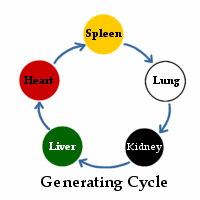
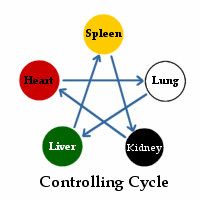
 The five phases have a flow in which they move called the Generating Cycle. Again looking at the seasons, put the phases in order by season and
you get the image to your right. (I myself wonder if this cycle was originally formed from the concept of Earth being Late Summer or if that was extrapolated later to
give some reasoning for this cycle.) Starting with water (a good way to remember it), water generates wood, wood generates fire, fire generates earth, earth generates metal, and metal generates water.
The Nan Jing or Classic of Difficulties, makes the analogy of mother to son when it comes to the generating cycle (e.g., fire is the mother and earth is the son, water is the mother wood and wood is the son of water, etc.). This becomes more relevant
when we look at the application of this theory to medical applications.
The five phases have a flow in which they move called the Generating Cycle. Again looking at the seasons, put the phases in order by season and
you get the image to your right. (I myself wonder if this cycle was originally formed from the concept of Earth being Late Summer or if that was extrapolated later to
give some reasoning for this cycle.) Starting with water (a good way to remember it), water generates wood, wood generates fire, fire generates earth, earth generates metal, and metal generates water.
The Nan Jing or Classic of Difficulties, makes the analogy of mother to son when it comes to the generating cycle (e.g., fire is the mother and earth is the son, water is the mother wood and wood is the son of water, etc.). This becomes more relevant
when we look at the application of this theory to medical applications.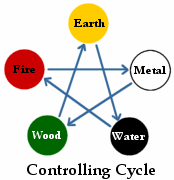
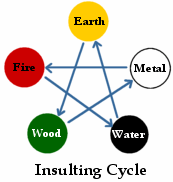


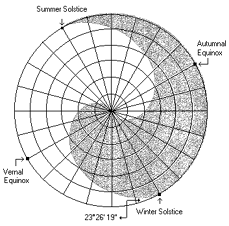

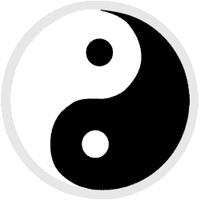


 The Web That Has No Weaver : Understanding Chinese Medicine by Ted J. Kaptchuk


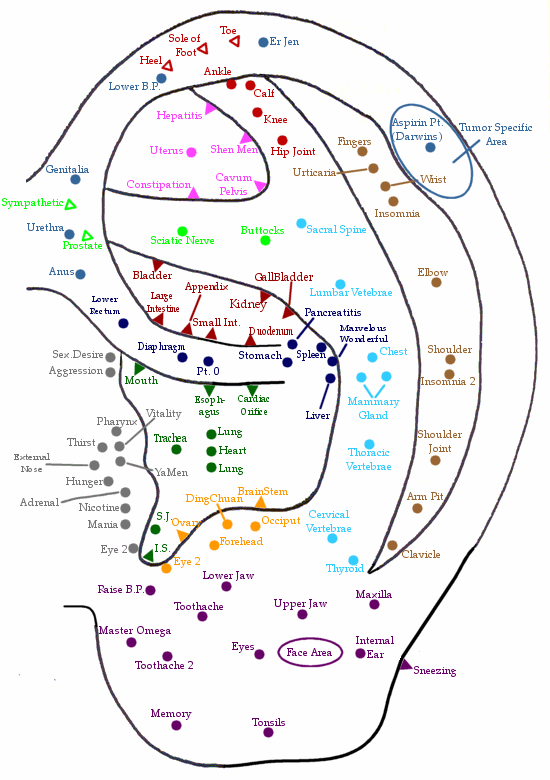
 Tight band of pressure pain
 Primary Mu point
 On the posterior side
 Area of pressure pain
 Secondary point


 Normal Pulse
 Deficient Pulse
 Excess Pulse